
Home › Research › Microsoft Office Statistics: Versions, Users, Support (2026)
Research data
Microsoft Office Statistics: Versions in Use, End-of-Support Dates, Microsoft 365 and Office Against Its Rivals
How many still use Office 2016, 2021 or 2003, when each version loses support, Microsoft 365 seats and Office against Google Workspace, with sources.
Key Microsoft Office statistics
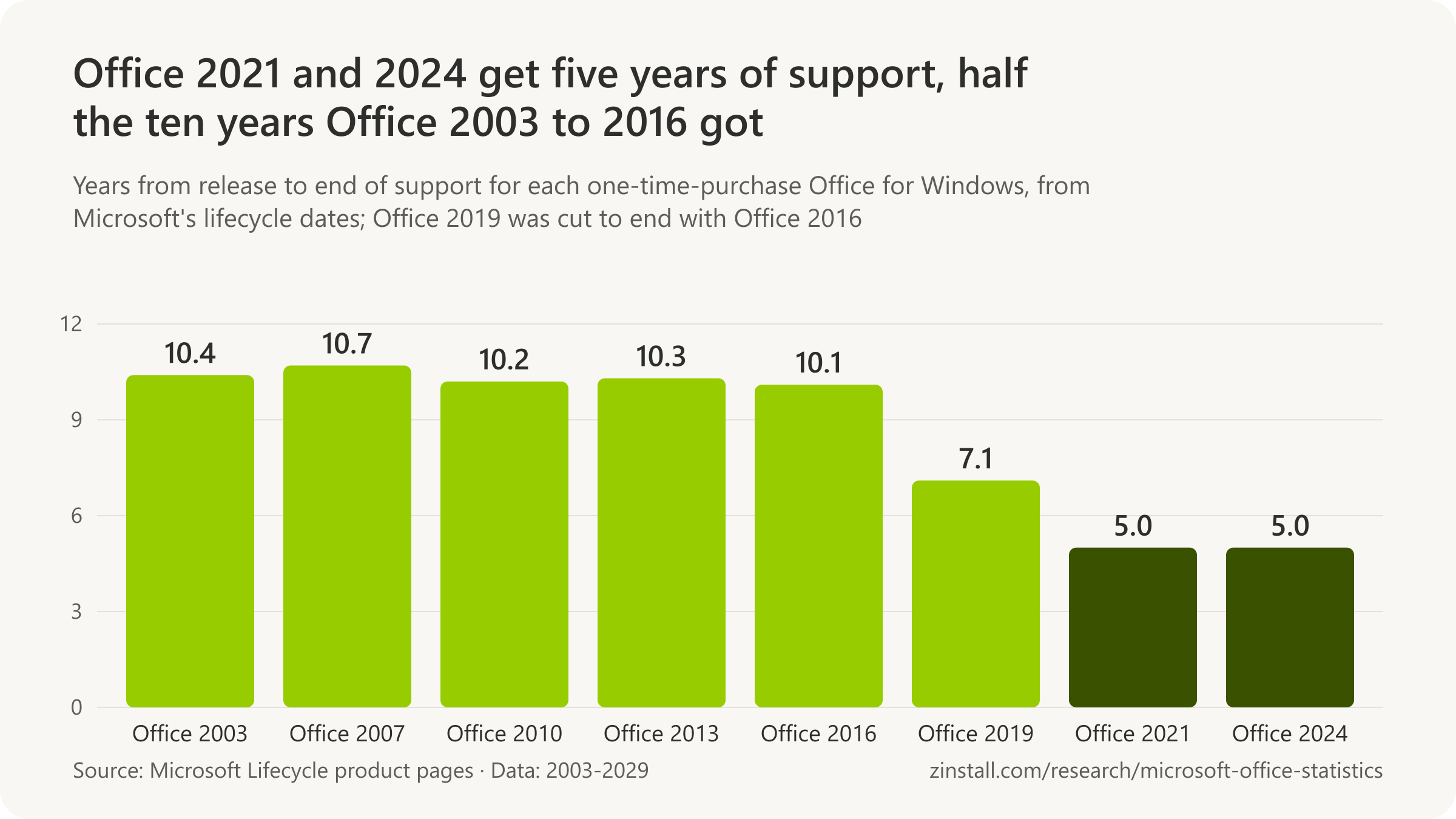
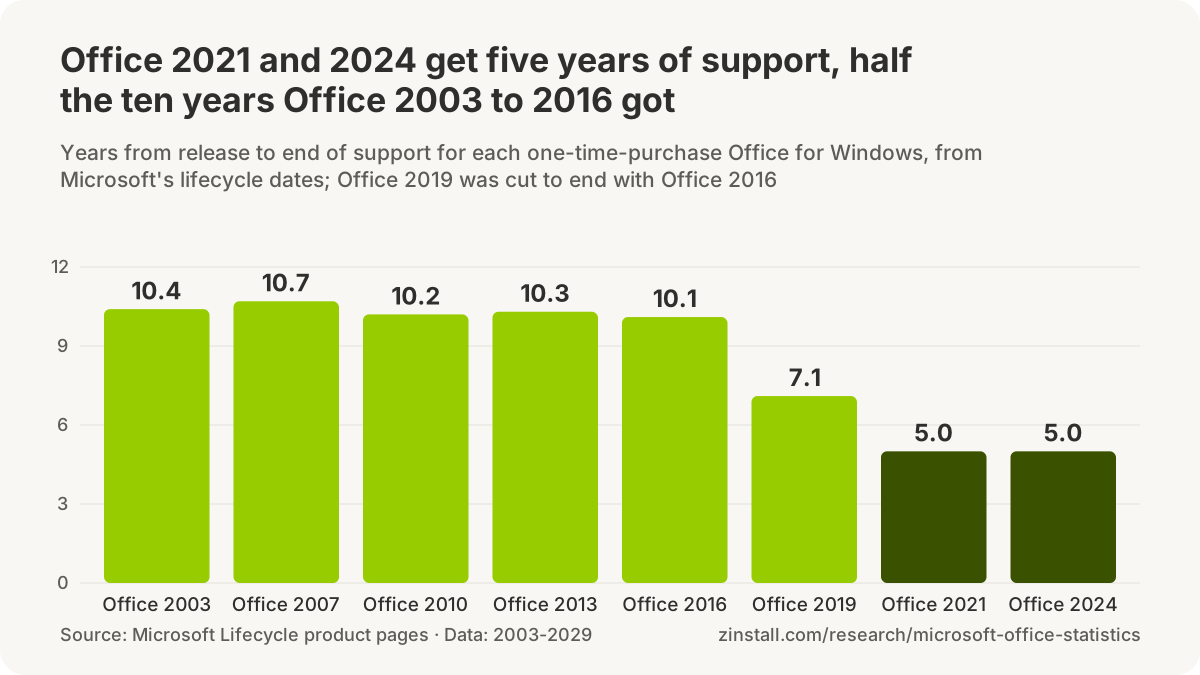
- Office 2021 and 2024 get 5 years of support; Office 2003 to 2016 each got about 10 (2026).
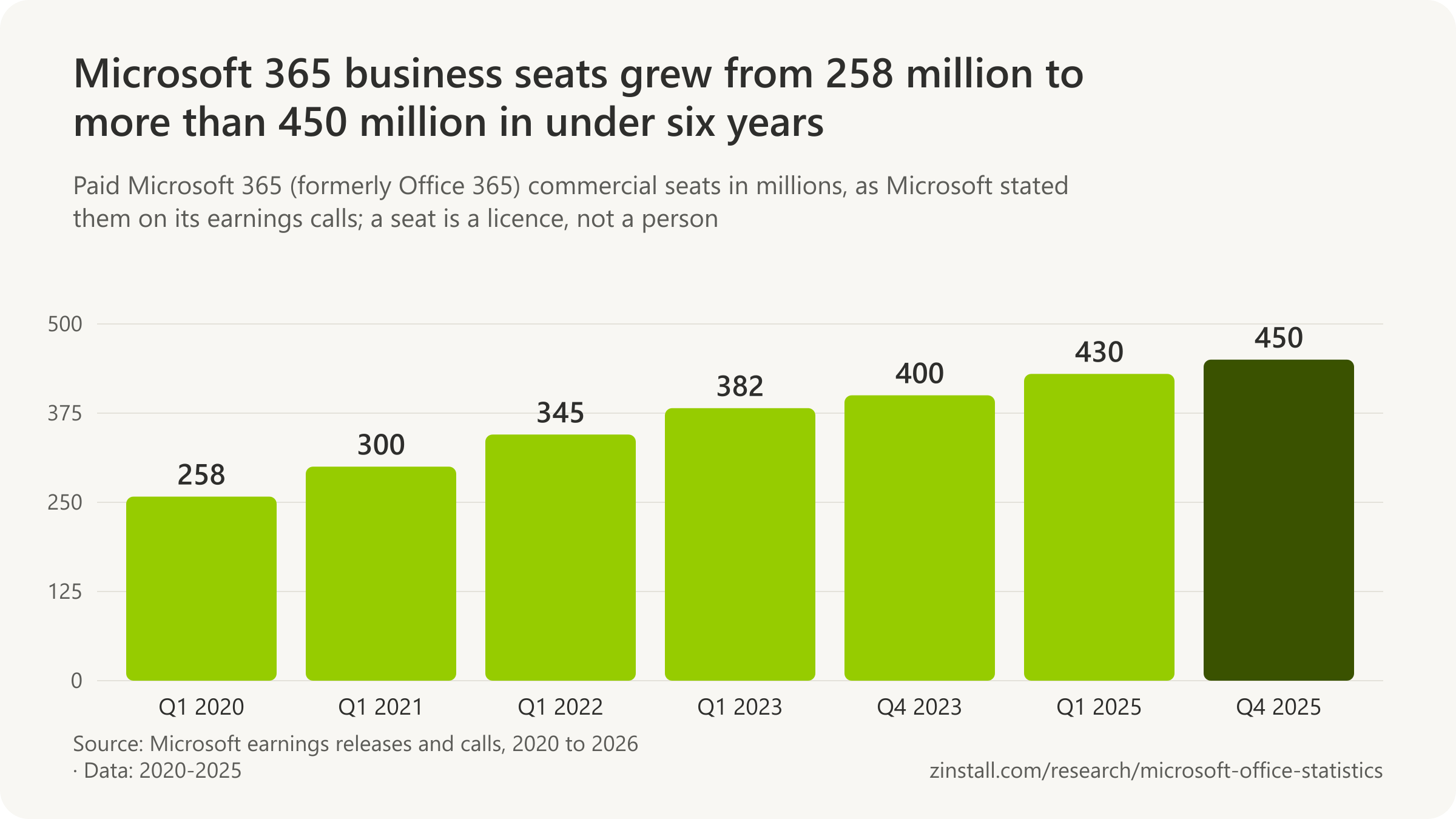
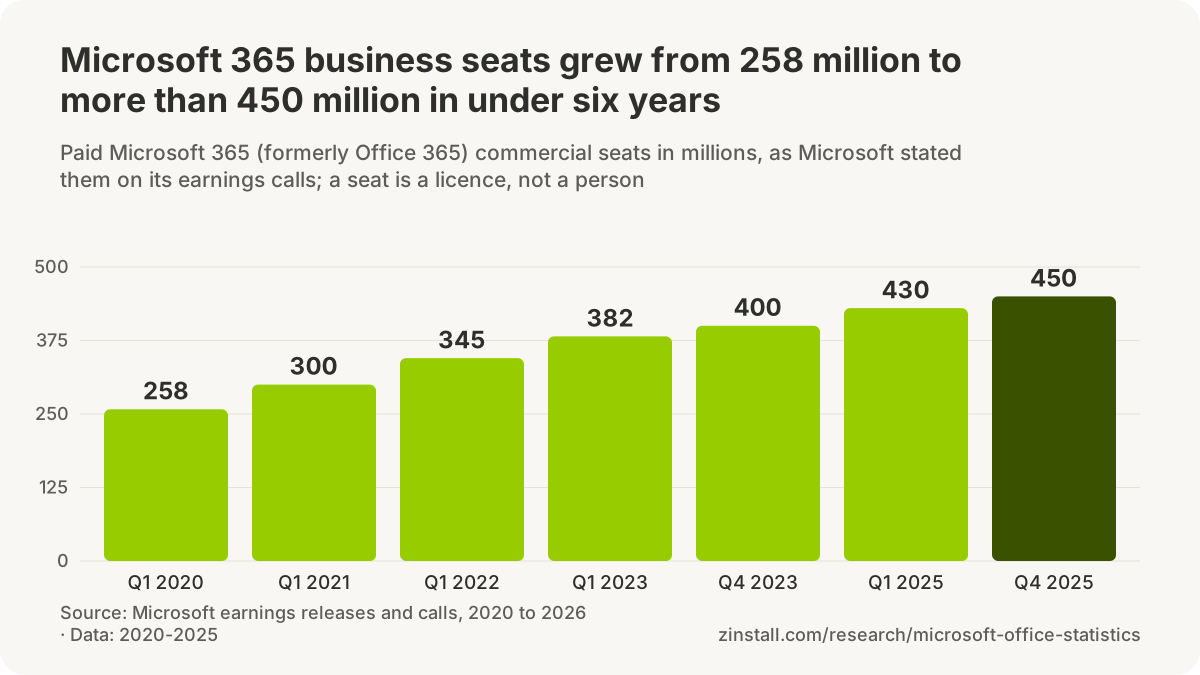
- Microsoft 365 had more than 450 million paid business seats at the end of 2025, its latest count (2026).
- After 13 October 2026, 82% of the on-premises Office PCs at small German firms ran an Office version without security updates.
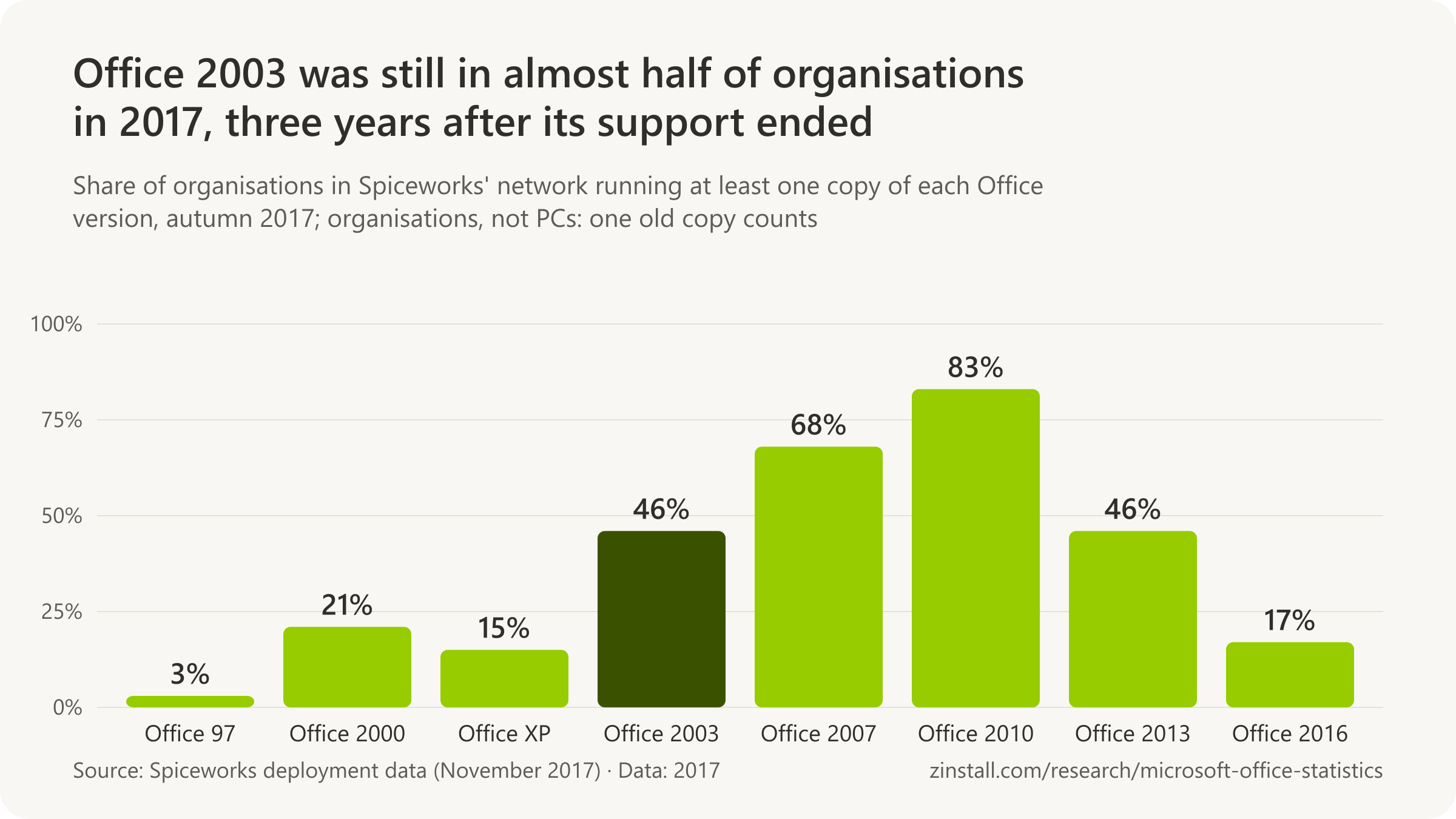
- In 2017, Office 2003 was still installed somewhere at 46% of organisations in a large IT-network sample, three years after support ended.
- The US government's list of actively exploited vulnerabilities includes 45 flaws in Microsoft Office apps (2026).
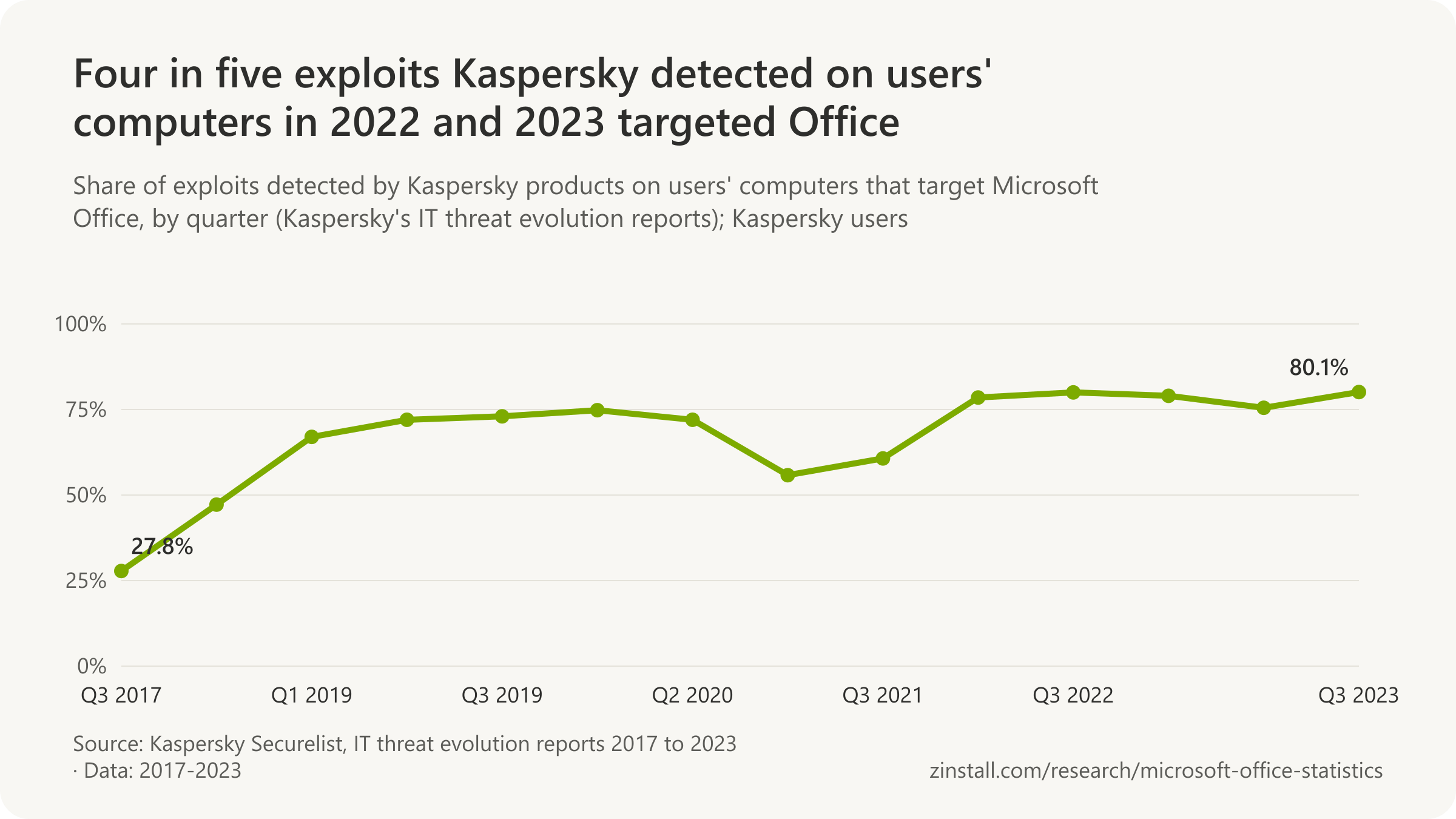
- 80.1% of the exploits that one security vendor's products detected on users' computers in the third quarter of 2023 targeted Office.
- Google Workspace has more than 13 million customers; its 3 billion users include free Google accounts.
- WPS Office counted 676 million monthly active devices worldwide in June 2026.
Sources: Microsoft (2026, 2024); Intra2net AG; Spiceworks; Cybersecurity and Infrastructure Security Agency; Kaspersky; Google; Kingsoft Corporation
When an Office version reaches its end of support or a new one ships, the same questions come up: how many people still run it, how the last deadlines went, how many have moved to Microsoft 365 and how Office compares with Google Workspace, LibreOffice and WPS. This page collects what has been published on each, with the measure, the date and the source named for every figure. Some answers do not exist: Microsoft publishes no count of users for any Office version, and no tracker measures the versions in use worldwide, so the page gives the closest labelled samples and says what each one measures.
When does each Office version reach end of support?
Office 2021 and 2024 get 5 years of support; Office 2003 to 2016 each got about 10 (Microsoft lifecycle dates, 2026).

- In 2019 Microsoft's Fixed Lifecycle Policy promised business products at least 10 years of support; today's policy text does not.
- Office 2019 got 7 years of support, an exception made so that it would end with Office 2016 in 2025.
- Office 2016 and 2019 lost supported connections to Microsoft 365 services on 10 October 2023, two years before their own end of support.
- Microsoft 365 Apps, the subscription Office, has no end date: it has been in support since 2015.
- Every Office for Mac since Office 2016 for Mac has had about 5 years of support.
| Version | End of support |
|---|---|
| Office 2003 | 8 April 2014 |
| Office 2007 | 10 October 2017 |
| Office 2010 | 13 October 2020 |
| Office 2013 | 11 April 2023 |
| Office 2016 | 14 October 2025 |
| Office 2019 | 14 October 2025 |
| Office 2021 | 13 October 2026 |
| Office LTSC 2021 | 13 October 2026 |
| Office 2024 | 9 October 2029 |
| Office LTSC 2024 | 9 October 2029 |
Sources: Microsoft (2018-2026)
Moving these programs to a new computer: Office 2016 · Office 2019 · Microsoft Office
More statistics (57)
Microsoft sets every Office version's end of support when it ships it, and the dates do not move: Microsoft has never extended one, and it sells no Extended Security Updates for Office as it does for Windows. Versions up to Office 2016 got about ten years of support; Office 2021 and 2024 get five. The subscription version, Microsoft 365 Apps, has no end date as long as it is kept up to date.
End of support for every Office version
| Version | End of support |
|---|---|
| Office 97 (assisted support) | 16 January 2004 |
| Office 2000 | 14 July 2009 |
| Office XP | 12 July 2011 |
| Office 2003 | 8 April 2014 |
| Office 2007 | 10 October 2017 |
| Office 2010 | 13 October 2020 |
| Office 2013 | 11 April 2023 |
| Office 2016 | 14 October 2025 |
| Office 2019 | 14 October 2025 |
| Office 2021 | 13 October 2026 |
| Office LTSC 2021 | 13 October 2026 |
| Office 2024 | 9 October 2029 |
| Office LTSC 2024 | 9 October 2029 |
| Office 2004 for Mac | 10 January 2012 |
| Office 2008 for Mac | 9 April 2013 |
| Office for Mac 2011 | 10 October 2017 |
| Office 2016 for Mac | 13 October 2020 |
| Office 2019 for Mac | 10 October 2023 |
| Office 2021 for Mac | 13 October 2026 |
| Office LTSC 2021 for Mac | 13 October 2026 |
| Office 2024 for Mac and Office LTSC 2024 for Mac | 9 October 2029 |
| Microsoft 365 Apps (subscription) | no end date |
How long Microsoft supports Office
- 30 June 2009 for Office 2000 and 30 June 2011 for Office XP were the end-of-extended-support dates Microsoft first published in 2004, later moved to the update Tuesdays of 14 July 2009 and 12 July 2011 (Microsoft, 2004).
- A minimum of five years of mainstream support, plus extended support 'for some products', is all Microsoft's current Fixed Lifecycle Policy promises, the policy that governs one-time-purchase Office (Microsoft Lifecycle, 2023).
- 10 years of support (at least five mainstream and five extended) was the minimum Microsoft's Fixed Lifecycle Policy promised business, developer and desktop operating system products in 2019, a promise absent from the current policy text (Microsoft, 2019).
- 12 months' notice is the minimum Microsoft gives before ending support for a product under its Modern Lifecycle Policy when no successor is offered; under the same policy Microsoft 365 Apps stays supported only while customers keep it current (Microsoft Lifecycle, 2024).
- 7 years of support (5 mainstream, 2 extended) was Microsoft's term for Office 2019, an exception to its usual 10-year Fixed Lifecycle term so that Office 2019 would end with Office 2016 in 2025 (Microsoft Lifecycle, 2018).
- 5 years of mainstream support was the term Microsoft set in February 2021 for Office LTSC, the next perpetual commercial Office, while Office 2021 for consumers and small businesses got 'a minimum of 5 years' under the Modern Lifecycle Policy (Microsoft Lifecycle, 2021).
- 5 years of support is the cadence Microsoft now gives on-premises versions of Office such as Office 2024 and Office LTSC 2024, arguing that 'software that is a decade old or more' becomes less productive and harder to secure (Microsoft Support, 2026).
- 5.0 years from release to end of support is the term of Office 2021 and Office 2024, half the 10.1 to 10.7 years that Office XP, 2003, 2007, 2010, 2013 and 2016 each received, with Office 2019 in between at 7.1 years (derived from Microsoft Lifecycle, 2026).
- About 5 years from release to end of support (5.0 to 5.1) is the term of every Office for Mac since Office 2016 for Mac, shorter than the 6.8 years of Office for Mac 2011 and 7.5 years of Office 2004 for Mac (derived from Microsoft Lifecycle, 2026).
Office and Microsoft 365 services
- 13 October 2020 was set in April 2017 as the date from which only Office 365 ProPlus or one-time-purchase Office still in mainstream support (Office 2016 and Office 2019) could connect to Office 365 services, ending support for Office 2010 and 2013 connections (Microsoft, 2017).
- October 2023 became the end of supported Office 2016 connections to Office 365 services after Microsoft relaxed, in September 2018, its rule that only Office 365 ProPlus or Office 2019 in mainstream support could connect from 13 October 2020 (Microsoft, 2018).
- 10 October 2023 was the date Microsoft stopped supporting connections from Office 2016 and Office 2019 to Microsoft 365 services such as Exchange Online, SharePoint Online and OneDrive, two years before the suites' own end of support (Microsoft, 2026).
- 13 October 2026 was the last day Office LTSC 2021 was supported for connecting to Microsoft 365 services, against 9 October 2029 for Office LTSC 2024 and no end date for Microsoft 365 Apps on a supported version (Microsoft, 2026).
- Office apps must be in mainstream support for their connection to Microsoft 365 cloud services to count as supported, Microsoft's Office and Windows configuration matrix states, which is why Office 2016 and 2019 lost connection support before their 2025 end of support (Microsoft Lifecycle, 2026).
Microsoft 365 Apps and Office on older Windows
- 10 January 2023 was the last day of security updates for Microsoft 365 Apps on Windows 7, three years after Windows 7's own end of support on 14 January 2020, though Microsoft no longer supported the apps on Windows 7 in that period (Microsoft, 2025).
- Version 2002 (February 2020) is the last version of Microsoft 365 Apps available for Windows 7, and new installations of it have failed since January 2022 (Microsoft, 2025).
- 10 January 2023 ended support for Microsoft 365 Apps on Windows 8.1, the same day as Windows 8.1 itself, with no further feature, security or quality updates and no new installations after that date (Microsoft, 2025).
- January 2023 for Windows 8.1 and October 2025 for Windows Server 2016 were the end dates Microsoft set in September 2018 for Office 365 ProPlus support, while dropping support on Windows 10 LTSC and Windows Server 2012 from 14 January 2020 (Microsoft Lifecycle, 2018).
- 14 October 2025 was the end of support for Microsoft 365 Apps on Windows Server 2016 and Windows Server 2019, with security updates continuing until 10 October 2028; on Windows Server 2022 support ended on 13 October 2026 (Microsoft, 2026).
- Office 2016 was supported on Windows 11 only by an exception Microsoft made 'to maximize customer access to Windows 11', since Office 2016 was already in extended support when Windows 11 shipped (Microsoft Lifecycle, 2026).
- Office 2016 and Office 2019 are listed as 'Not supported' on Windows 11 and Windows 10, while Office 2021 and Office 2024 are 'Supported' on Windows 11 and 'Supported (with exceptions)' on Windows 10, in Microsoft's 2026 support table (Microsoft Support, 2026).
Products that end on the same day
- Support for Office 2016 and Office 2019 ended on 14 October 2025 on all operating systems, the day Windows 10 support ended, and support for Office 2021 and Office LTSC 2021 was to end a year later, in October 2026 (Microsoft, 2026).
- 14 October 2025 ended support for Office 2016 and Office 2019 together with Outlook, Project, Visio, Skype for Business and Exchange Server 2016 and 2019 and the single Office apps, on the same day as Windows 10 (Microsoft Lifecycle, 2024).
- 13 October 2026 ended support for Office 2021 and Office LTSC 2021 together with Outlook 2021, Outlook LTSC 2021, Project 2021, Visio 2021 and the single Office 2021 apps, Microsoft's 'Ending Support in 2026' list shows (Microsoft Lifecycle, 2026).
- 9 October 2029 is the end of support for Office 2024 and Office LTSC 2024 together with Outlook, Access, Project, Visio and the single 2024 apps, the next Office deadline on Microsoft's lists, with no Publisher 2024 among them (Microsoft Lifecycle, 2025).
- 11 April 2023 ended support for Office 2013 together with Outlook, Access, Publisher, Visio and Project 2013 and Skype for Business 2015, and 10 October 2023 ended Office 2019 for Mac and mainstream support for Office 2019 for Windows (Microsoft Lifecycle, 2024).
- 14 October 2026 at 06:59:59 UTC is how Microsoft's lifecycle database stores the end of Office 2021, which its pages display as 13 October 2026 in Pacific time, so tools that read the raw value can print a date one day late (Microsoft Lifecycle, 2026).
Publisher
- October 2026 was announced by February 2024 as the end of life of Microsoft Publisher: after it, Publisher would no longer be included in Microsoft 365 and existing on-premises versions would no longer be supported (Microsoft, 2024).
- 1 October 2026 was the date from which Microsoft 365 subscribers lost access to Microsoft Publisher as a removal update rolled out, after which .pub files can no longer be opened or edited in Publisher, Microsoft's support page says (Microsoft Support, 2026).
- 13 October 2026 ended support for the perpetual versions of Microsoft Publisher, on the day Office LTSC 2021 and consumer Office 2021 reached end of support, making Publisher 2021 and Publisher LTSC 2021 the last versions (Microsoft Support, 2026).
- 8 versions of Publisher appear in Microsoft's lifecycle database, from Publisher 2003 to Publisher 2021 and Publisher LTSC 2021, and none from 2024: Office 2024 and Office LTSC 2024 shipped without Publisher (Microsoft Lifecycle, 2026).
Office for Mac and macOS
- 3 most recent versions of macOS are the only ones Office for Mac is supported on: Microsoft drops the oldest each time Apple ships a new major release, so a Mac that cannot upgrade loses Office support within about three years (Microsoft, 2026).
Numbers in circulation
- 10 Office releases from Office 2007 to Office 2024 are listed by the tracker endoflife.date with end dates matching Microsoft's Pacific-time dates, but its table has no row for Office LTSC 2021, which ended on 13 October 2026 (endoflife.date, 2026).
- 1 October 2024 is the release date endoflife.ai's Office end-of-life reference gives Office LTSC 2024, against the 18 September 2024 start date on Microsoft's lifecycle page, and it labels Office 2024's 9 October 2029 end 'extended support' although Office 2024 has no extended phase (endoflife.ai, 2026).
- 1 October 2029 is the end of support Office Watch's 2026 support-dates checklist gives Office 2024, eight days earlier than Microsoft's 9 October 2029, and it guesses the same day for classic Outlook (Office Watch, 2026).
Sources: Microsoft (2004-2026); endoflife.date; endoflife.ai; Office Watch
How many people use Microsoft Office?
Microsoft 365 had more than 450 million paid business seats at the end of 2025, its latest count (Microsoft, 2026).

- Microsoft 365 had nearly 95 million consumer subscribers in March 2026.
- Microsoft dropped consumer subscribers from its reported metrics in fiscal 2026; since then it has given a total on only two earnings calls.
- Microsoft's last total of people using Office, more than 1.2 billion, appeared in its 2016 annual report.
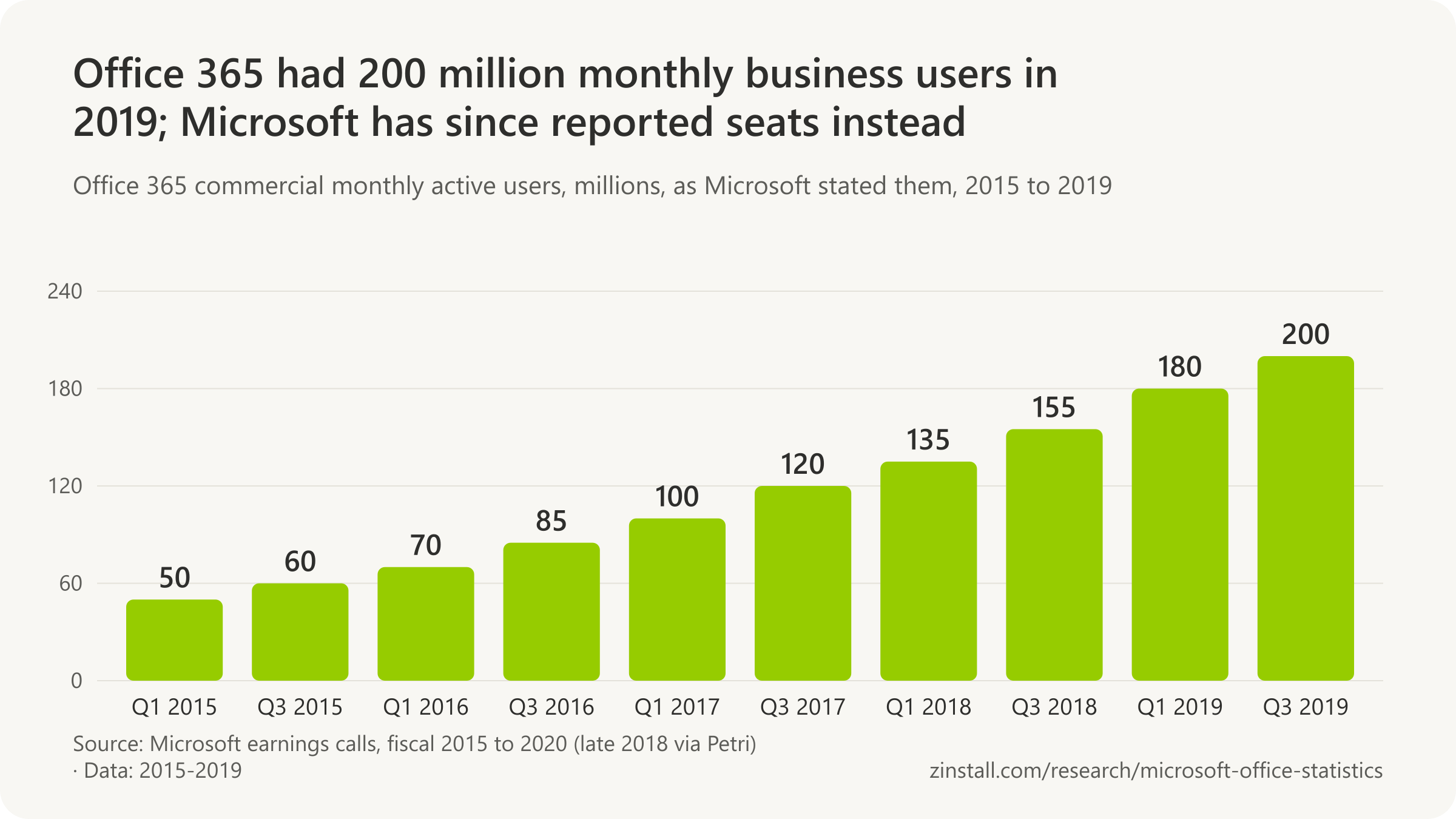
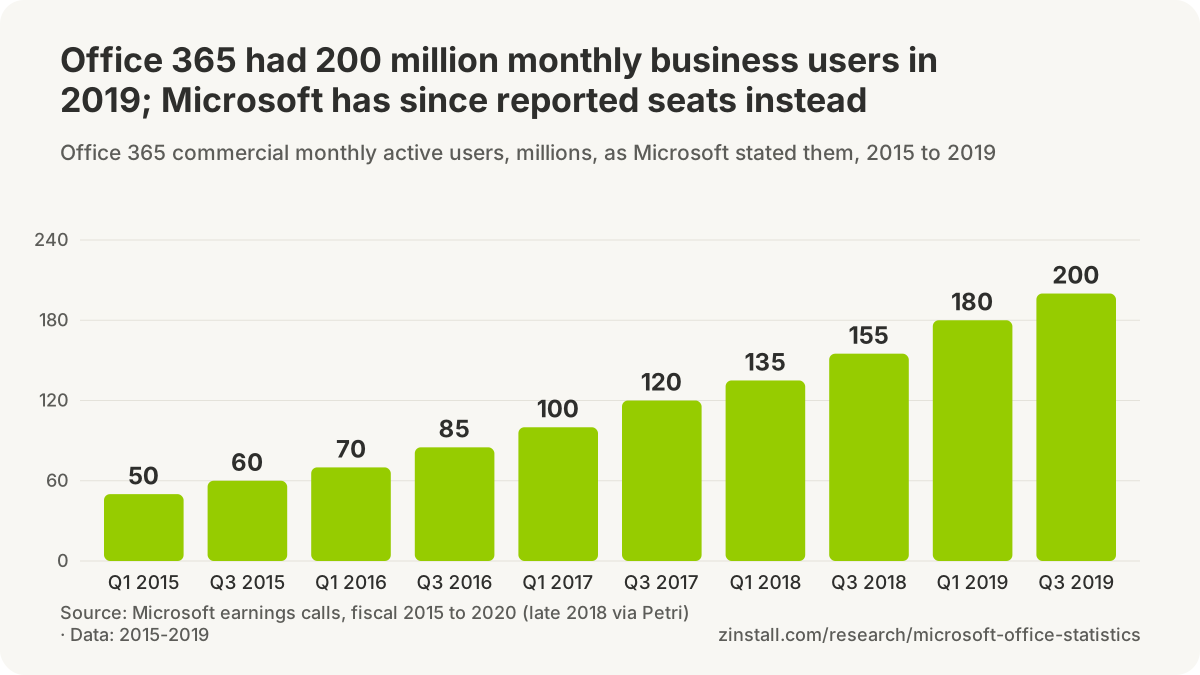
- Office 365 had more than 200 million monthly business users in September 2019, before Microsoft switched to counting seats.
- Even Microsoft has called its seats people: a December 2025 post turned 430 million paid seats into people using its apps.
| Measure and date | Count |
|---|---|
| Office installed base, 2005 (as reported) | 400 million |
| Office Web Apps: monthly visitors, 2011 | 50 million |
| People using Office, 2012 | 1 billion |
| People using Office, 2015 to 2018 | more than 1.2 billion |
| Consumer subscribers, March 2014 | 4.4 million |
| Business monthly active users, September 2015 | 60 million |
| Fortune 500 companies with Office 365, 2015 | four out of five |
| Office mobile app downloads, 2015 | 340 million |
| Consumer subscribers, June 2025 | 89.0 million |
Sources: Microsoft (2011-2026); The Register
Moving these programs to a new computer: Microsoft 365 · Microsoft Office · Outlook
More statistics (17)
Microsoft has counted Office use in four ways, one after another: people (until 2018), monthly business users (2015 to 2019), paid business seats (since 2020) and consumer subscribers (2014 to 2026). A seat is a licence held by a business, school or government, not a person, and a consumer subscription can be shared by a household. Microsoft has given no total of people since 2018.
People using Office: Microsoft's totals
- 1 billion people worldwide use Microsoft Office, Microsoft's Office Division president Kurt DelBene announced at the July 2012 Worldwide Partner Conference (Microsoft, 2012).
- More than 1.2 billion people use Microsoft Office, Microsoft said on its 'By the Numbers' fact page from at least October 2015, a figure it repeated until 2018 (Microsoft, 2015).
- Office had more than 1.2 billion users, Satya Nadella wrote in Microsoft's fiscal 2016 annual report letter in October 2016, the last time an all-Office user total appears in a Microsoft annual report (Microsoft, 2016).
Paid business seats

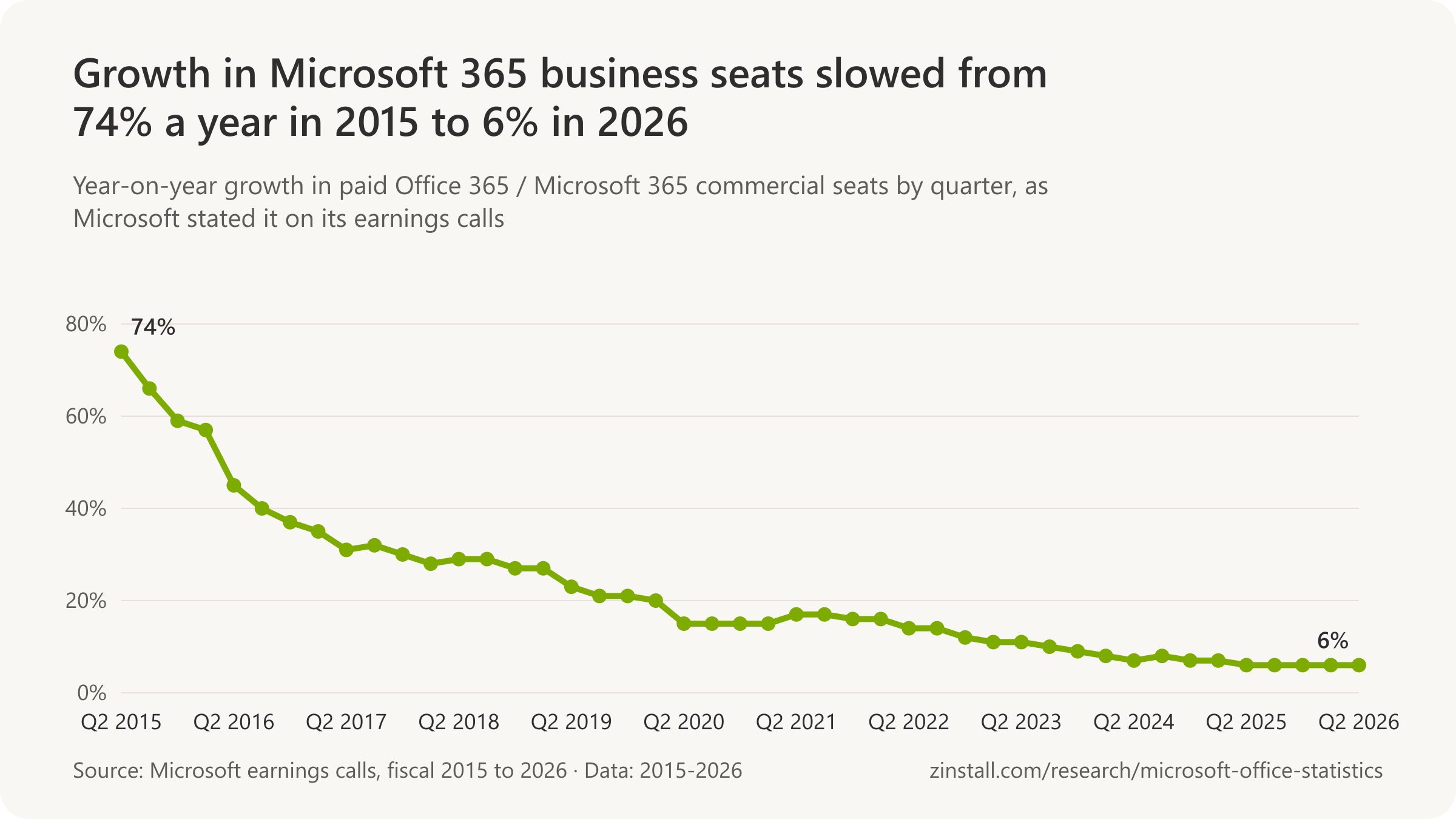
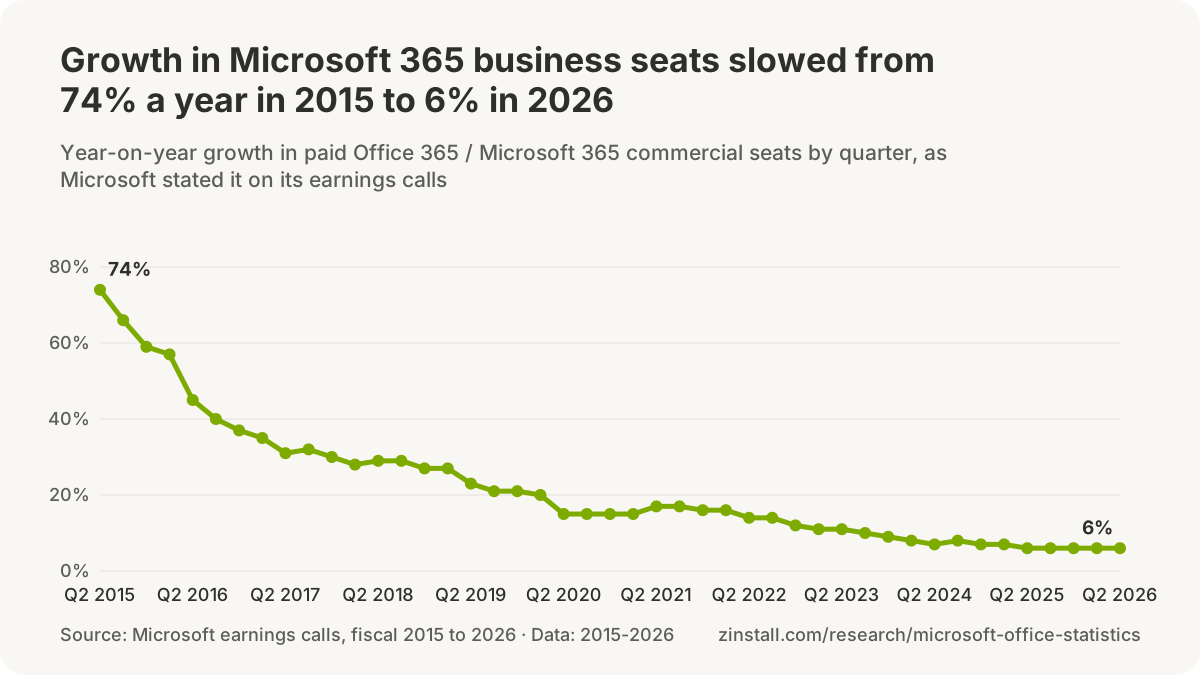
- Office 365 had over 300 million paid commercial seats in August 2021, ten years after its launch, Microsoft said when it announced its first substantive commercial price rise (Microsoft, 2021).
- Office 365 commercial seats grew by triple digits in the quarter to December 2013, Microsoft said in its January 2014 earnings release, without giving a rate or a count (Microsoft, 2014).
- Office 365 commercial seats nearly doubled in the year to September 2014, Microsoft said on its October 2014 earnings call (Microsoft, 2014).
- Four out of five Fortune 500 enterprises had Office 365 by mid-2015, Microsoft said on its July 2015 earnings call, four years after the service launched (Microsoft, 2015).
- 50,000 new small and medium business customers adopted Office 365 every month for more than a year to mid-2015, Microsoft said on its July 2015 earnings call (Microsoft, 2015).
Monthly business users, 2015 to 2019

Consumer subscribers

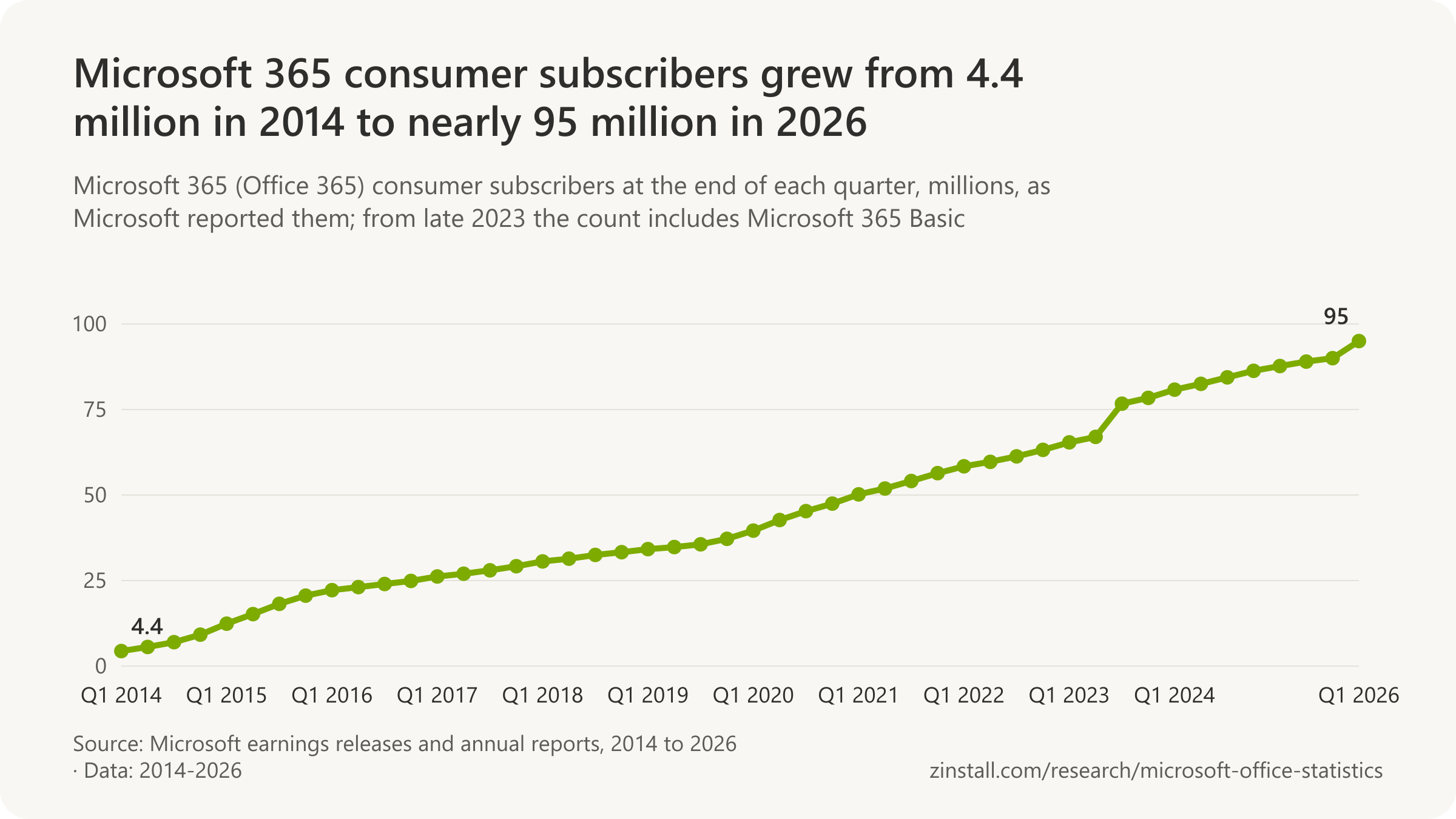
- Microsoft 365 Consumer had 74.9 million subscribers at the end of June 2023 on Microsoft's widened definition that counts Microsoft 365 Basic, against 67.0 million as first reported (Microsoft, 2024).
- Microsoft 365 consumer subscriptions grew 6% year over year in the quarter to December 2025, Microsoft said on its January 2026 earnings call without giving a total (Microsoft, 2026).
- Microsoft 365 consumer subscriptions grew 7% year over year in the quarter to June 2026, Microsoft said on its July 2026 earnings call without giving a total (Microsoft, 2026).
- Microsoft 365 Consumer subscribers was removed from Microsoft's reported metrics in the July to September 2025 quarter, its fiscal 2026 annual report says, ending a quarterly count kept since 2014 (Microsoft, 2026).
Numbers in circulation
- Over 430 million people using Microsoft 365 apps is how Microsoft's own December 2025 pricing post restated its 430 million paid commercial seats, turning seats into people (Microsoft, 2025).
- Petri reported from Build 2016 that there were 1.2 billion Office users, 'all Office users, not just Office 365', with 340 million mobile app downloads, restating Microsoft's claim (Petri, 2016).
- Countly's July 2026 roundup put Microsoft 365 at about 450 million paid subscribers, 400 million commercial seats and 50 million consumers, figures that do not match Microsoft's own disclosures (Countly, 2026).
- 1.2 billion Office users was Microsoft's claim that Office Watch called hard to believe in June 2016, noting it had grown from the unexplained 1 billion of 2012 without evidence (Office Watch, 2016).
- 60 million Office 365 commercial customers is how Windows Central reported Microsoft's figure of 60 million monthly active users at Build in March 2016, turning users into customers (Windows Central, 2016).
Sources: Microsoft (2012-2026); Petri IT Knowledgebase (2016, 2018); Countly; Office Watch; Windows Central
How many people still use Office 2016, 2019 and 2021?

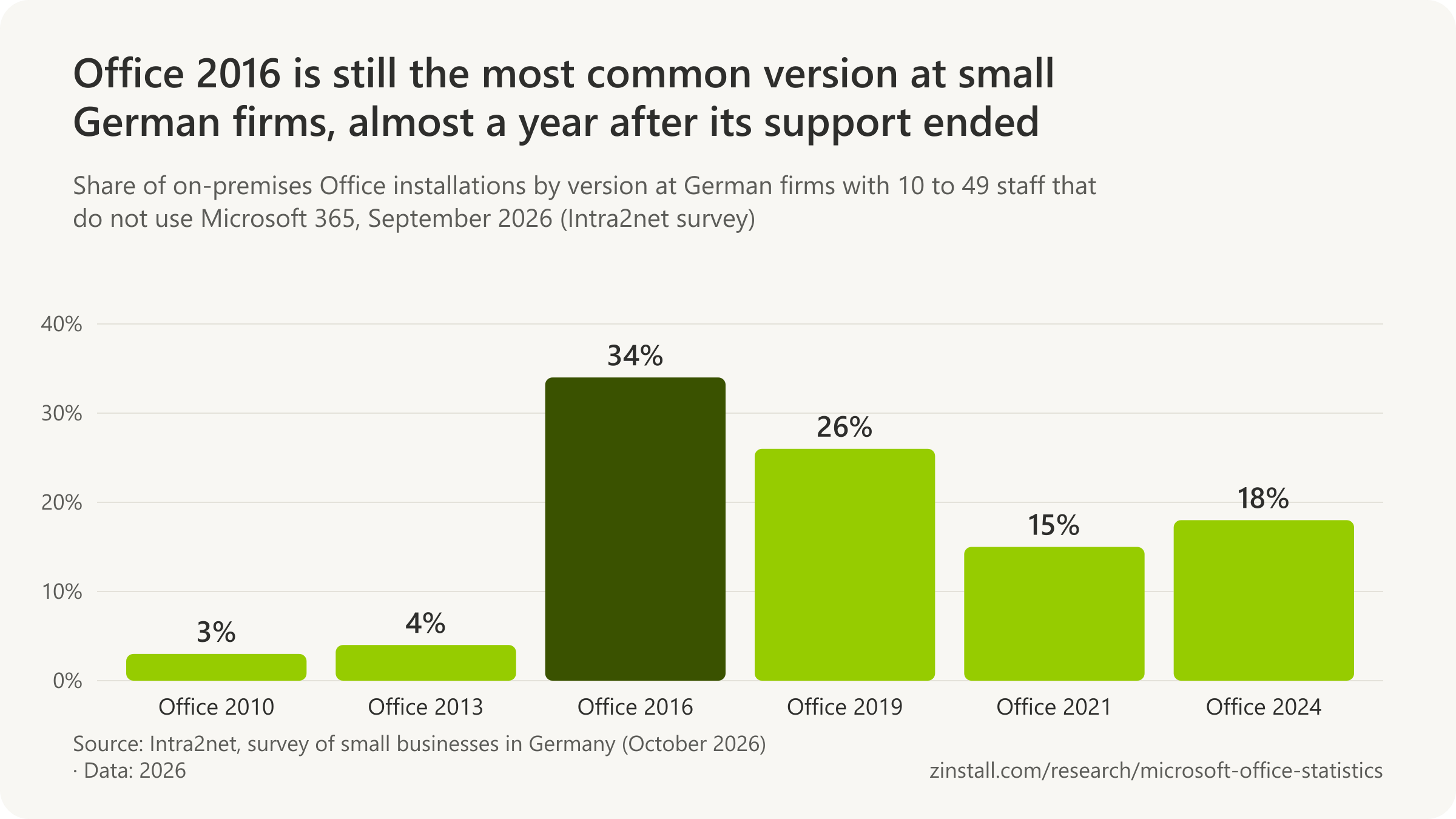
- After 13 October 2026, 82% of the on-premises Office PCs at small German firms ran an Office version without security updates.
- Only one in ten small German firms with on-premises Office updated it in the year to September 2026.
- Microsoft pushed an update in 2023 to count users of Office 2007, 2010 and 2013, but has never published the result.
| Source, version, measure and year | Share |
|---|---|
| Litmus: Outlook 2016's share of desktop Outlook email opens, 2017 | 38% |
| Litmus: Outlook 2010's share of desktop Outlook email opens, 2017 | 23% |
| Litmus: Outlook 2013's share of desktop Outlook email opens, 2017 | 21% |
| Smart Profile: Dutch business sites using Office 2010, 2017 | 38% |
| Smart Profile: Dutch business sites using Office 2013, 2017 | 29% |
| Smart Profile: Dutch business sites using Office 365, 2017 | about 29% |
| CPAFMA: US accounting firms standardised on Office 2016 or 365, 2018 | 45% |
| Office Watch: readers sticking with Office 2016, 2019 poll | 17% |
| Avast: PCs with Office 2010 installed, 2018 | 3% |
Sources: Intra2net AG (2026a, 2026b); Microsoft; Litmus; Smart Profile; CPA Trendlines; Office Watch; Avast
Moving these programs to a new computer: Office 2016 · Office 2019
More statistics (44)
Microsoft publishes no count of people or PCs on any Office version, and no tracker measures the versions in use worldwide. The one regular sample is Intra2net's yearly survey of small German firms that do not use Microsoft 365, which covers the one-time-purchase versions only. Email-open trackers such as Litmus can no longer tell Outlook 2016 and later apart, and older counts come from IT-management networks, polls and security scans.
Intra2net: Office versions at small German firms

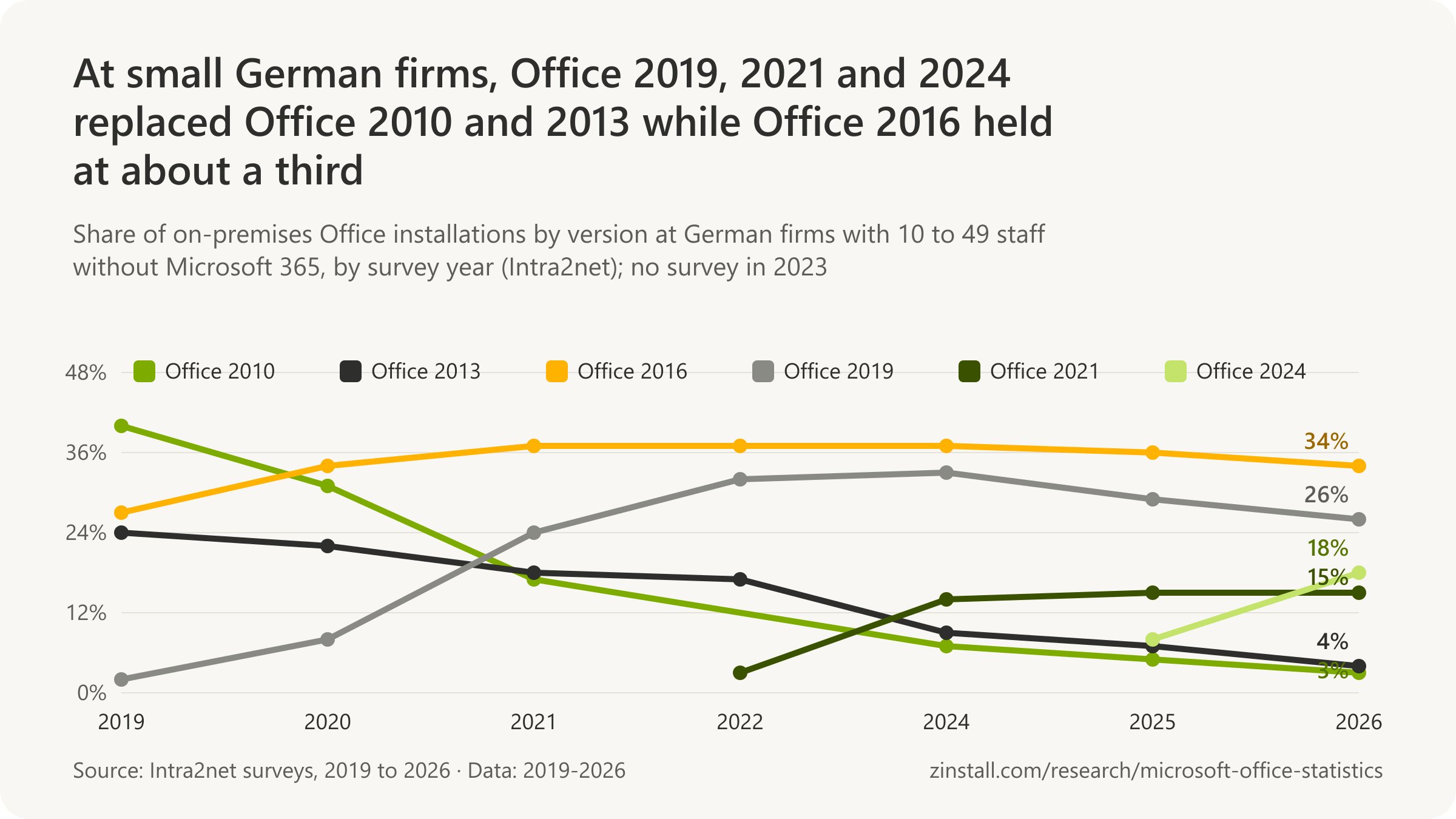
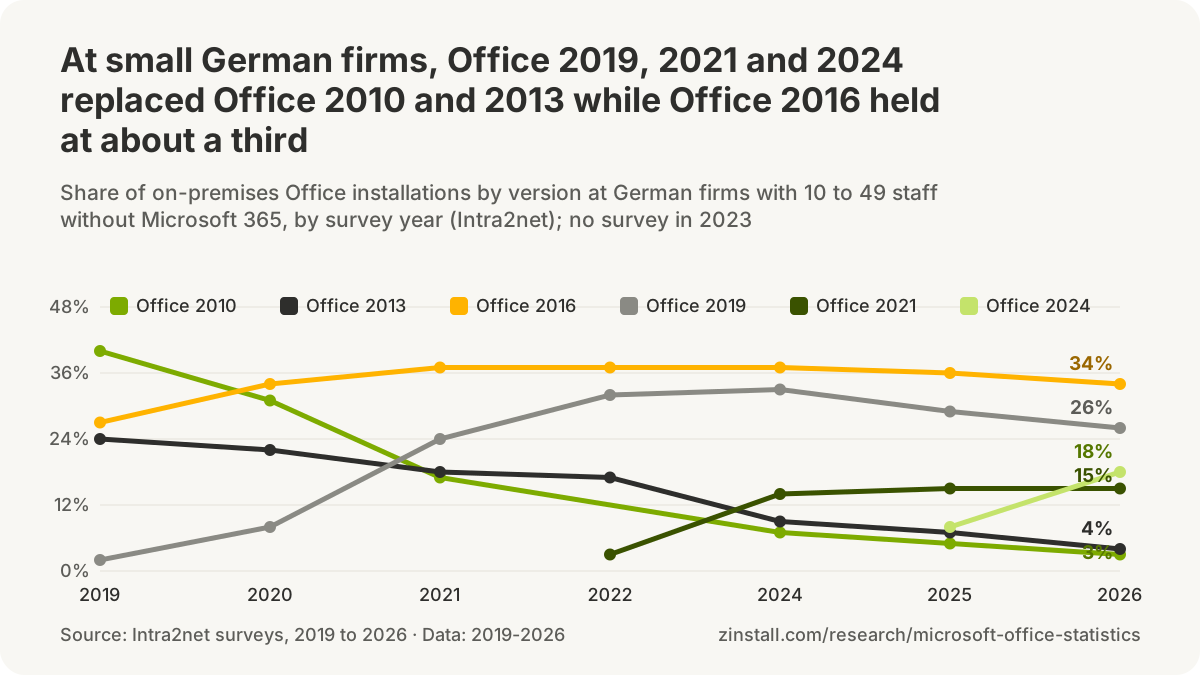

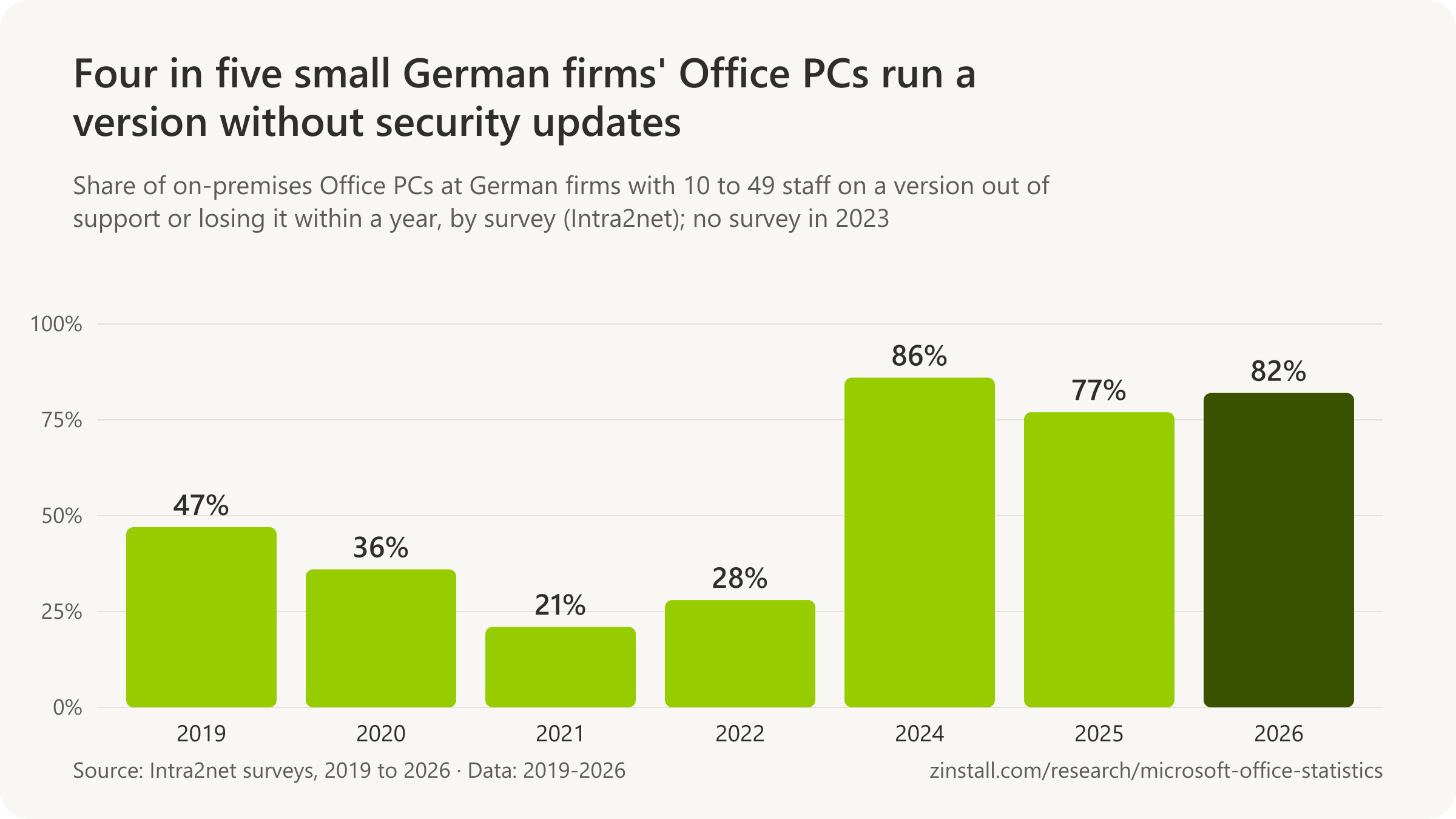
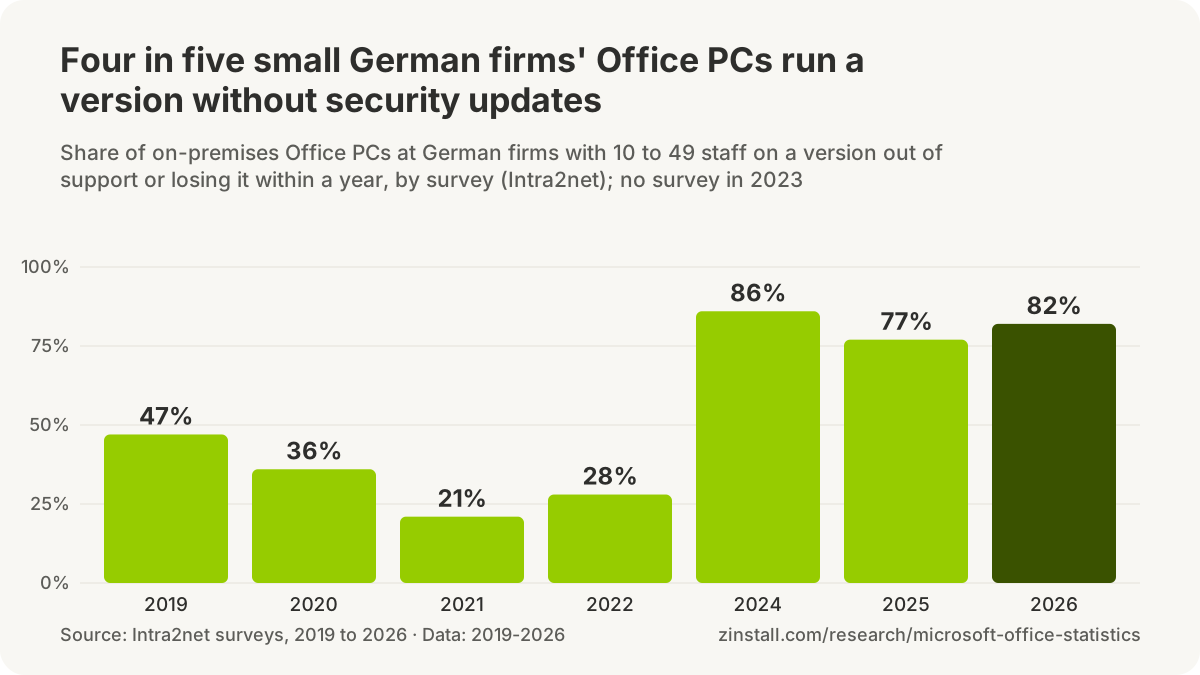
- One in ten small German businesses (10%) updated its on-premises Office suite in the twelve months to September 2026, despite the October 2025 end of support for Office 2016 and 2019, Intra2net found (Intra2net, 2026).
Outlook versions in email opens (Litmus)
- 38% of the email opens in desktop Outlook tracked by Litmus in 2017 came from Outlook 2016, replacing Outlook 2010 as the most used version (Litmus, 2018).
- 23% of the email opens in desktop Outlook tracked by Litmus in 2017 came from Outlook 2010, down from 35% in February 2016 (Litmus, 2018).
- 21% of the email opens in desktop Outlook tracked by Litmus in 2017 came from Outlook 2013 (Litmus, 2018).
- 10% of the email opens in desktop Outlook tracked by Litmus in 2017 came from Outlook 2007, the year Office 2007 lost support (Litmus, 2018).
- 7% of the email opens in desktop Outlook tracked by Litmus in 2017 came from Outlook 2000 to 2003, more than three years after Office 2003's end of support (Litmus, 2018).
- 35% of the email opens in desktop Outlook tracked by Litmus in February 2016 came from Outlook 2010, still the most used version (Litmus, 2016).
- 26% of the email opens in desktop Outlook tracked by Litmus in February 2016 came from Outlook 2013 (Litmus, 2016).
- 9% of the email opens in desktop Outlook tracked by Litmus in February 2016 came from Outlook 2016, five months after its release (Litmus, 2016).
- Over 5% of the email opens in desktop Outlook tracked by Litmus in 2015 came from Outlook 2016 within months of its September 2015 release, while Outlook 2003 opens fell 35% over the year (Litmus, 2016).
- No tracker can split Outlook 2016, 2019, 2021, 2024 and Microsoft 365 opens: Litmus says in 2026 that most desktop Outlook opens come from 'Outlook 2016 and newer', which all share one identifier (Litmus, 2026).
Other samples: Smart Profile, accounting firms, Office Watch, Avast and Spiceworks
- 82% of organisations used an on-premises (one-time purchase) version of Microsoft Office in September 2017, while 53% also used the Office 365 subscription, in Spiceworks' survey of 1,168 IT professionals in the US, Canada and the UK (Spiceworks, 2017).
- 38% of Dutch business sites with 50 or more employees still used Office 2010 in 2017, seven years after its release and down from more than half in 2016, Smart Profile found (Smart Profile, 2017).
- 29% of Dutch business sites with 50 or more employees used Office 2013 in 2017, as many as used the Office 365 subscription, Smart Profile found (Smart Profile, 2017).
- About 29% of Dutch business sites with 50 or more employees used the Office 365 subscription in 2017, against 38% still on Office 2010, Smart Profile found (Smart Profile, 2017).
- Nearly one in seven (about 14%) Dutch business sites with 50 or more employees used Office 2016 in 2017, two years after its release, ranging from about 16% at sites with 50 to 100 staff to 5% at sites with over 1,000 (Smart Profile, 2017).
- 3% of PCs worldwide running Avast and AVG software had Office 2010 installed in 2018, Avast's PC Trends Report 2019 said, two years before its end of support (Avast, 2019).
- 45% of PCs worldwide running Avast and AVG software had some version of Microsoft Office installed in 2018, from Office 2007 to Office 2016 and Office 365, Avast said (Avast, 2019).
- 17% of Office Watch readers in a small 2019 poll were sticking with Office 2016, while 'well over half' used Office 365 and very few Office 2019 (Office Watch, 2019).
- 13% of Office Watch readers in a small 2019 poll still used Office 2010, more than the 7% on the newer Office 2013 (Office Watch, 2019).
- 23% of US accounting firms in the CPA Firm Management Association's 2018 IT survey had standardised on Office 2010, eight years after its release, against 31% on Office 2013 (CPA Trendlines, 2018).
- 45% of US accounting firms in the CPA Firm Management Association's 2018 IT survey had standardised on Office 2016, a figure that counts Office 365 users with it (CPA Trendlines, 2018).
Why no source counts Office 2021 users
- Microsoft pushed a one-time update (KB5021751) in January 2023 to count users of Office 2007, 2010 and 2013 and other out-of-support versions, but has never published the result, so no Microsoft count of old-Office users exists (Microsoft, 2023).
- No count of how many people use Office 2021 or Office LTSC 2021 has been published by Microsoft or any tracker; the closest labelled sample, Intra2net's, found Office 2021 on 15% of on-premises Office PCs at small German firms in September 2026 (Intra2net, 2026).
- No count of how many people still use Office 2016 or Office 2019 has been published since their October 2025 end of support; the closest labelled sample, Intra2net's, found them on 60% of on-premises Office PCs at small German firms in September 2026 (Intra2net, 2026).
- No count of Office 2024 or Office LTSC 2024 users has been published; Microsoft says only that Office 2024 one-time purchases lifted its on-premises revenue, and Intra2net found Office 2024 on 18% of on-premises Office PCs at small German firms in September 2026 (Intra2net, 2026).
- No count of Office LTSC (volume-licensed perpetual Office) users has been published; Microsoft says only that many customers deploy Office LTSC on a subset of their devices alongside Microsoft 365 Apps (Microsoft, 2024).
- Lansweeper offers customers an Office end-of-life audit of their own networks but has published no aggregate share of Office versions across its customer base, unlike its Windows end-of-life figures (Lansweeper, 2026).
- No usage figure for Office 2016, 2019, 2021 or 2024 for Mac has been published by Microsoft or any tracker; the last found is from Forrester's 2013 survey, in which 17% of 155 client companies had Office for Mac 2011 (Forrester via PCWorld, 2013).
Numbers in circulation
- 77% of small German businesses would no longer receive security updates for their Office suite after 14 October 2025, heise reported the same day from Intra2net's SME study (heise online, 2025).
- 77% of small German firms still ran old Office packages against '89 percent' a year earlier, Computerwoche reported from Intra2net's study, although Intra2net's own 2024 figures add up to 86% for the same versions (Computerwoche, 2025).
- 65% was the installation rate of Office 2016 and 2019 as 'the dominant on-premises packages' in October 2025, heise recalled in April 2026, a figure from Intra2net's survey of small German firms without Microsoft 365 (heise online, 2026).
- 80% of smaller German companies used Office packages needing an update in 2025, Computerwoche reported in November 2024, rounding down Intra2net's 'more than 80%' (Computerwoche, 2024).
- More than 620 companies use Microsoft Office 2016, a market share under 0.01%, the technographics vendor Datanyze claimed in October 2024, a web-detection count with no published method that says nothing about how many people use Office 2016 (Datanyze, 2024).
- 673 'verified companies' use Microsoft Office 2016, the technographics vendor Landbase claims on a page titled for 2026 but last updated in August 2025, with no published method (Landbase, 2025).
- 'Old Microsoft Office versions (45%)' were still widely used, Deskmodder wrote in January 2019, misreading Avast's figure that 45% of PCs had any version of Office installed (Deskmodder, 2019).
- About 1 billion devices worldwide ran Office 2013, an IT services firm's blog claimed in June 2022 without a source, apparently stretching Microsoft's 1.2 billion Office users (all versions) to a single version (Woodstock IT, 2022).
- 250 million users 'may be operating with no security' after Office 2010's end of support, an IT services firm wrote in October 2020, a hypothetical quarter of a 'nearly one billion' Office 2010 user base it did not source (IT Solutions, 2020).
- 5,429 'customers' use Microsoft Office 2013, a 0.21% share of the office suites category, the technographics vendor 6sense claimed in October 2026, a web-detection count with no published method that says nothing about how many people use Office 2013 (6sense, 2026).
Sources: Intra2net AG (2019-2026); Litmus (2016, 2018, 2026); Spiceworks; Smart Profile; Avast; Office Watch; CPA Trendlines; Microsoft (2023, 2024); Lansweeper; PCWorld; heise online (2025, 2026); Computerwoche (2024, 2025); Datanyze; Landbase; Deskmodder; Woodstock IT Services; IT Solutions Consulting; 6sense
How many people still use Office 2003?
In 2017, Office 2003 was still installed somewhere at 46% of organisations in a large IT-network sample, three years after support ended (Spiceworks, 2017).

- Gartner put Office 2003's presence in business at 30% to 40% in February 2014, two months before its support ended.
- Outlook 2000 to 2003 still opened 7% of the email read in desktop Outlook that Litmus tracked in 2017.
- Office 2003 was still in use at 28% of 155 companies Forrester surveyed in 2013, six months before its support ended.
- 15% of Avast and AVG users still had Office 2007 Enterprise installed in 2018, after its support ended.
| Source, measure and date | Share |
|---|---|
| Gartner: share of the business Office base, late 2004 (projection) | 1% |
| Microsoft figures as reported: share of PCs, mid-2005 | 15% |
| Office Watch: readers using it at work, December 2005 | 45% |
| Forrester: IT professionals using Office 2003 or earlier, March 2009 | 80% |
| Nikkei ITpro: Japanese Office users on Office 2003 at work, 2009 | more than half |
| Mynavi News: readers using Office 2003 at home, March 2014 | 12.6% |
| Microsoft: successful Office attacks on copies last updated in 2003, late 2009 | 56% |
Sources: Spiceworks (2017a, 2017b); Computerworld (2014, 2010); Litmus; Mynavi News; PCWorld; Avast Software; InfoWorld; The Register; Office Watch; Redmond magazine; Nikkei ITpro
Moving these programs to a new computer: Microsoft Office
More statistics (31)
Office 2003 lost support on 8 April 2014, the same day as Windows XP. Nobody has counted its users since: the last published shares are from 2017, when Spiceworks still found it in almost half of the organisations in its IT network and Litmus still saw Outlook 2000 to 2003 opening email. Older figures show how slowly businesses moved from one version to the next.
Office 2003 and other old versions after their end of support
- 15% of users worldwide still had the Enterprise edition of Office 2007 installed in 2018, more than a year after its end of support, in Avast's PC Trends Report 2019 drawn from 163 million devices running Avast and AVG software (Avast, 2019).
At Office 2003's end of support, 2013 and 2014
| Version | Share of companies |
|---|---|
| Office 2010 | 85% |
| Office 2007 | 51% |
| Office 2003 | 28% |
| Office for Mac 2011 | 17% |
| Office 2013 | 22% |
- 17.6% of Japanese Mynavi News readers still actively used a home or family PC with Office 2003 in March 2014, two weeks before its end of support, in a poll of 500 members (Mynavi News, 2014).
- 12.6% of Japanese Mynavi News readers named Office 2003 among the Office versions on their home PCs in March 2014, against 41.0% for Office 2010 and 15.4% for Office 2013 (Mynavi News, 2014).
- 30% to 40% was Gartner analyst Michael Silver's estimate of how prevalent Office 2003 still was in business in February 2014, eight weeks before its end of support, an estimate rather than a measured share (Computerworld, 2014).
Office 2007 against Office 2003 in 2009 and 2010 surveys
- Nearly 35% of Windows PCs ran some variant of Office 2007 in September 2009, in the exo.performance.network sample of about 10,000 monitored PCs reported by InfoWorld (InfoWorld, 2009).
- 80% of the IT professionals in Forrester's March 2009 survey of 152 used Office 2003 or earlier versions, two years after Office 2007's release, Redmond magazine reported (Forrester via Redmond, 2009).
- 57% of the IT professionals in Forrester's March 2009 survey of 152 used Office 2007, against 80% still on Office 2003 or earlier, Redmond magazine reported (Forrester via Redmond, 2009).
- 92% of the IT decision-makers in Forrester's 2009 survey of 152 were supporting Office 2007 or Office 2003 or earlier, Network World reported in January 2010 (Forrester via Network World, 2010).
- 81% of the enterprises in Forrester's 2010 survey of 115 North American and European firms were running Office 2007, as Office 2010 reached business customers, ZDNet reported (Forrester via ZDNet, 2010).
- More than half of the Microsoft Office users in Nikkei ITpro's 2009 reader survey used Office 2003 at work rather than the newer Office 2007, two and a half years after its release (Nikkei ITpro, 2009).
Office 2003 against Office XP, 2000 and 97 in 2004 and 2005 surveys
| Version | Share of the base |
|---|---|
| Office XP | 50% |
| Office 2000 | 45% |
| Office 97 | 4% |
| Office 2003 | 1% |
| Version | Share of readers |
|---|---|
| Office 2003 | 45% |
| Office 2000 | 23% |
| Office XP | 19% |
| Office 97 | 5% |
- 15% of PCs ran Office 2003 in mid-2005, two years after its launch, against Microsoft's aim of two thirds of its Office base by the next release, The Register reported from Microsoft's internal figures (The Register, 2005).
- 400 million was the size of Microsoft Office's installed base in July 2005, The Register reported, with Microsoft expecting two thirds of it to run Office 2003 by the time Office 12, released as Office 2007, shipped (The Register, 2005).
- About 45% of larger enterprises still used Office 2000 in late 2004 and fewer than 10% the then-current Office 2003, Gartner analyst Michael Silver told eWeek (Gartner via eWeek, 2004).
- About 15% of enterprise customers polled at a 2004 Gartner conference still used Office 97, months after Microsoft stopped supporting it, Gartner's Michael Silver told eWeek (Gartner via eWeek, 2004).
Numbers in circulation
- 83% of enterprises 'use a version of Microsoft Office', TechRepublic wrote in November 2017, restating Spiceworks' finding that 83% of organisations ran Office 2010 somewhere on their networks (TechRepublic, 2017).
- 83% of IT pros' organisations used Office 2010, 68% Office 2007 and 46% Office 2003 'per that survey', Virtualization Review reported in 2017, attributing Spiceworks' network-inventory figures to its survey of 1,168 IT pros in the US and Canada (Virtualization Review, 2017).
- 28% 'were using Office 2003 or earlier (presumably XP)', Network World wrote in October 2013, widening Forrester's 28% for Office 2003 to cover older versions too (Network World, 2013).
- 'Businesses Still Prefer Office 2007', Tom's Hardware headlined in November 2017, turning Spiceworks' finding that 68% of organisations ran at least one copy of Office 2007 into a preference, although Office 2010 led at 83% (Tom's Hardware, 2017).
Sources: Avast Software; PCWorld; Forrester Research; Mynavi News; Computerworld; InfoWorld (2004, 2009); Redmond magazine; Network World (2010, 2013); ZDNet; Nikkei ITpro; Office Watch; The Register; eWeek; TechRepublic; Virtualization Review; Tom's Hardware
What happened when Office 2016, 2013 and 2010 support ended?
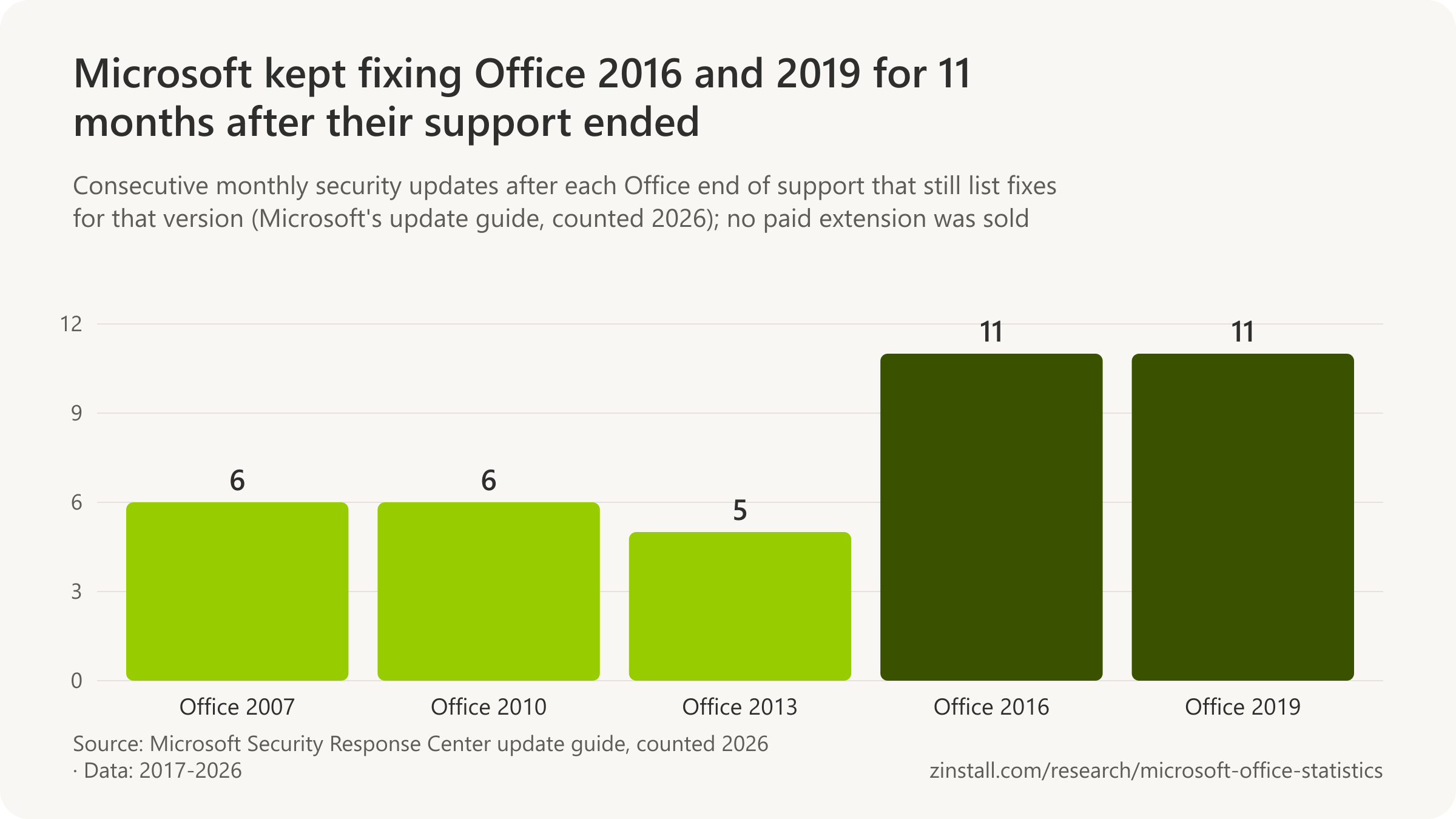
Microsoft kept shipping fixes for Office 2016 and 2019 for 11 months after support ended, against five or six for earlier versions (Microsoft, 2026).

- When Office 2016 and 2019 support ended in October 2025, 77% of small German firms' on-premises Office PCs lost security updates.
- Office 2021 got no extension and no extended security updates when its support ended on 13 October 2026.
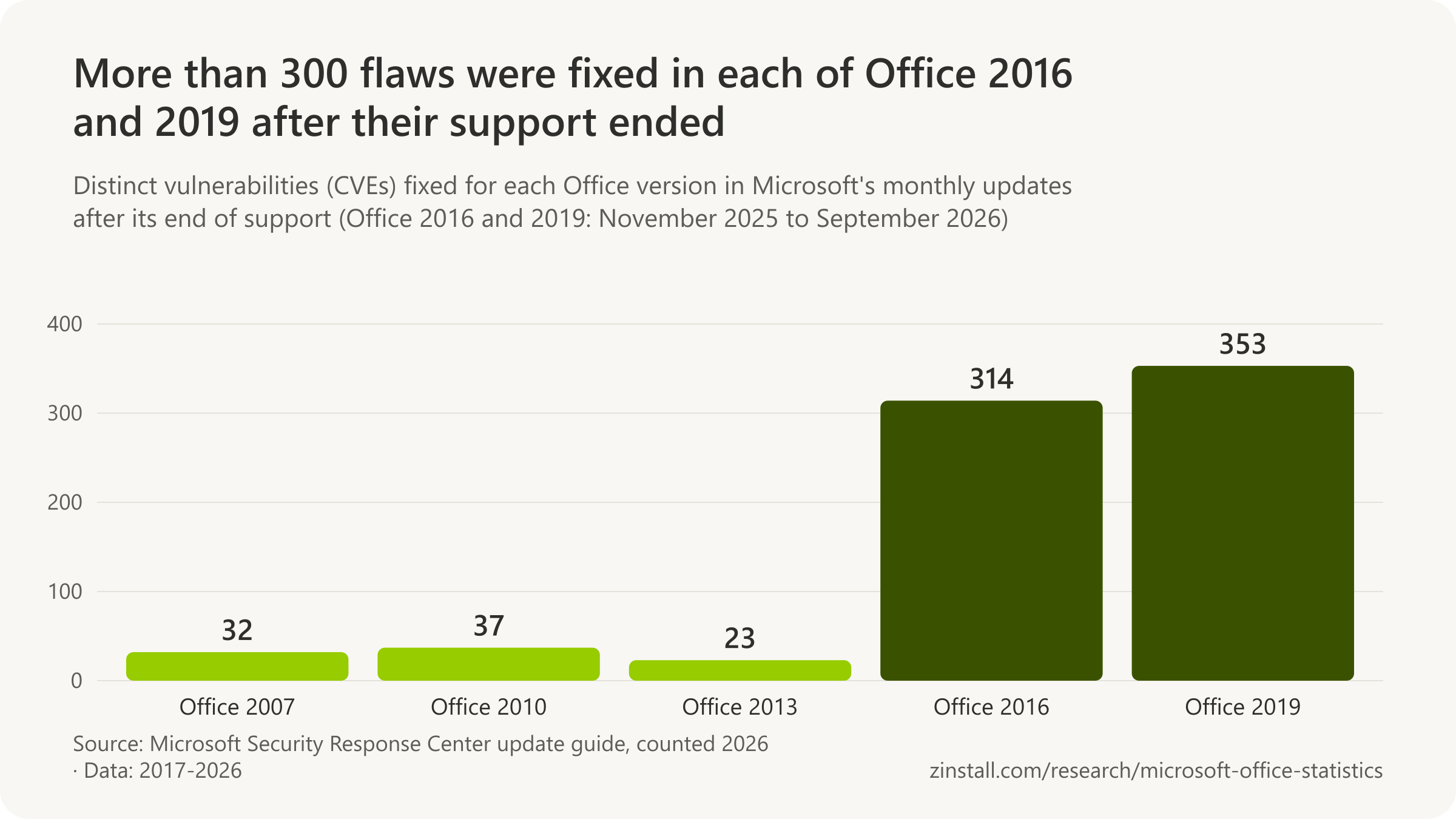
- 353 security flaws in Office 2019 were fixed in the eleven months after its October 2025 end of support.
- Microsoft kept updating the MSI edition of Office 2016 until September 2026, at what it calls its sole discretion.
- The UK government paid £5.584 million for a year of security patches for Office 2003 and Windows XP after April 2014.
| Version or buyer, measure and date | Figure |
|---|---|
| Office 2016: flaws fixed after its end of support, to September 2026 | 314 |
| Office LTSC 2021: flaws fixed in its last security update, October 2026 | 125 |
| Office 2016 MSI edition: patches after its end of support, to July 2026 | 36 |
| Microsoft's free FastTrack help leaving Office LTSC 2021: minimum size, 2026 | over 150 seats |
| Microsoft's discount for small firms leaving XP and Office 2003, 2013 | 15% ($84 per PC) |
| US Navy: custom support for 100,000 XP and Office 2003 workstations, 2015 | $9.1 million |
| US Navy: Microsoft custom support contract to 2017 | $30.8 million |
| NHS: end of its custom support for Office 2003 and Windows XP | 14 April 2015 |
Sources: Microsoft Security Response Center (2026a, 2026b, 2026c); Intra2net AG; Microsoft (2026a, 2026b, 2026c); The Register; Office Watch; Computerworld; Defense One; Washington Technology; Department of Health and Crown Commercial Service
Moving these programs to a new computer: Office 2016 · Office 2019 · Microsoft Office
More statistics (34)
At every Office deadline Microsoft offered an upgrade, not an extension: no Extended Security Updates have ever been sold for Office. It did keep listing fixes for the outgoing versions in its monthly security updates for months afterwards, eleven months for Office 2016 and 2019, under a clause that leaves those updates to its discretion. Governments that could not move in time bought custom support, as Britain and the US Navy did for Office 2003.
Security fixes after the deadline

- October 2026's security release, on 13 October 2026, was the first since Office 2016 and Office 2019 support ended to list neither version, after eleven straight months of fixes for both (Microsoft MSRC, counted 2026).
- 125 security vulnerabilities in Office LTSC 2021 were fixed in Microsoft's 13 October 2026 security release, the last update before its end of support that day (Microsoft MSRC, counted 2026).
- 470 security vulnerabilities affected Office LTSC 2021 in Microsoft's January to October 2026 security updates, its last ten months of support, against 141 in the whole of 2025 (Microsoft MSRC, counted 2026).
- 103 security vulnerabilities affected Office 2016 for Windows in Microsoft's monthly updates from January to its 14 October 2025 end of support, the last ten months it was supported (Microsoft MSRC, counted 2026).
- Microsoft shipped security updates for Office 2016 and Office 2019 on 26 January 2026, three months after their end of support, to fix CVE-2026-21509, an Office flaw it marked as already exploited (Microsoft MSRC, 2026).
- Microsoft kept releasing security updates almost monthly for Office 2016 and Office 2019 in the year after their October 2025 end of support, Help Net Security's October 2026 Patch Tuesday forecast noted, arguing it was time to truly end them (Help Net Security, 2026).
- 36 distinct security patches were released for MSI installations of Office 2016 between its end of support and July 2026, while the Click-to-Run edition most homes and small businesses have got none, Office Watch counted (Office Watch, 2026).
- September 2026 brought the latest of the monthly updates Microsoft has kept shipping for the MSI edition of Office 2016 since its 14 October 2025 end of support, under a clause reserving updates 'at Microsoft's sole discretion' (Microsoft, 2026).
- 13 April 2021, six months after Office 2010's end of support, Microsoft published a security update for it (KB4493215, fixing Word flaw CVE-2021-28453) through Microsoft Update, its last month of post-deadline Office 2010 fixes (Microsoft Support, 2021).
- 12 September 2023, five months after Office 2013's end of support, Microsoft published a security update for it (KB5002477, fixing CVE-2023-36767 and CVE-2023-41764), its last month of post-deadline Office 2013 fixes (Microsoft Support, 2023).
What Microsoft offered and said
- No extension and no extended security updates are offered for Office 2021, Microsoft's end-of-support page says now that support ended on 13 October 2026, unlike the paid Extended Security Updates it sold for Windows 10 (Microsoft Support, 2026).
- Office 2016 and Office 2019 apps may continue to function after support ended on 14 October 2025, but users could be exposed to security risks and the apps' performance may degrade over time, Microsoft says (Microsoft Support, 2026).
- No option to extend support beyond 11 April 2023 was offered for Office 2013, Microsoft's lifecycle notice said, the same no-extension policy it applied to Office 2016, 2019 and 2021 (Microsoft Lifecycle, 2021).
- No on-premises version of Office can use Microsoft 365 Copilot, Microsoft reminded customers on 14 October 2025, the day Office 2016 and 2019 support ended, steering them to Microsoft 365 or Office LTSC 2024 (Microsoft, 2025).
- 13 July 2026 was the day Office 2019 for Mac began opening documents read-only, unable to edit or save, after a licensing certificate expired; Microsoft says updating or reinstalling cannot fix it, while up-to-date Office 2021 for Mac kept working (Microsoft Support, 2026).
- No new security updates and no free or paid assisted support options remained for Office 2003 after 8 April 2014, when it went out of support on the same day as Windows XP and Exchange 2003, Microsoft's lifecycle notice says (Microsoft Lifecycle, 2014).
- 15% off Windows 8 Pro and Office 2013 Standard, or 84 dollars per PC, was Microsoft's offer to small and medium businesses still on Windows XP and Office 2003, a year before both lost support in April 2014, Computerworld reported (Computerworld, 2013).
- No security updates and no free or paid assisted support options are available for Office 2007 after its 10 October 2017 end of support, Microsoft's lifecycle notice says, pointing customers to Office 365 or the latest Office (Microsoft Lifecycle, 2020).
- 31 October 2017, three weeks after Office 2007's end of support, was the day RPC over HTTP stopped being supported for Exchange Online, leaving Outlook 2007, which cannot use its successor MAPI over HTTP, in an unsupported state with Microsoft 365 mail (Microsoft, 2024).
- No extension and no extended security updates were offered for Office 2010 when its support ended on 13 October 2020, and Microsoft also stopped letting customers download it, its end-of-support page says (Microsoft Support, 2026).
- Microsoft no longer provides security updates, bug fixes or technical support for Office LTSC 2021 suites and apps from 13 October 2026, it said that day, recommending Microsoft 365 or, for devices that cannot move to the cloud, Office LTSC 2024 (Microsoft, 2026).
- Over 150 seats was the threshold for Microsoft's no-cost FastTrack App Assure help with line-of-business apps, its main offer to organisations leaving Office LTSC 2021 when support ended on 13 October 2026; no discount or extended updates were offered (Microsoft, 2026).
- Microsoft offers no more security updates and no more downloads of Office 2007 after its 10 October 2017 end of support, its end-of-support page says, although the apps 'will continue to function' (Microsoft Support, 2026).
Custom support for Office 2003
- 14 April 2015 was the end of the Microsoft Custom Support for Office 2003, Windows XP and Exchange 2003 that the UK Department of Health and Crown Commercial Service bought for the NHS, a year past Office 2003's 8 April 2014 end of support (Department of Health, 2014).
- 5.584 million pounds was the price of the UK government's one-year Microsoft deal to keep security patches flowing for Office 2003, Windows XP and Exchange 2003 across the public sector after April 2014, The Register reported (The Register, 2014).
- 9.1 million dollars was the US Navy's contract for Microsoft custom support to July 2016 for 100,000 workstations still running Windows XP, Office 2003, Exchange 2003 and Server 2003, Defense One reported in June 2015, more than a year after Office 2003 support ended (Defense One, 2015).
- 30.8 million dollars was the value the US Navy's Microsoft support contract for Windows XP, Office 2003, Exchange 2003 and Server 2003 could reach if all options ran to June 2017, Washington Technology reported (Washington Technology, 2015).
How the press reported the deadlines
- No extension and no extended security updates were offered for Office 2016 and 2019, The Register reported a month before their 14 October 2025 end of support, while Exchange and Skype for Business servers got a security-update reprieve for customers who signed up (The Register, 2025).
- Office 2016 and 2019 users were 'out of luck' after 14 October 2025, The Register wrote: unlike Windows 10 there was no paid Extended Security Updates programme, leaving Office LTSC 2024 or a Microsoft 365 subscription (The Register, 2025).
- Office 2016 and Office 2019 keep working after their 14 October 2025 end of support but are 'vulnerable to attacks', BleepingComputer reported, pointing to Office 2024 and Office LTSC 2024, supported until 9 October 2029, as the one-time-purchase replacements (BleepingComputer, 2025).
- 13 October 2026, the end of support for Office 2021 and Office LTSC 2021, was also the last patch day of Windows 10's one-year consumer Extended Security Updates, heise noted, and Microsoft offered no paid extension for Office (heise online, 2026).
- Office 2021 owners had no free upgrade path when support ended on 13 October 2026: Windows Report noted they must buy new Office 2024 licences or move to Microsoft 365 (Windows Report, 2026).
- Office 2016 and 2019 Home and Business installations suddenly lost their activation in September 2026, nearly a year after end of support, in a bug users linked to an optional Microsoft 365 Apps update (KB5002907) that Microsoft then paused, The Register reported (The Register, 2026).
Numbers in circulation
- 5.548 million pounds is the price Government Business gave for the UK's one-year Microsoft deal covering Office 2003, Windows XP and Exchange 2003, against the £5.584 million The Register reported a week earlier (Government Business, 2014).
Sources: Microsoft Security Response Center (2018-2026); Help Net Security; Office Watch; Microsoft (2014-2026); Computerworld; Department of Health and Crown Commercial Service; The Register (2014, 2025, 2026); Defense One; Washington Technology; BleepingComputer; heise online; Windows Report; Government Business
How many security vulnerabilities does Microsoft Office have?
The US government's list of actively exploited vulnerabilities includes 45 flaws in Microsoft Office apps (CISA, 2026).

- 30 of the 45 Office flaws in CISA's catalogue of exploited vulnerabilities date from 2017 or earlier.
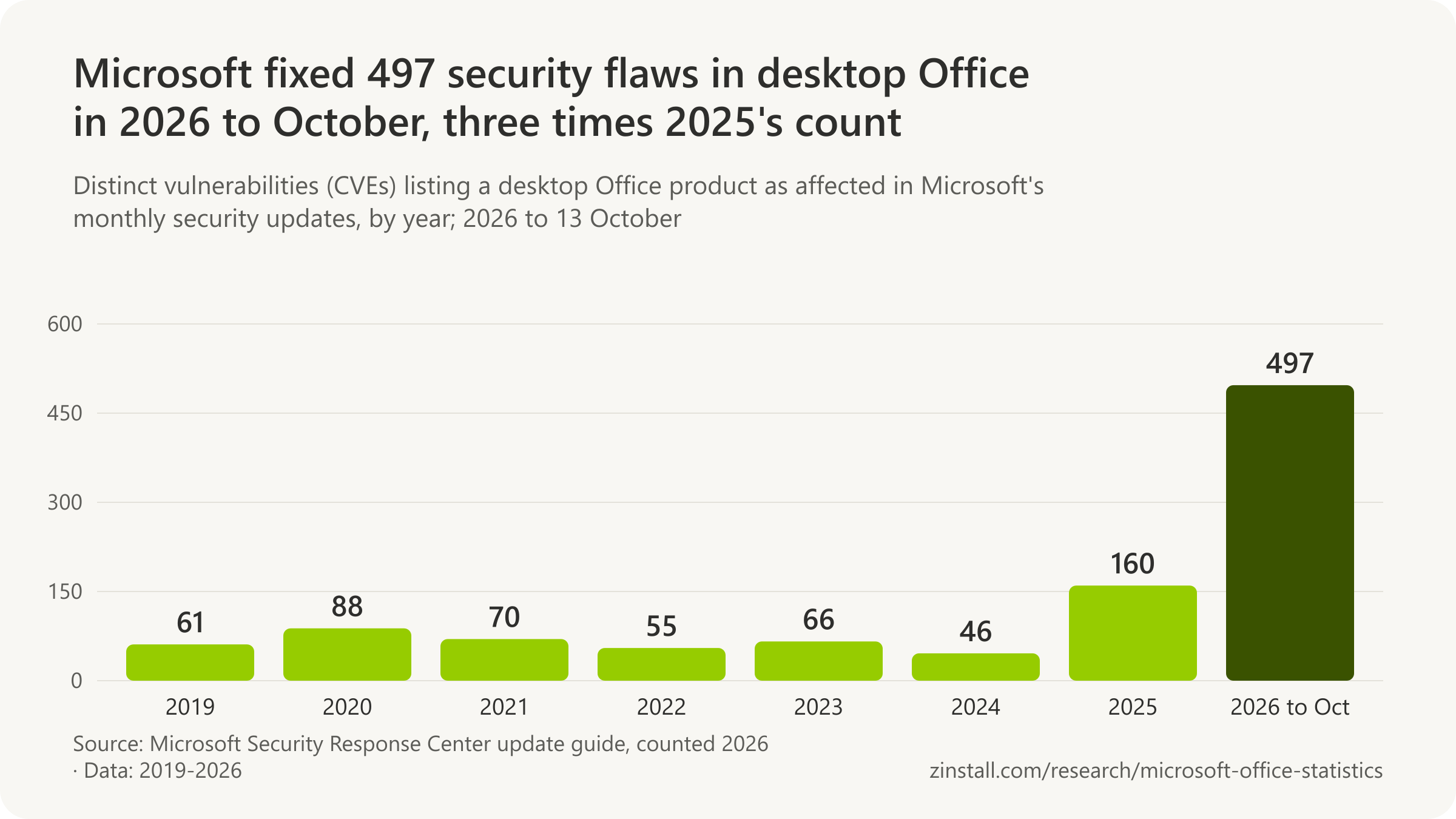
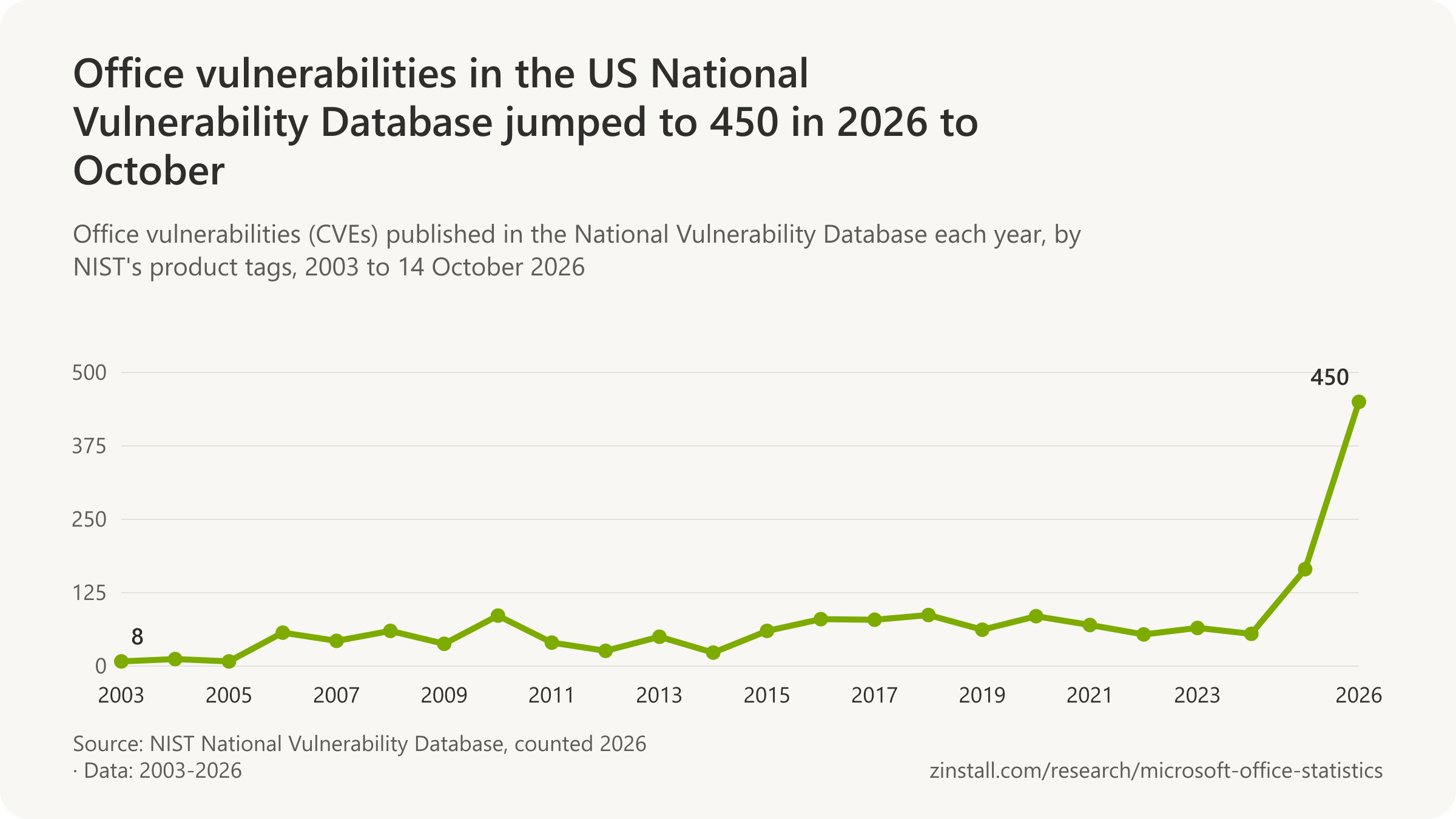
- Microsoft fixed 497 desktop Office vulnerabilities in 2026 to October, three times the 160 of all of 2025.
- Four of the 10 flaws most exploited by cyber actors from 2016 to 2019 were in Office, US agencies said in 2020.
- Attackers' use of macro-enabled attachments fell about 66% after Microsoft said it would block internet macros by default.
| Measure and date | Figure |
|---|---|
| Office flaws in the US National Vulnerability Database, 1997 to 2026 | 1,815 |
| Exploited flaws that affect Office 2016, 2026 | 24 |
| Exploited Office flaws known to be used by ransomware, 2026 | 5 |
| Office flaws Microsoft marked as exploited when it fixed them, 2016 to 2026 | 15 |
| Kaspersky users attacked through CVE-2018-0802 (Equation Editor), Q2 2023 | over 130,000 |
| Office flaws in Recorded Future's ten most exploited, 2019 | 3 of 10 |
| Office-targeted threats using macros, 2016 (Microsoft) | 98% |
Sources: Cybersecurity and Infrastructure Security Agency; Kaspersky (2023a, 2023b); Microsoft Security Response Center (2019-2026); Cybersecurity and Infrastructure Security Agency and Federal Bureau of Investigation; Proofpoint; National Institute of Standards and Technology, National Vulnerability Database; Help Net Security; Microsoft
Moving these programs to a new computer: Microsoft Office
More statistics (23)
Office is one of the most attacked programs on a PC, and an unsupported copy gets none of the fixes. Microsoft's monthly updates fixed 497 desktop Office vulnerabilities in 2026 to October, more than in any earlier full year; CISA lists 45 Office flaws as actively exploited, two thirds of them from 2017 or earlier; and old Equation Editor flaws still lead security vendors' exploit counts. The counts below are this page's own tallies of the public catalogues, with the method in each record.
Vulnerabilities fixed each year
- 89 distinct security vulnerabilities (CVEs) affected Microsoft's desktop Office apps for Windows and Mac in its 2017 monthly security updates, the year Office 2007 support ended (Microsoft MSRC, counted 2026).
- 92 distinct security vulnerabilities (CVEs) affected Microsoft's desktop Office apps for Windows and Mac in its 2018 monthly security updates (Microsoft MSRC, counted 2026).

- 15 desktop Office vulnerabilities were already being exploited when Microsoft released their fixes between 2016 and February 2026, by Microsoft's own 'Exploited:Yes' flag, at most 4 in any year (2023) (Microsoft MSRC, counted 2026).
Exploited Office flaws

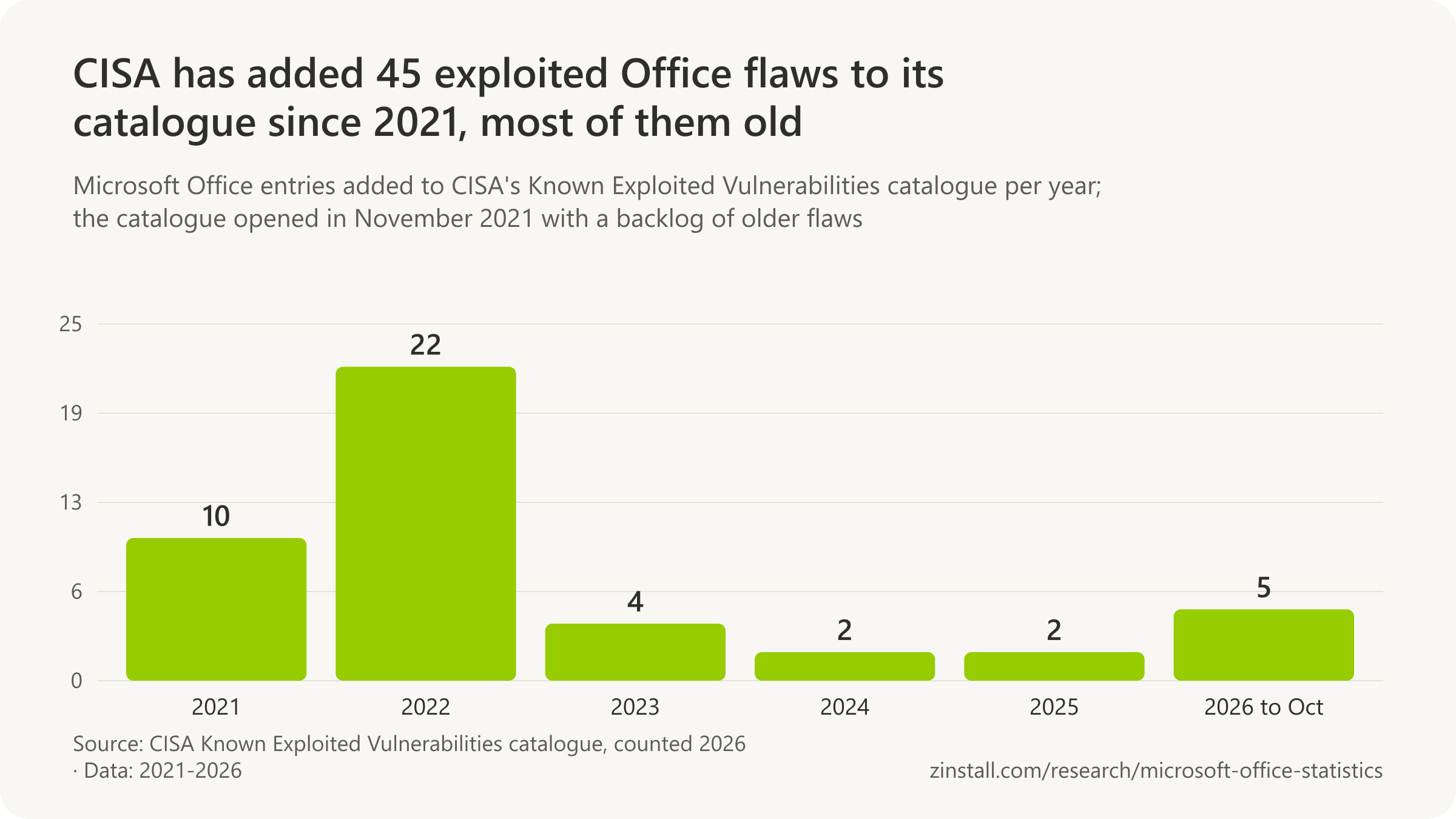
- 45 of the 1,745 actively exploited vulnerabilities in CISA's Known Exploited Vulnerabilities catalogue at 14 October 2026 are flaws in Microsoft Office applications such as Office, Word, Excel, PowerPoint and Outlook, 11.5% of the catalogue's 390 Microsoft entries (CISA, counted 2026).
- 30 of the 45 Microsoft Office flaws in CISA's Known Exploited Vulnerabilities catalogue at 14 October 2026 carry CVE ids from 2017 or earlier, and 7 date from 2006 to 2009, old bugs that still work against unpatched copies (CISA, counted 2026).
- 5 of the 45 Microsoft Office flaws in CISA's Known Exploited Vulnerabilities catalogue are marked as known to be used in ransomware campaigns at 14 October 2026: CVE-2012-0158, CVE-2017-0199, CVE-2017-11882, CVE-2018-0802 and CVE-2021-38646 (CISA, counted 2026).
- CVE-2026-21509, an actively exploited Microsoft Office security-feature bypass, was added to CISA's Known Exploited Vulnerabilities catalogue on 26 January 2026 with a three-week deadline for US federal agencies to fix it (CISA, 2026).
- 24 actively exploited vulnerabilities in CISA's catalogue affect Office 2016 according to Microsoft's advisories, as of 14 October 2026, a year after its support ended, including CVE-2026-21509 from January 2026 (CISA and Microsoft MSRC, counted 2026).
- 4 of the 10 vulnerabilities most exploited by state, non-state and unattributed cyber actors from 2016 to 2019 were Microsoft Office flaws (CVE-2017-11882, CVE-2017-0199, CVE-2012-0158 and CVE-2015-1641), the US CISA and FBI said in May 2020 (CISA and FBI, 2020).
- The three vulnerabilities used most by state-sponsored hackers from China, Iran, North Korea and Russia from 2016 to 2019 were all in Microsoft Office's OLE technology (CVE-2017-11882, CVE-2017-0199 and CVE-2012-0158), the US CISA and FBI said in May 2020 (CISA and FBI, 2020).
- CVE-2012-0158, an Office flaw patched in April 2012, was still frequently exploited by Chinese state hackers in December 2019, the US CISA and FBI said, a sign that many organisations had not applied the patch (CISA and FBI, 2020).
- CVE-2017-11882, the Office Equation Editor flaw patched in 2017, was the only Office vulnerability among the 14 topmost exploited of 2020 named by the US, UK and Australian cyber agencies in July 2021, which said attackers would keep using it while systems stay unpatched (CISA, 2021).
- 56% of the successful attacks on Office that Microsoft sampled in the second half of 2009 hit copies last updated in 2003, mostly Office 2003 installations never patched since release, Computerworld reported from Microsoft's Security Intelligence Report (Computerworld, 2010).
- Over 130,000 users encountered attacks exploiting CVE-2018-0802, a 2018 Office Equation Editor flaw, in the second quarter of 2023, making it attackers' most prevalent exploit, while attacks on CVE-2017-11882 hit more than 11,000 users, Kaspersky said (Kaspersky, 2023).
- Microsoft Office exploits, long the most used in targeted (APT) attacks, were overtaken by a WinRAR vulnerability in 2023, Kaspersky said in May 2024, though vulnerable office applications remained a main entry point (Kaspersky, 2024).
- 3 of the 10 vulnerabilities most exploited by cybercriminals in 2019 were Microsoft Office flaws (CVE-2017-11882, CVE-2017-0199 and CVE-2012-0158), in Recorded Future's ranking as reported by Help Net Security (Help Net Security, 2020).
- January 2018 was when Microsoft removed Equation Editor 3.0 from all versions of Office 'because of security issues', the component behind CVE-2017-11882 and CVE-2018-0802, still among the most exploited Office flaws in 2026 (Microsoft Support, 2026).
Office's share of attacks

Macros
- 98% of Office-targeted threats used macros, Microsoft said in March 2016 citing its Office 365 Advanced Threat Protection data, as it added a policy to Office 2016 that blocks macros in files from the internet (Microsoft, 2016).
- 7 February 2022 was when Microsoft announced that Office would block VBA macros in files from the internet by default, after decades of letting users enable them with one click; the rollout paused in July 2022 and then resumed (Microsoft, 2022).
- 27 July 2022 was when Microsoft began blocking macros in internet files by default in Office's Current Channel (Version 2206), reaching the Semi-Annual Enterprise Channel on 10 January 2023, on Windows only (Microsoft Learn, 2026).
- Threat actors' use of macro-enabled attachments fell by about 66% between October 2021 and June 2022, after Microsoft said it would block macros by default, while container files such as ISO and RAR and Windows shortcut (LNK) files rose, Proofpoint found (Proofpoint, 2022).
Numbers in circulation
- 'Almost 98%' of all Office-targeted threats were macro-based malware after 'an increase' Microsoft reported in 2016, the IT management vendor N-able wrote in February 2020, restating a 2016 share of detections as a rise that Microsoft's post did not describe (N-able, 2020).
Sources: Microsoft Security Response Center (2017, 2018, 2026); Cybersecurity and Infrastructure Security Agency; Cybersecurity and Infrastructure Security Agency and Federal Bureau of Investigation; CISA, Australian Cyber Security Centre, UK National Cyber Security Centre and FBI; Computerworld; Kaspersky (2017-2026); Help Net Security; Microsoft (2016, 2022, 2026); Proofpoint; N-able; National Institute of Standards and Technology, National Vulnerability Database
How fast are new Office versions adopted?
Microsoft sold nearly 200 million Office 2010 licences in its first 18 months, the last such count it gave (Microsoft, 2012).

- Microsoft sold 120 million Office licences between Office 2007's launch in November 2006 and July 2008.
- Only 16% of firms Forrester surveyed in mid-2013 planned to roll out Office 2013 within a year.
- 4% of IT departments had fully deployed Office 2010 less than six months after release, in a vendor-funded 2010 survey.
- Microsoft gave no sales or adoption figure for Office 2021 after its October 2021 launch.
| Release | Date |
|---|---|
| Office 2003 | 21 October 2003 |
| Office 2007 (businesses) | 30 November 2006 |
| Office 2010 (businesses) | 12 May 2010 |
| Office 365 (businesses) | 28 June 2011 |
| Office 365 Home Premium (consumers) | 29 January 2013 |
| Office 2016 | 22 September 2015 |
| Office 2019 | 24 September 2018 |
| Office 365 renamed Microsoft 365 (consumer plans) | 21 April 2020 |
| Office LTSC 2021 for volume licence customers (Office 2021 from 5 October) | 16 September 2021 |
| Office LTSC 2024 for volume licence customers (all customers from 1 October) | 16 September 2024 |
Sources: Microsoft (2003-2024); Forrester Research; Dimensional Research; Intra2net AG (2020-2026)
Moving these programs to a new computer: Microsoft Office · Office 2019
More statistics (92)
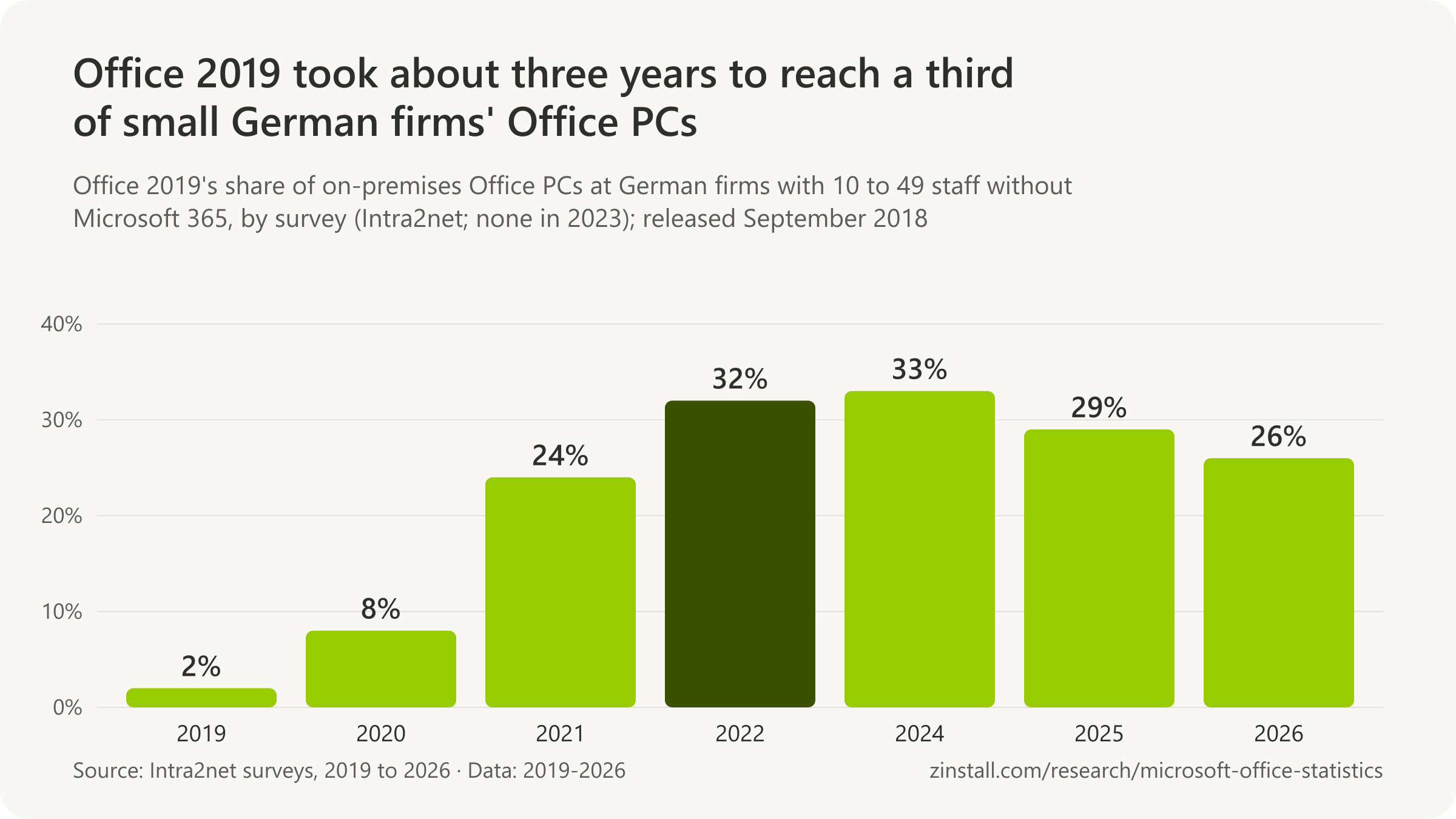
Microsoft gave sales figures for Office 2007 and Office 2010, the fastest-selling version it ever announced, and none for any one-time-purchase version since: its later launches were measured in subscribers. Businesses have always moved slowly. Surveys around each launch found one firm in six to one in three planning to upgrade within a year, and at small German firms Office 2019 took three years to reach a third of PCs.
Launch dates
| Release | Date |
|---|---|
| Office 2003 | 21 October 2003 |
| Office 2007 (businesses) | 30 November 2006 |
| Office 2007 (consumers) | 30 January 2007 |
| Office 2008 for Mac | 15 January 2008 |
| Office 2010 (businesses) | 12 May 2010 |
| Office 2010 (consumers) | 15 June 2010 |
| Office for Mac 2011 | 26 October 2010 |
| Office 365 (businesses) | 28 June 2011 |
| Office 365 Home Premium (consumers) | 29 January 2013 |
| Office 2016 for Mac | 9 July 2015 |
| Office 2016 | 22 September 2015 |
| Office 2019 | 24 September 2018 |
| Office 365 renamed Microsoft 365 (consumer plans) | 21 April 2020 |
| Office LTSC 2021 | 16 September 2021 |
| Office LTSC 2024 | 16 September 2024 |
| Office app and Office.com renamed Microsoft 365 | November 2022 |
Sales and licences after each launch
- More than 200 million people would be using at least one of Windows Vista, the 2007 Office system or Exchange Server 2007 by the end of 2007, Steve Ballmer forecast at the business launch in November 2006 (Microsoft, 2006).
- More than 1 billion user sessions of customers who let Microsoft watch them work guided the design of Windows Vista, the 2007 Office system and Exchange 2007, Microsoft said at the November 2006 launch (Microsoft, 2006).
- 106.3% more US retail revenue was taken by Office 2007 in its launch week at the end of January 2007 than Office 2003 had in its own launch week, the NPD Group said (NPD Group, 2007).
- 108.6% more units of Office 2007 were sold by US retailers in its launch week at the end of January 2007 than of Office 2003 in its launch week, the NPD Group said (NPD Group, 2007).
- 61.3% more Office 2007 units were reported by US value-added resellers in December 2006, its first full month for businesses, than for Office 2003 in its first full month, the NPD Group said (NPD Group, 2007).
- 97.8% more Office 2007 revenue was reported by US value-added resellers in December 2006, its first full month for businesses, than for Office 2003 in its first full month, the NPD Group said (NPD Group, 2007).
- 71 million Office licences, new and upgrades, were delivered by Microsoft in its fiscal year to June 2007, the year Office 2007 launched, Jeff Raikes told analysts in July 2007 (Microsoft, 2007).
- 6.6 million downloads of the Office 2007 trial were made in the first months after launch, Microsoft said in July 2007 (Microsoft, 2007).
- Twice as many Office consumer licences were sold in Europe, the Middle East and Africa with the Office 2007 launch, driven by the Home and Student edition, Microsoft said in July 2007 (Microsoft, 2007).
- 120 million Office licences were sold between the launch of Office 2007 in November 2006 and July 2008, Stephen Elop told analysts in July 2008 (Microsoft, 2008).
- Office 2007 was deployed slightly faster than Office 2003 over the same time from launch, as a share of the installed base of business PCs, despite its new interface, Microsoft said in July 2008 (Microsoft, 2008).
- US$250 million more revenue came from the 2007 Office system in its first six months on sale than from Office 2003 in the same period, Microsoft Austria said in December 2007 (Microsoft, 2007).
- More than 10 million downloads of the Office 2007 trial were made by November 2007, about one million a month, Microsoft Austria said (Microsoft, 2007).
- Over 15% revenue growth was recorded for Office 2010 in its first full quarter on the market (July to September 2010), Microsoft said in its October 2010 earnings release (Microsoft, 2010).
- Over 50% more Office 2010 licences were sold than Office 2007 licences over the same period after launch, making Office 2010 the fastest-selling consumer version of Office, Microsoft said in January 2011 (Microsoft, 2011).
- Office 2010 had become the fastest-selling version of Office in history within a year of its spring 2010 release, Microsoft said in its April 2011 earnings release (Microsoft, 2011).
- Over 100 million Office 2010 licences were sold by June 2011, a little over a year after its launch, Microsoft said in July 2011, calling it the fastest-selling version of Office in history (Microsoft, 2011).
- Nearly 200 million Office 2010 licences were sold in the 18 months after its launch, Microsoft said in January 2012, the last licence count it gave for a one-time-purchase Office version (Microsoft, 2012).
- 5 times the level of Office 2007 at the same point after its launch was where Office 2010 stood in September 2011, Microsoft's chief operating officer Kevin Turner told analysts, without naming the measure (Microsoft, 2011).
- More than one copy of the new Office (Office 2013 suites and Office 365 subscriptions together) was sold every second on average in the four months after the January 2013 launch, making it the best-selling Office edition yet, Microsoft said (Microsoft, 2013).
- Office 2016 generated more deal volume than Microsoft expected in its first year, giving better than expected transactional revenue in April to June 2016, Microsoft said in July 2016 (Microsoft, 2016).
- About 3 points of Microsoft's 17% Office commercial revenue growth in July to September 2018 came from demand ahead of a price increase with the launch of Office 2019, Microsoft said (Microsoft, 2018).
- About 5 points of Microsoft's 16% Office consumer revenue growth in July to September 2018 came from channel demand ahead of a price increase with the launch of Office 2019, Microsoft said (Microsoft, 2018).
- Office 2019 sold better than Microsoft expected in July to September 2020, two years after launch and during the pandemic shift to home working, Microsoft said in October 2020 (Microsoft, 2020).
- No sales or adoption figure for Office 2021 was given by Microsoft: its earnings calls after the October 2021 launch credited Office consumer growth to Microsoft 365 subscriptions alone, as in January 2022 (Microsoft, 2022).
- Fewer Office 2010 units and dollars were sold at US retail in its first two weeks in June 2010 than Office 2007 in its first two weeks, a start NPD called 'a bit disappointing' (NPD Group, 2010).
- Over US$1.5 billion of Office 2007 was sold at US retail in the three and a half years it was on the shelf, about 10 million new copies on top of copies preinstalled on PCs, NPD estimated in 2010 (NPD Group, 2010).
- Nearly three times the sales pace of Office 2004 for Mac after its launch was reached by Office 2008 for Mac in its first four months, the fastest-selling Office for Mac in 19 years, Microsoft's Mac unit said in May 2008 (Microsoft, 2008).
- About US$500 million of sales and marketing went into the launch of Office 2003 (the Microsoft Office System), two to three times more than Microsoft had spent on any earlier Office launch, Jeff Raikes said in November 2003 (Microsoft, 2003).
- Office 2003 was being deployed faster than Office XP in every segment of Microsoft's business, Jeff Raikes told analysts in July 2005, 21 months after its launch, without giving figures (Microsoft, 2005).
- 63 million new and renewed Office licences were sold by Microsoft in its fiscal year to June 2005, the second full year of Office 2003, Jeff Raikes told analysts (Microsoft, 2005).
- Five times faster deployment of Office 2010 than of Office 2007 was reported among business customers by Microsoft on Office 2010's first anniversary in June 2011, as quoted by InfoWorld (Microsoft, 2011).
Betas, downloads, devices and first subscribers
- More than 3.5 million people downloaded the second beta of the 2007 Microsoft Office system, the largest Office beta programme to that date, Microsoft said when the code was finished in November 2006 (Microsoft, 2006).
- 8.6 million people were already using Office 2010 and related products through Microsoft's beta programme at the May 2010 business launch, three times the number in the Office 2007 beta, Microsoft said (Microsoft, 2010).
- More than 9 million downloads of the Office 2010 beta were made before its June 2010 retail launch, which Microsoft called more than six times the size of the Office 2007 beta programme (Microsoft, 2010).
- 75% of Office 2010 beta users said they planned to buy Office 2010 within six months, in a Microsoft survey of its beta users published at the June 2010 launch (Microsoft, 2010).
- More than 100 million PCs would ship with Office 2010 preloaded in its first year on sale, ready to activate with a purchase, Microsoft forecast at the June 2010 consumer launch (Microsoft, 2010).
- Over 5 million Office 365 seats had been signed up and about 2.8 million deployed less than three months after the June 2011 launch, Kevin Turner told analysts in September 2011 (Microsoft, 2011).
- More than 1 million subscribers signed up to Office 365 Home Premium in just over 100 days after its January 2013 launch, Microsoft said in May 2013 (Microsoft, 2013).
- 340 million downloads of the Office apps on iOS and Android were reached in October to December 2015, Microsoft said on its January 2016 earnings call (Microsoft, 2016).
- Hundreds of millions of devices worldwide received Office through Click-to-Run, the streaming installer introduced with Office 2013, by September 2018, when Microsoft moved the one-time-purchase Office 2019 onto it as well (Microsoft, 2018).
- 12 million downloads of the Office apps for iPad were made in the first week after their launch in late March 2014, Microsoft said, as GeekWire reported (GeekWire, 2014).
- Three quarters of all Mac users had Microsoft Office installed, Microsoft's Office for Mac general manager Eric Wilfrid said at the October 2010 launch of Office for Mac 2011, a vendor claim with no stated source (Microsoft, 2010).
- 50 million unique monthly visitors were using the free Office Web Apps a year after their June 2010 launch with Office 2010, Microsoft's Takeshi Numoto told InfoWorld in June 2011 (Microsoft, 2011).
How fast businesses moved
- 90% of larger businesses would have deployed Office 2007 by the summer of 2009, two and a half years after its launch, Microsoft's own research projected in July 2008 (Microsoft, 2008).
- 27% of IT decision-makers surveyed by Forrester in 2009 planned to upgrade to Office 2007 within a year, 14% within six months and 26% within two years, more than two years after its launch (Forrester, 2009).
- 38.2% of IT decision-makers surveyed by Forrester in 2009 said the economic downturn had delayed their Office upgrade plans and 5.3% said it had halted them (Forrester, 2009).
- One third of firms surveyed by Forrester in April 2010 planned to upgrade to Office 2010 within a year, mainly because their licence agreement covered it, and two thirds within two to three years (Forrester, 2010).
- 3% of firms surveyed by Forrester in April 2010 said they were moving off Microsoft Office rather than upgrading to Office 2010 (Forrester, 2010).
- 63% of 111 productivity professionals surveyed by Forrester in early 2010 planned to upgrade to Office 2010, and half of those without plans were still moving to Office 2007 (Forrester, 2010).
- One in five of Microsoft's enterprise customers had the paid Office 365 service in February 2013, 18 months after its launch and up from one in seven a year earlier, Microsoft said (Microsoft, 2013).
- One in four of Microsoft's enterprise customers had Office 365 in April 2013, with net seat additions five times higher than a year earlier, Microsoft said on its earnings call (Microsoft, 2013).
- Office 2016 was being adopted faster than Office 2013 over the same time after launch, Microsoft said in January 2016, four months after release, without giving a figure (Microsoft, 2016).
- 78% of IT decision-makers in a Gartner survey of January 2016 said their organisations used or planned to use Office 365, 13 points more than in Gartner's 2014 survey (Gartner, 2016).
- 36% of firms surveyed by Forrester in mid-2013 planned to move to Office 2013, on top of the 22% already on it six months after launch, and Forrester expected slower uptake than for Office 2010 (Forrester, 2013).
- About half of Microsoft Office's licensed base of some 170 million users were licensed for Office XP in 2002, about a year after its May 2001 launch, Jeff Raikes told analysts (Microsoft, 2002).
- Half of all Microsoft enterprise agreement renewals in April to June 2015 were for Office 365, two months before Office 2016 shipped, Microsoft said in July 2015 (Microsoft, 2015).
- More than two thirds of Office migrations at small German businesses in the year to September 2022 went to Office 2019, not the new Office 2021 launched in October 2021, Intra2net found (Intra2net, 2022).
- Small German businesses that upgraded Office in the year to September 2025 moved directly to Office 2024, mostly from Office 2019, while Office 2021 played 'virtually no role' in new migrations, Intra2net found (Intra2net, 2025).
- 16% of firms surveyed by Forrester in mid-2013 planned to roll out Office 2013 within a year, which with the 22% already using it would take it to 38% of firms by mid-2014, and 20% planned to do so later, Journal du Net reported (Forrester, 2013).
- One in seven of Microsoft's enterprise customers had the paid Office 365 service in early 2012, about eight months after its launch, Microsoft said when it reported one in five a year later (Microsoft, 2013).
- About 65% of organisations in Gartner's 2014 Office 365 survey were using or planning to use Office 365, derived from Gartner's 2016 figure of 78% and its 13-point rise (Gartner, 2016).
- 4% of corporate IT organisations had fully deployed Office 2010 less than six months after its May 2010 release, in a Dimensional Research survey funded by Dell KACE (Dimensional Research, 2010).
- 42% of IT professionals surveyed in September 2010 planned to deploy Office 2010 broadly in 2011, against 18% by the end of 2010, while 15% had no plans to deploy it, Dimensional Research found for Dell KACE (Dimensional Research, 2010).
- 45% of IT professionals named user training on the ribbon interface, introduced with Office 2007, as a concern about deploying Office 2010, the top worry in a Dimensional Research survey of 2010 (Dimensional Research, 2010).
- 20% higher sales than Office 2007 in its early months were claimed for Office 2010 by Microsoft in October 2010, as Computerworld reported, three months before Microsoft put the lead at over 50% (Computerworld, 2010).
- 52% of IT departments supported Office 2010 in early 2011, about nine months after its launch, against 72% for Office 2007 and 74% for Office 2003 or earlier, in a Forrester survey of 150 decision-makers (Forrester, 2011).
Numbers in circulation
- 70 million copies of Office 2007 sold, a figure attributed to Microsoft France in September 2007, was wrong: Microsoft's own statement was more than 71 million licences of all Office versions in its fiscal year to June 2007, Neowin reported (Neowin, 2007).
- More than 10 million Office licences in 120 days was PCWorld's arithmetic from Microsoft's 'more than one sold every second' claim for Office 2013 and Office 365 in May 2013, a derived figure Microsoft never stated (PCWorld, 2013).
- Office 2010's first two weeks of sales were 'greater than those of Office 2007', PCWorld wrote in July 2010, misreading NPD, whose own post said units and dollars were down from Office 2007's first two weeks (PCWorld, 2010).
- About 31.5 million copies of Office 2010 in its first year was InfoWorld's arithmetic in June 2011 from Microsoft's 'a copy of Office every second', a month before Microsoft itself reported over 100 million Office 2010 licences sold (InfoWorld, 2011).
Sources: Microsoft (2002-2024); Computerworld (2010, 2022); NPD Group (2007, 2010); Microsoft Austria; TechCrunch; GeekWire; Forrester Research (2009-2013); Gartner; Intra2net (2022, 2025); Dimensional Research (2010); Neowin; PCWorld (2010, 2013); InfoWorld
How many people pay for Microsoft 365 instead of buying Office?
More than 70% of Microsoft's paid business Office base was on Office 365 subscriptions by September 2020 (Microsoft, 2020).

- 85% of Microsoft's consumer Office revenue came from Microsoft 365 subscriptions in the third quarter of 2024.
- Office 365 business revenue overtook traditional Office licensing for the first time in the April to June 2017 quarter.
- Microsoft 365's business products and cloud services brought in $102.0 billion in the year to June 2026.
- Microsoft 365 Personal and Family went up $3 a month in the US in January 2025, the first rise since 2013.
- Office Home 2024, the one-time purchase, costs $179.99 in the US; Microsoft 365 Personal costs $99.99 a year.
| Plan, period and date | Price |
|---|---|
| Microsoft 365 Personal, a month, 2013 to 2024 | $6.99 a month |
| Microsoft 365 Personal, a month, 2026 | $9.99 a month ($99.99 a year) |
| Microsoft 365 Family, a month, 2013 to 2024 | $9.99 a month |
| Microsoft 365 Family, a month, 2026 | $12.99 a month ($129.99 a year) |
| Microsoft 365 Basic (storage only), a month, 2023 | $1.99 a month ($19.99 a year) |
| Microsoft 365 Premium, a month, 2025 | $19.99 a month |
| Office Home 2024, one-time purchase, at launch in 2024 | $149.99 |
| Office Home & Business 2024, one-time purchase, 2026 | $249.99 |
| Microsoft 365 Business Basic, per user a month, from March 2022 | $6 (from $5) |
| Microsoft 365 E3, per user a month, from July 2026 | $39 (from $36) |
Sources: Microsoft (2017-2026)
Moving these programs to a new computer: Microsoft 365 · Microsoft Office
More statistics (43)
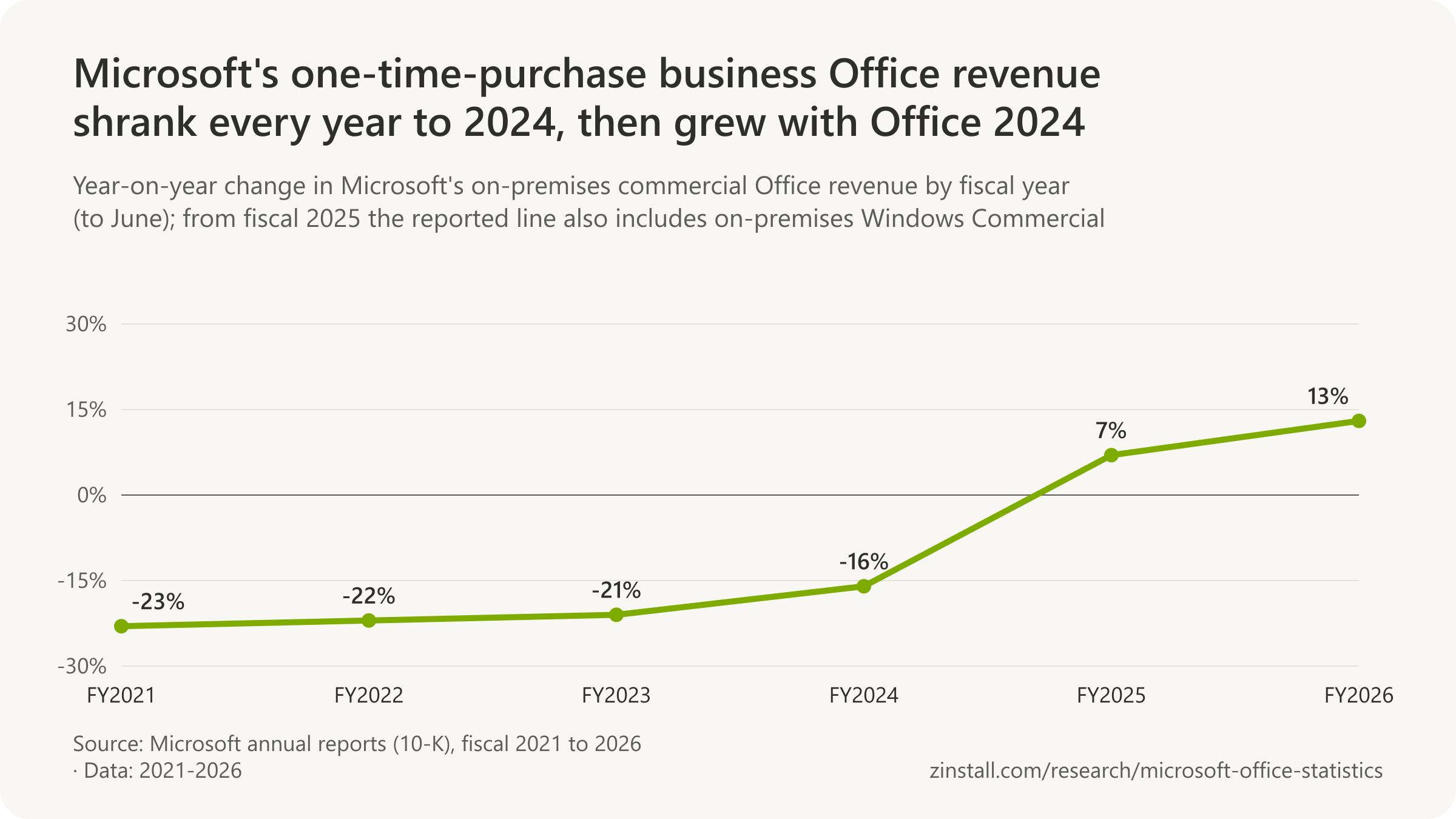
Microsoft does not say how many people still use a one-time-purchase Office. Its accounts show the shift instead: Office 365 business revenue overtook traditional licensing in 2017, most of the paid business Office base was on subscriptions by 2020, and most consumer Office revenue came from subscriptions by 2024. One-time purchases rose again in 2025 and 2026, as Office 2016 and 2019 lost support and Office 2024 shipped.
Revenue

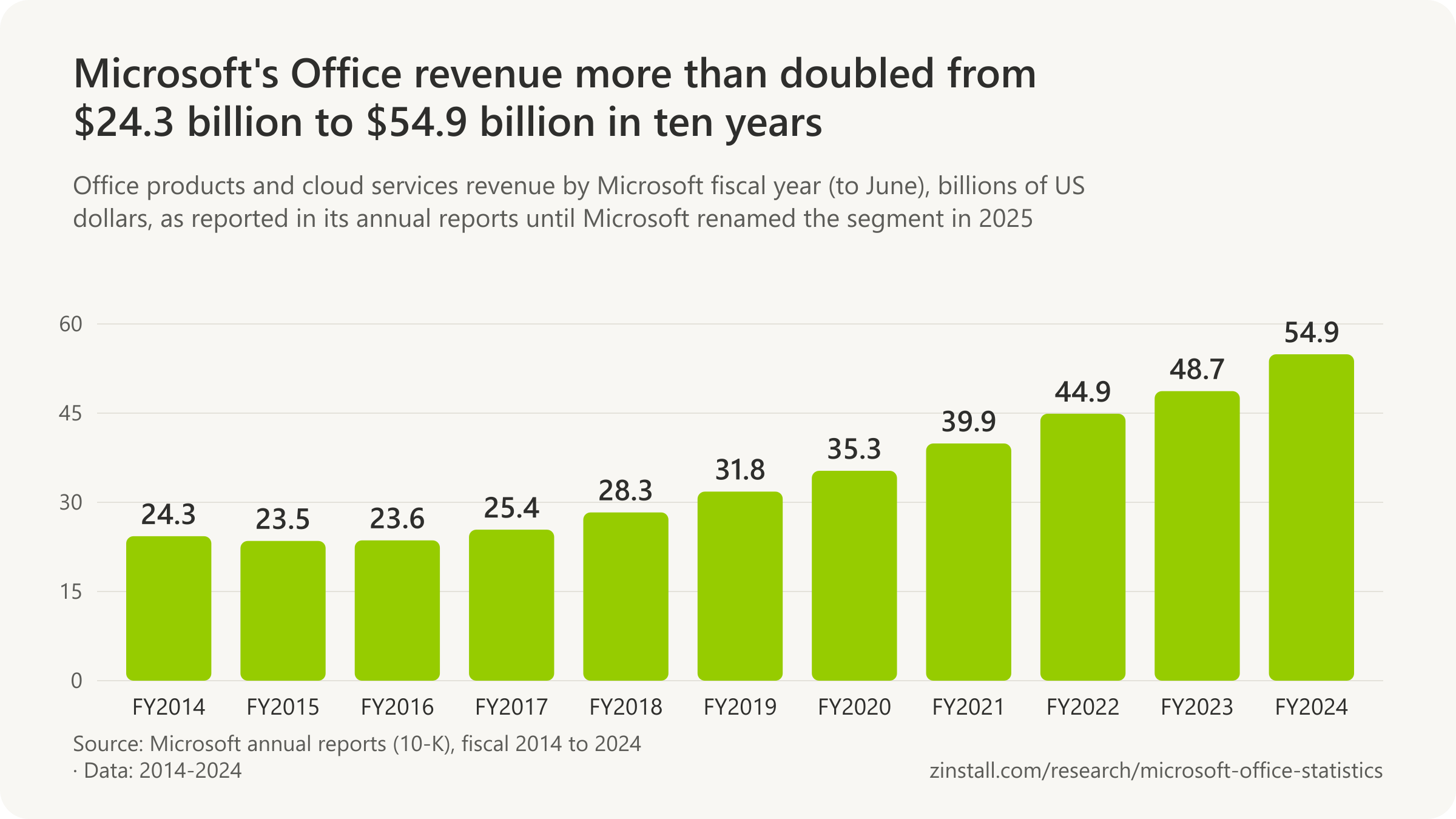

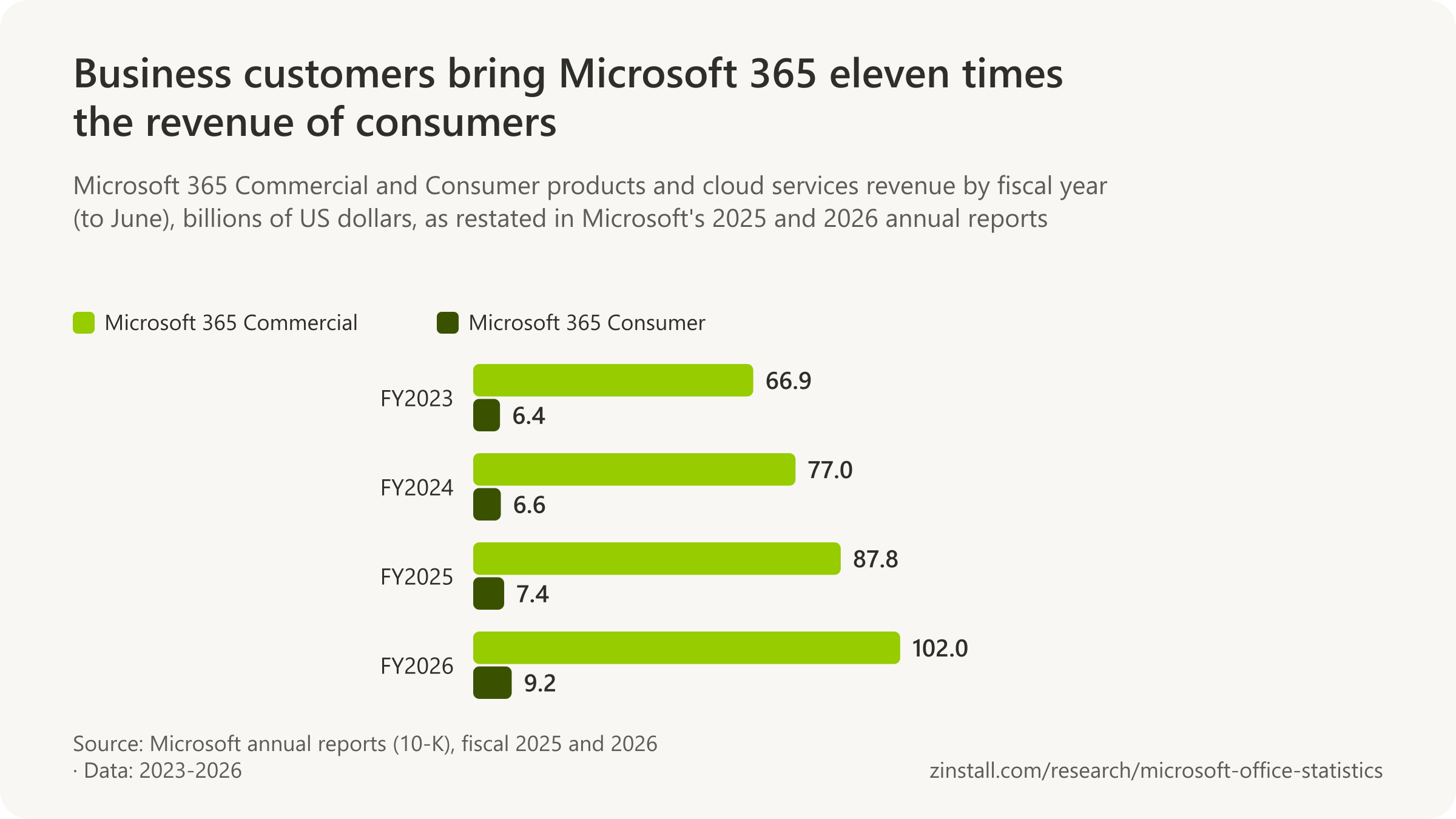
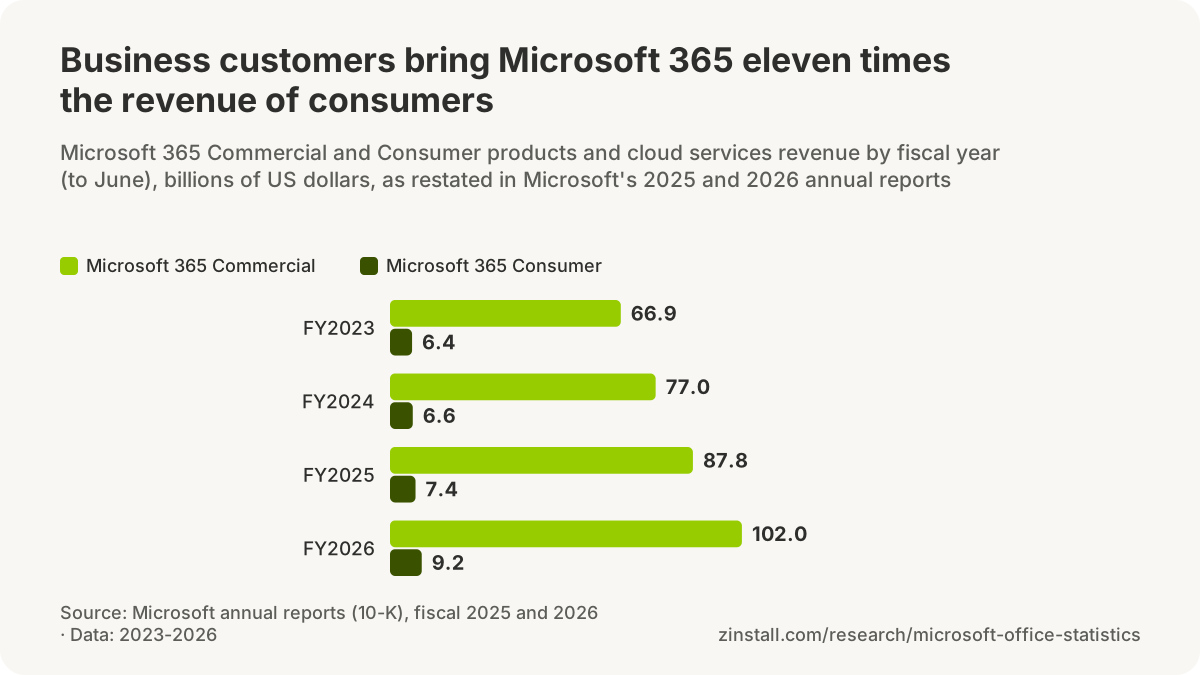


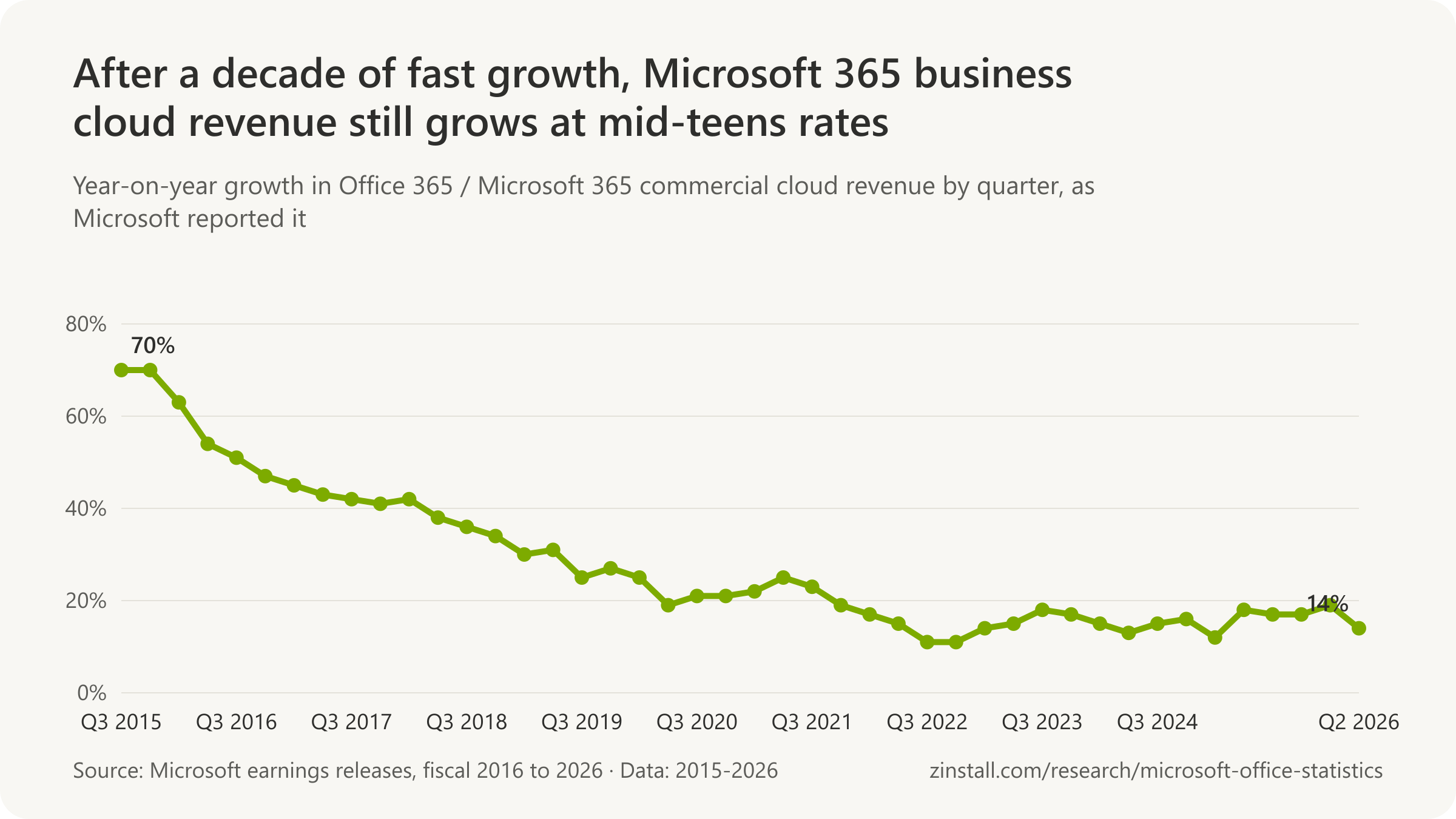
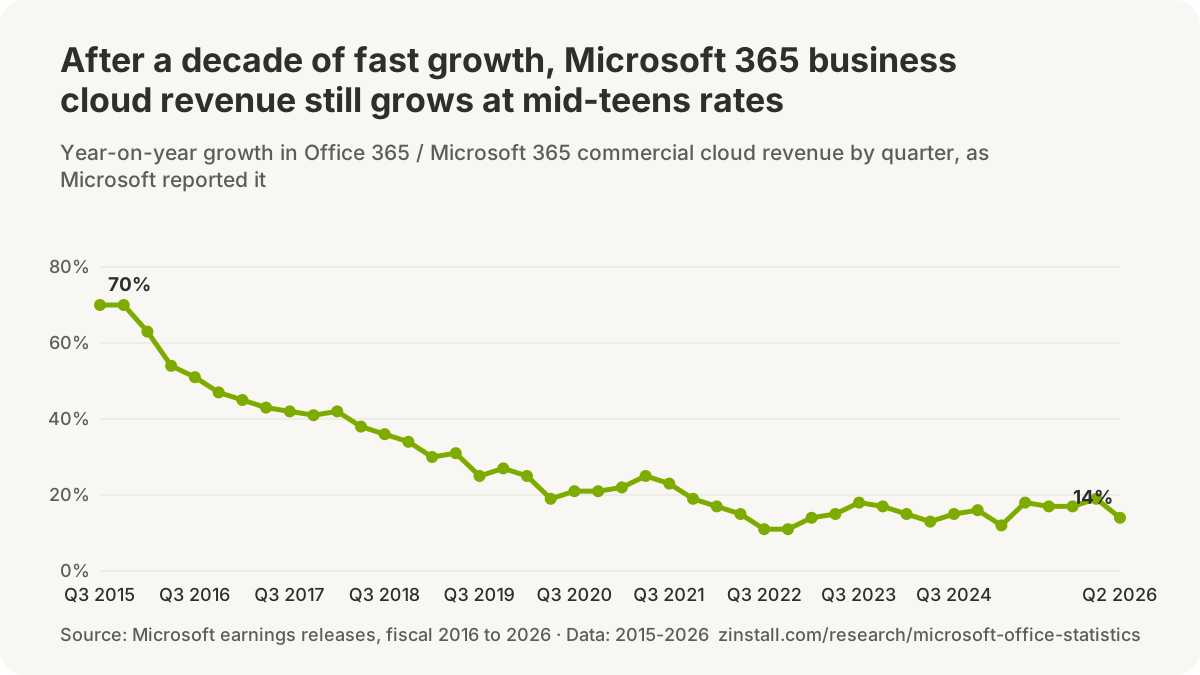

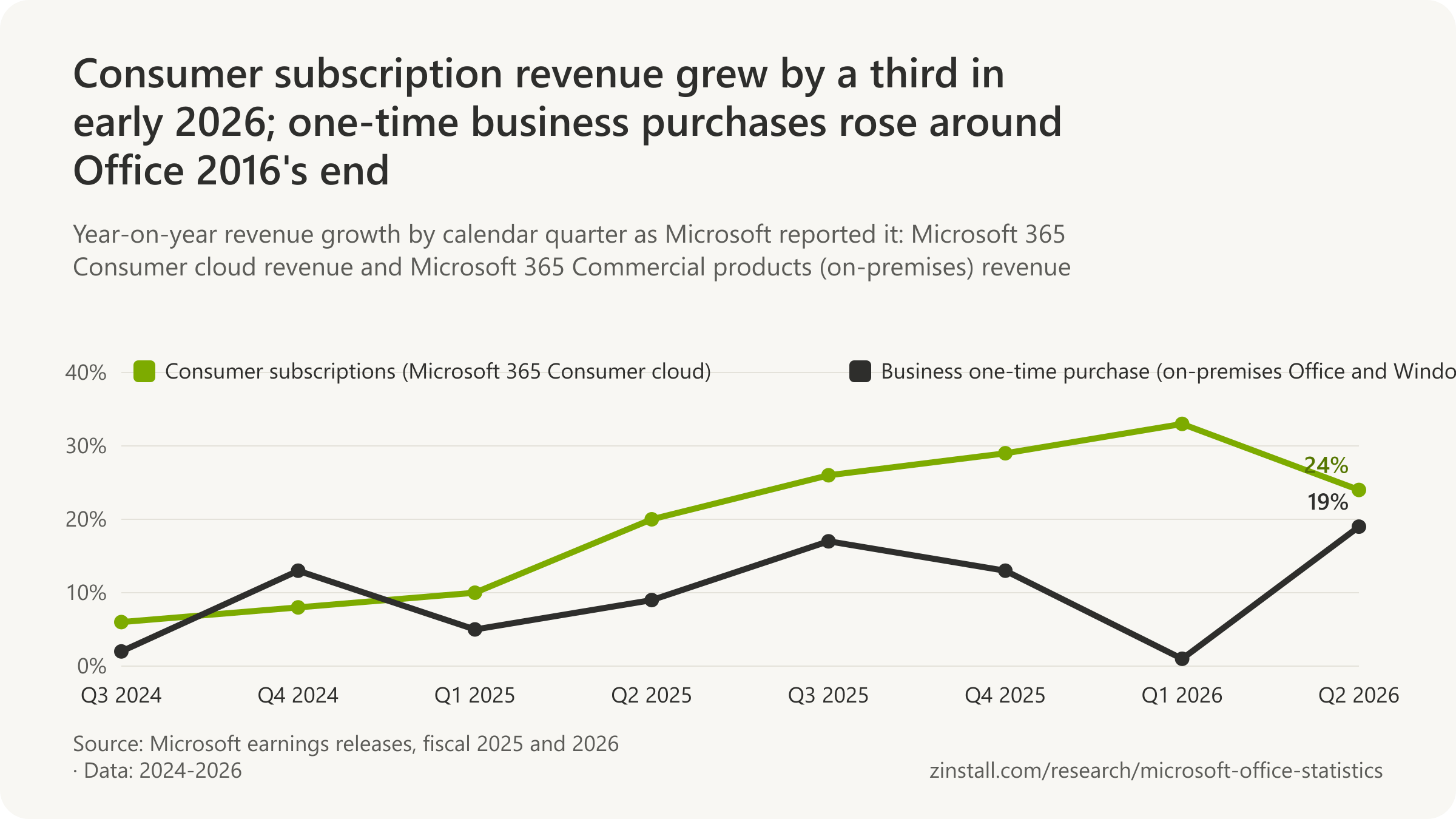
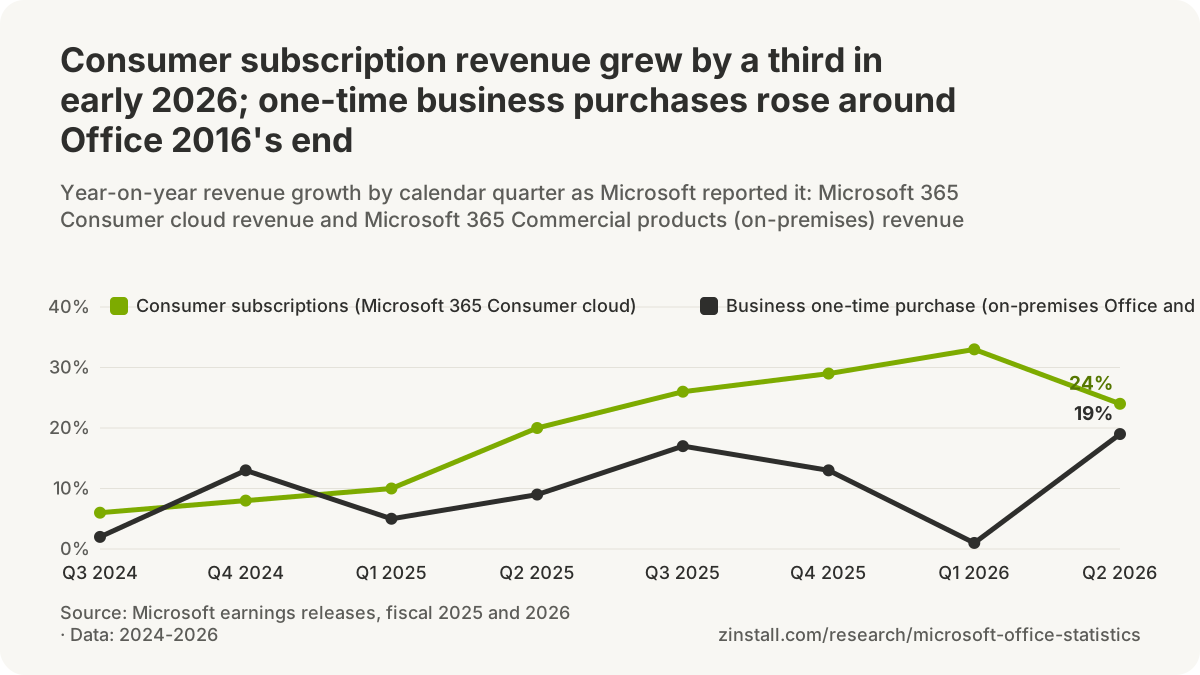
- Microsoft 365 commercial and consumer products and cloud services brought in $111.2 billion combined in Microsoft's fiscal year to June 2026, summed from its 10-K (Microsoft, 2026).
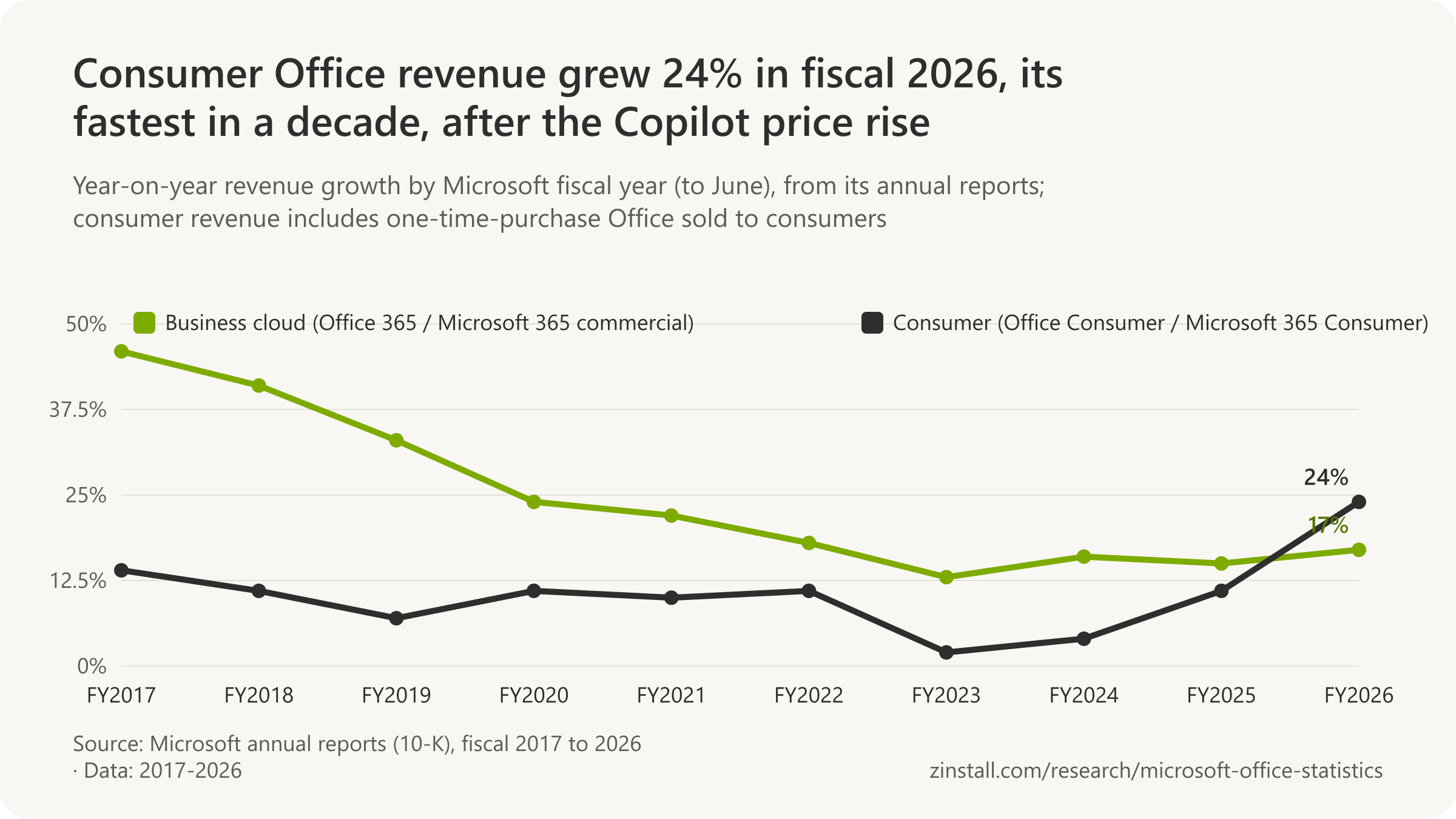
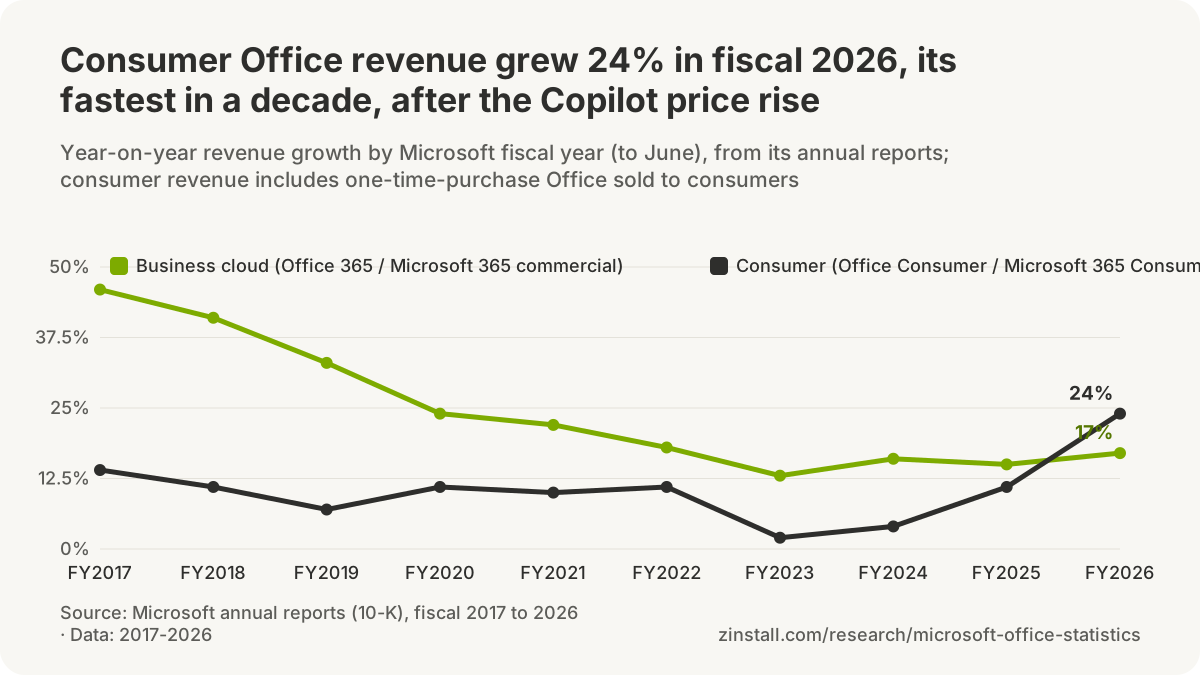
- The continued shift from one-time-purchase Office to Microsoft 365 Consumer subscriptions is one of the two main drivers of Microsoft's consumer Office revenue, its 2026 annual report says, without a split between perpetual and subscription users (Microsoft, 2026).
From one-time purchase to subscription
- Office 365 commercial revenue overtook revenue from Microsoft's traditional Office licensing for the first time in the April to June 2017 quarter, CFO Amy Hood said, the tipping point from perpetual to subscription Office in business (Microsoft, 2017).
- Over 70% of Microsoft's paid Office Commercial installed base was on Office 365 subscriptions by September 2020, leaving under 30% on one-time-purchase business Office, Microsoft said in October 2020 (Microsoft, 2020).
- 45% of Office renewal seats moved to the cloud in the October to December 2014 quarter, Microsoft said in January 2015, as business customers renewing agreements switched to Office 365 (Microsoft, 2015).
- 70% of Office enterprise agreement renewals were in the cloud in mid-2016, Microsoft said on its July 2016 earnings call, up from 45% of renewal seats in late 2014 (Microsoft, 2016).
- 85% of Microsoft's consumer Office revenue came from Microsoft 365 Consumer subscriptions in the July to September 2024 quarter, the rest mainly from one-time-purchase Office, Microsoft said in October 2024 (Microsoft, 2024).
- More Office 365 seats than one-time-purchase Office licences were added with small and medium business customers in each quarter from July 2014 to March 2015, Microsoft said (Microsoft, 2015).
Business prices
| Plan and date | Price |
|---|---|
| Microsoft 365 Business Basic, from March 2022 | $6 (from $5) |
| Microsoft 365 Business Premium, from March 2022 | $22 (from $20) |
| Office 365 E1, from March 2022 | $10 (from $8) |
| Office 365 E3, from March 2022 | $23 (from $20) |
| Office 365 E5, from March 2022 | $38 (from $35) |
| Microsoft 365 E3, from March 2022 | $36 (from $32) |
| Microsoft 365 Business Basic, from July 2026 | $7 (from $6) |
| Microsoft 365 Business Standard, from July 2026 | $14 (from $12.50) |
| Office 365 E3, from July 2026 | $26 (from $23) |
| Microsoft 365 E3, from July 2026 | $39 (from $36) |
| Microsoft 365 E5, from July 2026 | $60 (from $57) |
| Microsoft 365 F1, from July 2026 | $3 (from $2.25) |
| Microsoft 365 F3, from July 2026 | $10 (from $8) |
- 1 March 2022 was the date of the first substantive commercial price rise for Microsoft 365 since Office 365 launched in 2011, which Microsoft announced in August 2021 (Microsoft, 2021).
- Annual Microsoft 365, Office 365 and other business subscriptions paid monthly cost 5% more than those paid up front from 1 April 2025, Microsoft announced in November 2024, as Redmond Magazine reported (Redmond Magazine, 2024).
- Up to 10% was the price rise Microsoft set for Office LTSC 2024, which it called 'a specialty product' kept 'for use in exceptional circumstances' such as offline factory and medical devices (Microsoft, 2024).
- 10% was the price rise for Office LTSC 2021 Professional Plus, Standard and the individual apps, announced in February 2021 alongside shorter five-year support, The Register reported (The Register, 2021).
- 10% was the rise in Office 2019 commercial prices over existing on-premises Office prices from 1 October 2018, Microsoft told partners in July 2018 (Microsoft, 2018).
Consumer prices
- $6.99 a month was the US price of Microsoft 365 Personal in January 2023, unchanged since the consumer subscription launched in 2013, Microsoft said (Microsoft, 2023).
- $9.99 a month was the US price of Microsoft 365 Family (up to six people) in January 2023, unchanged since the consumer subscription launched in 2013, Microsoft said (Microsoft, 2023).
- $1.99 a month or $19.99 a year was the price of Microsoft 365 Basic, a cheaper plan with 100 GB of storage and no desktop Office apps, launched worldwide on 30 January 2023 (Microsoft, 2023).
- Microsoft 365 Personal and Family went up by $3 a month in the US from January 2025, the first price rise since the consumer subscription launched in 2013, as Microsoft added Copilot (Microsoft, 2025).
- Personal Classic and Family Classic, plans without Copilot, were offered for a limited time to existing Microsoft 365 subscribers on recurring billing from January 2025 (Microsoft, 2025).
- $9.99 a month or $99.99 a year is the US price of Microsoft 365 Personal on Microsoft's store in October 2026, after the January 2025 rise of $3 a month (Microsoft, 2026).
- $12.99 a month or $129.99 a year is the US price of Microsoft 365 Family (up to six people) on Microsoft's store in October 2026, after the January 2025 rise of $3 a month (Microsoft, 2026).
- $19.99 a month is the price of Microsoft 365 Premium, the top consumer plan combining Family and Copilot Pro that Microsoft launched in October 2025 (Microsoft, 2025).
- $179.99 is the US price of Office Home 2024, the one-time-purchase Office for one PC or Mac, on Microsoft's store in October 2026, against $99.99 a year for Microsoft 365 Personal (Microsoft, 2026).
- $249.99 is the US price of Office Home & Business 2024, the one-time-purchase Office with Outlook for one PC or Mac, on Microsoft's store in October 2026 (Microsoft, 2026).
- No price change for consumer Office 2024 at release was planned, Microsoft said in March 2024, while it raised Office LTSC prices for organisations by up to 10% (Microsoft, 2024).
- $69.99 a year, or $6.99 a month on monthly billing, was the US price of Microsoft 365 Personal on Microsoft's store in December 2024, the last month before the January 2025 Copilot price rise (Microsoft, 2024).
- $99.99 a year, or $9.99 a month on monthly billing, was the US price of Microsoft 365 Family on Microsoft's store in December 2024, the last month before the January 2025 Copilot price rise (Microsoft, 2024).
- $99.99 a year is the US price of Microsoft 365 Personal on Microsoft's store in October 2026, up from $69.99 before the January 2025 Copilot price rise (Microsoft, 2026).
- $129.99 a year is the US price of Microsoft 365 Family on Microsoft's store in October 2026, up from $99.99 before the January 2025 Copilot price rise (Microsoft, 2026).
- $149.99 was the US price of Office Home 2024, the one-time-purchase Office for one PC or Mac, on Microsoft's store in October 2024, ten days after its release (Microsoft, 2024).
Sources: Microsoft (2014-2026); Redmond Magazine; The Register
What is Microsoft Office's market share against Google Workspace and LibreOffice?
Microsoft took 29.7% of worldwide spending on collaboration software in 2022 and Google 13.5% (IDC via Computerworld, 2023).

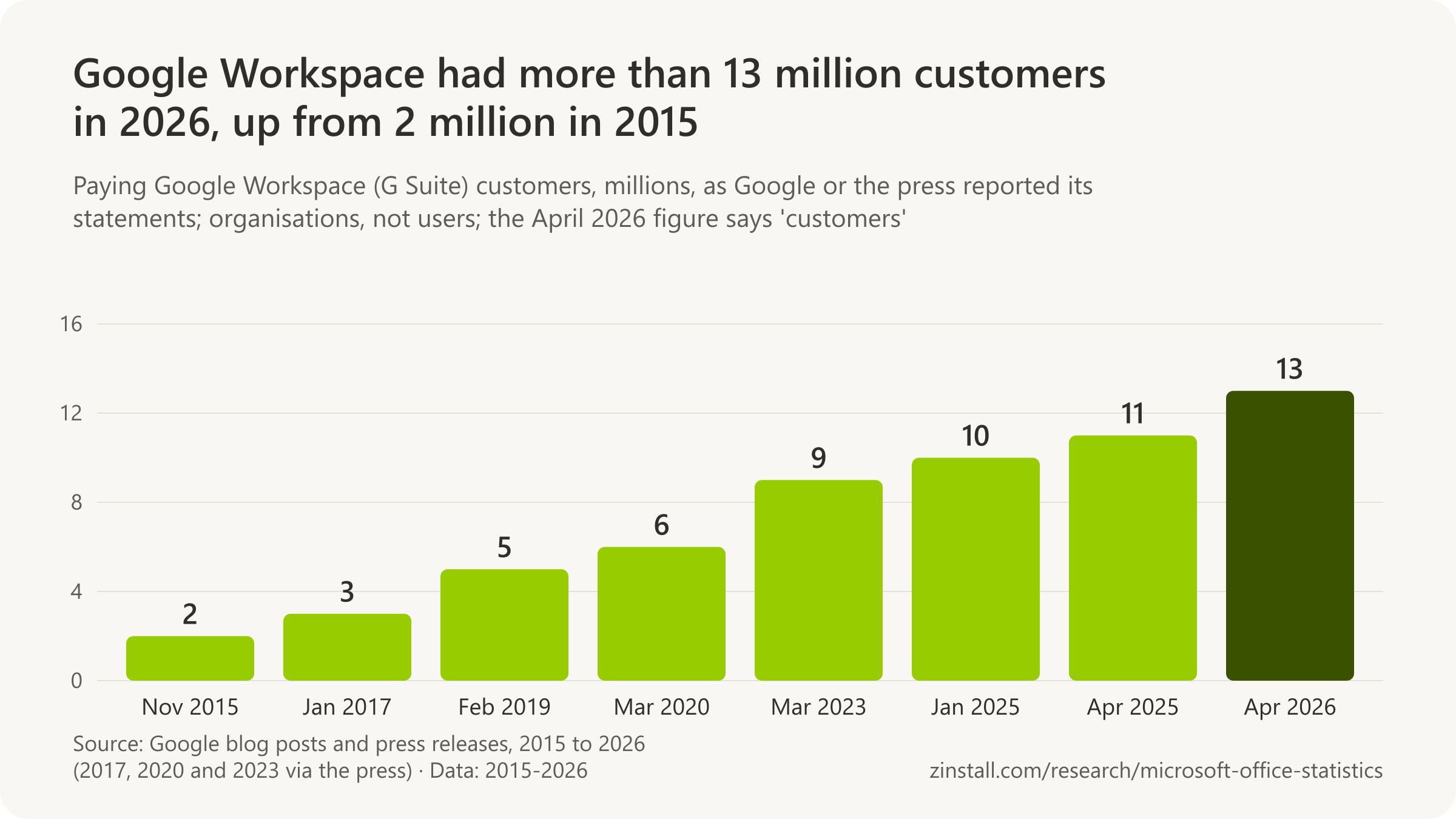
- Google Workspace has more than 13 million customers; its 3 billion users include free Google accounts.
- WPS Office counted 676 million monthly active devices worldwide in June 2026.
- LibreOffice estimates its users at around 100 million, half the figure it gave in January 2025.
- 51% of the Microsoft 365 business customers in Okta's network also used Google Workspace.
- Germany's federal administration had about 473,000 workplaces with Microsoft licences at the end of 2025.
| Suite, measure and date | Count |
|---|---|
| Apache OpenOffice: downloads in 2025 | 11.6 million |
| Apache OpenOffice: downloads since May 2012 | 404.8 million |
| LibreOffice: downloads in 2025 | 44.8 million |
| WPS Office: paying subscribers in China, June 2026 | 48.25 million |
| Google Workspace for Education: users, 2021 | more than 170 million |
| OnlyOffice: users, 2026 | more than 21 million |
| Zoho Workplace: customers, 2026 | over 450,000 |
| Apple iWork: users, 2013 | over 10 million |
| WordPerfect Office: customers, 2005 | more than 20 million |
| openDesk: licences in use in Germany's federal administration, April 2026 | 8,475 |
Sources: Computerworld (2023, 2005); Google (2015-2026); Kingsoft Corporation; The Document Foundation; Okta; Bundesregierung (2026a, 2026b); Apache OpenOffice; Ascensio System SIA; Zoho Corporation; Apple; TechCrunch; CNBC; Business Insider
Moving these programs to a new computer: Microsoft Office · WordPerfect
More statistics (87)
No source measures every office suite in the same unit, so there is no honest worldwide market share for Office. Each rival counts itself its own way: Google counts Workspace customers (organisations), Kingsoft counts WPS Office's monthly active devices, The Document Foundation estimates LibreOffice users from downloads, and Apache OpenOffice publishes only downloads. The independent comparisons are narrower: IDC's spending shares, Okta's customer network and surveys of IT staff.
Google Workspace
- Four million paying customers used G Suite in February 2018, Google CEO Sundar Pichai said with Alphabet's fourth-quarter 2017 results, double the count of two years earlier (TechRadar, 2018).
- More than 3 billion users had Google Workspace once Google opened it to everyone with a Google account in June 2021, Google said in October 2021, a count of accounts including free Gmail users (Google, 2021).

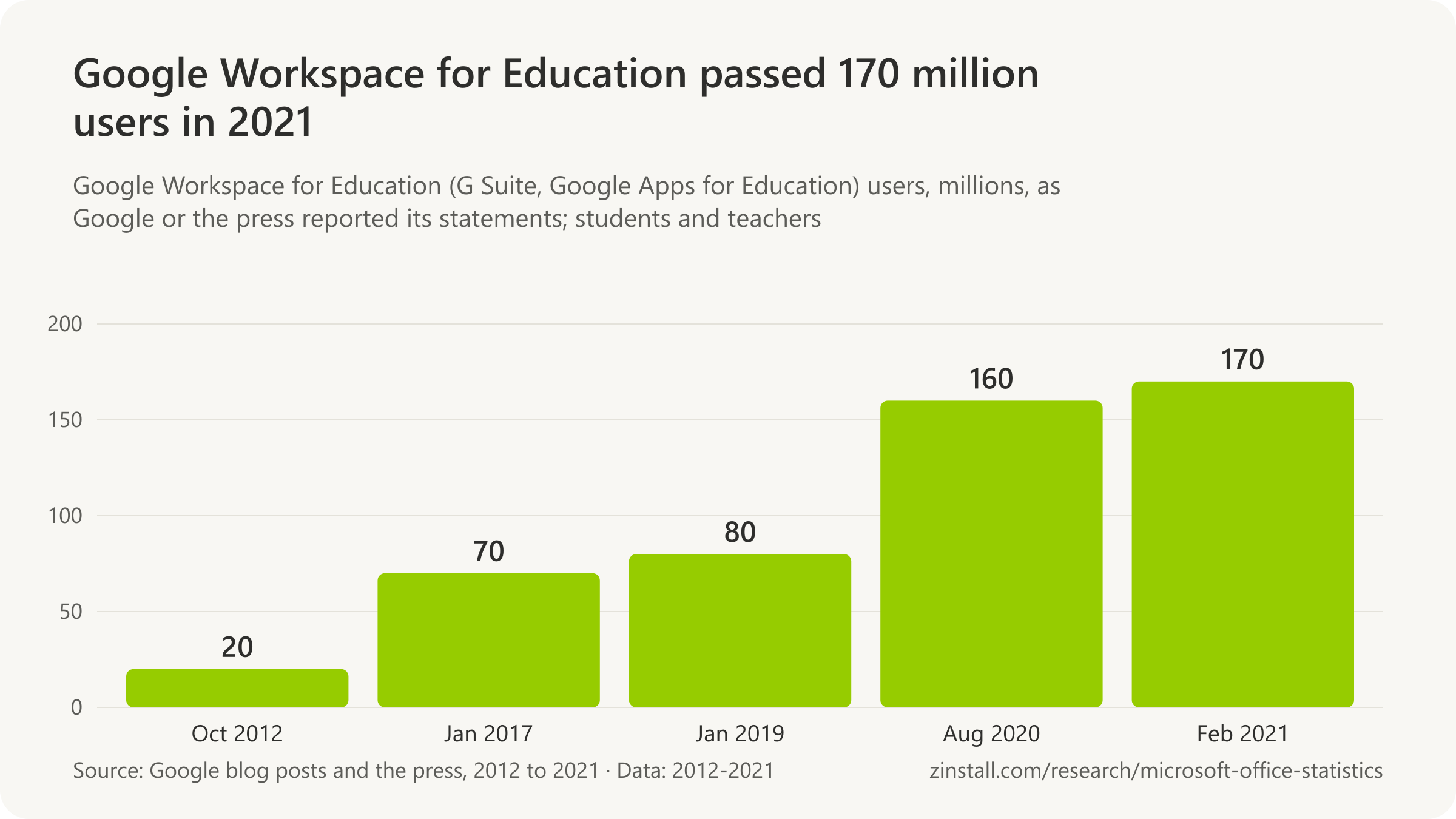
LibreOffice and Apache OpenOffice

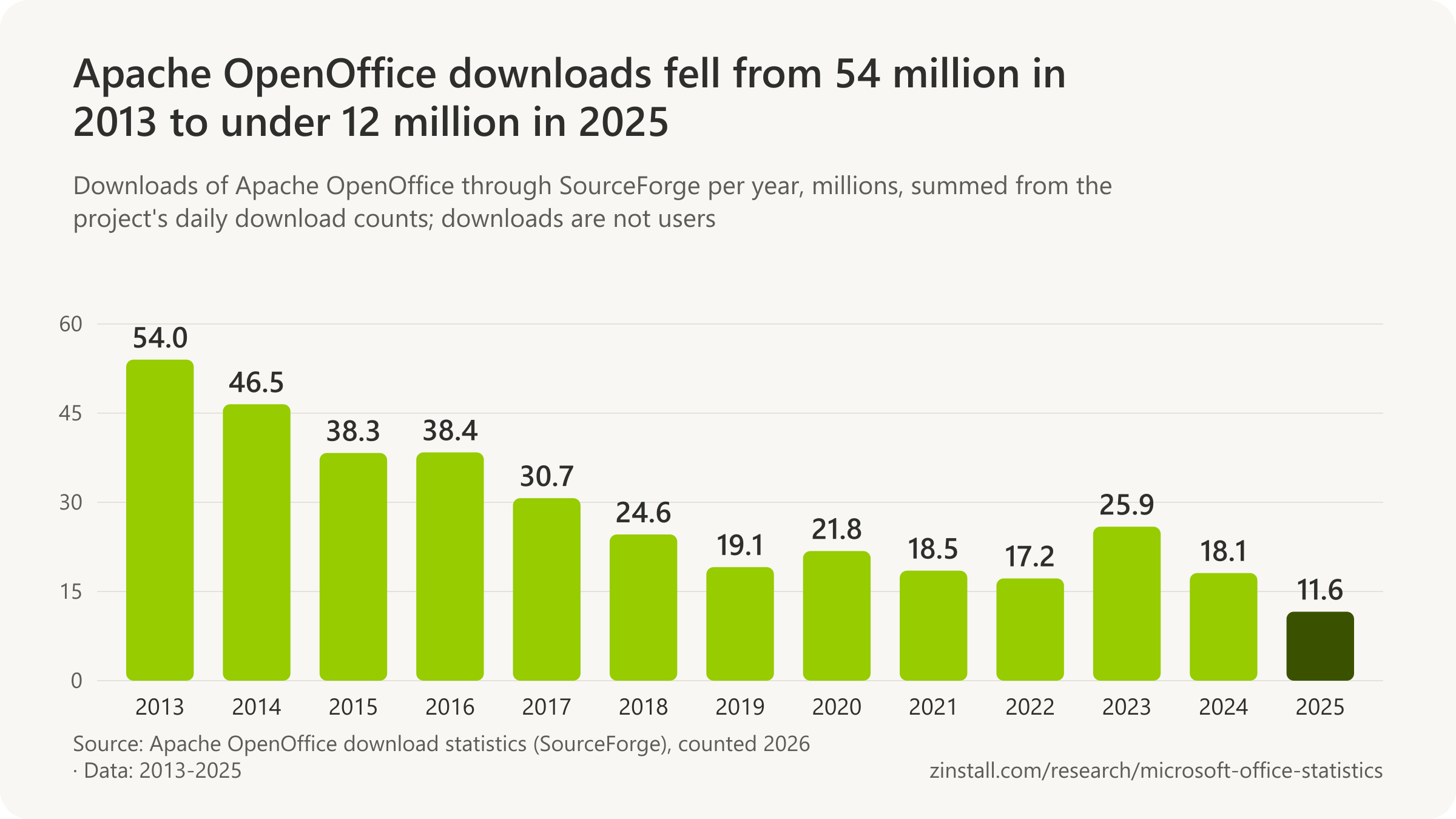
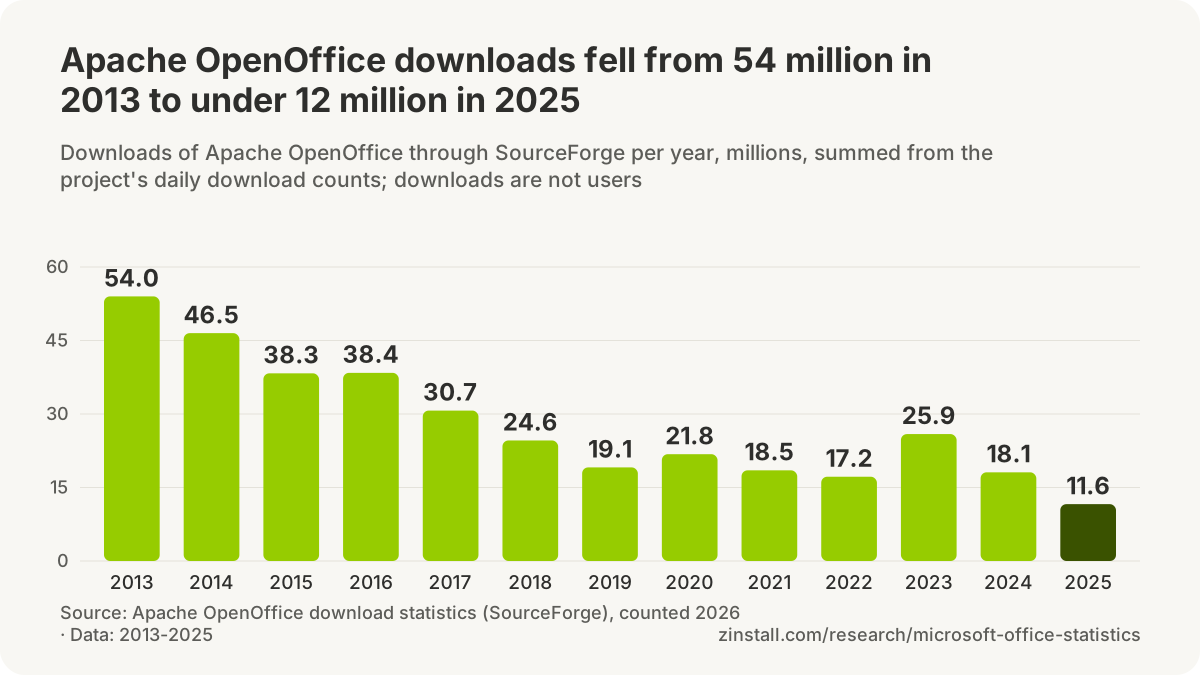

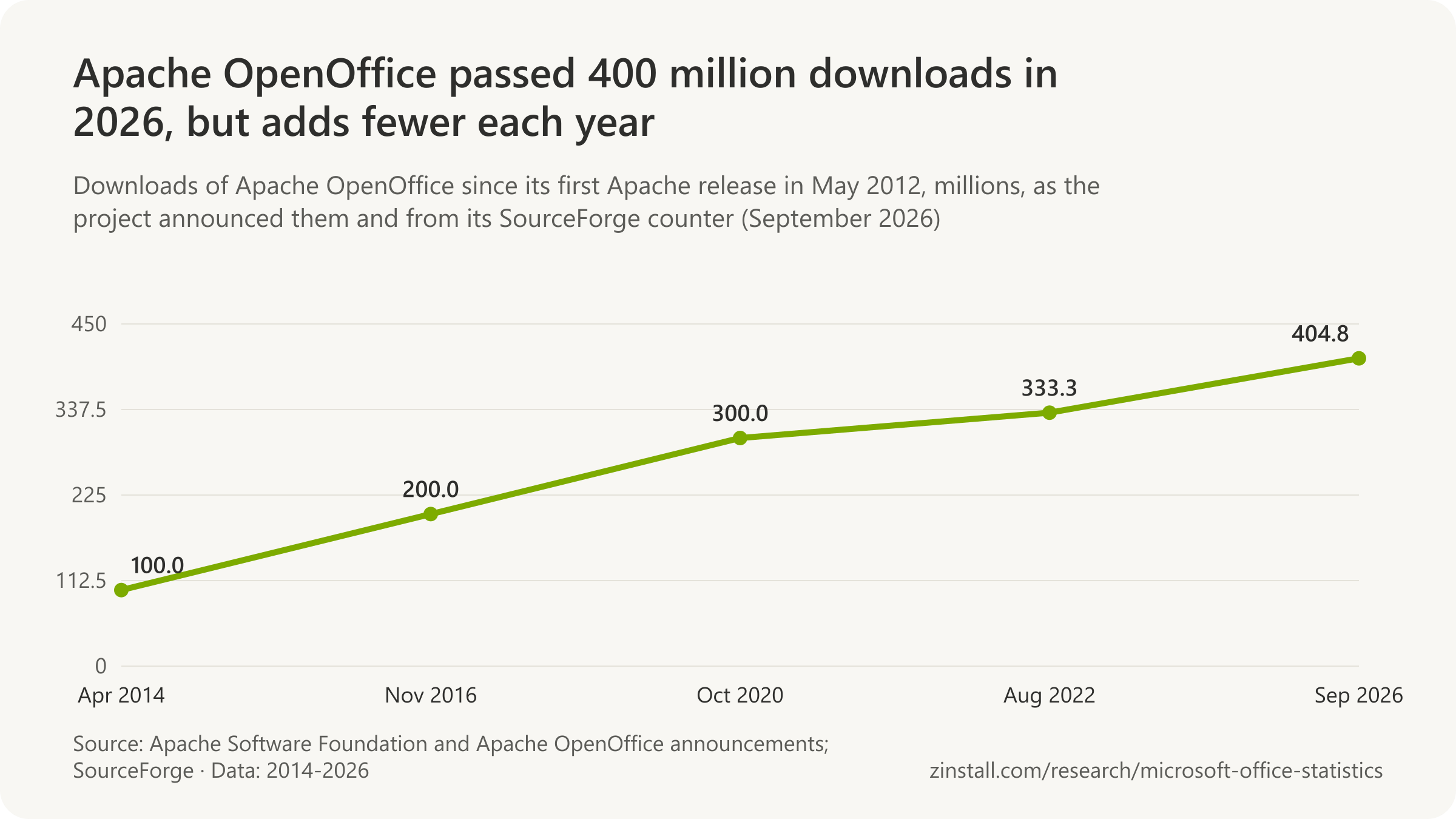
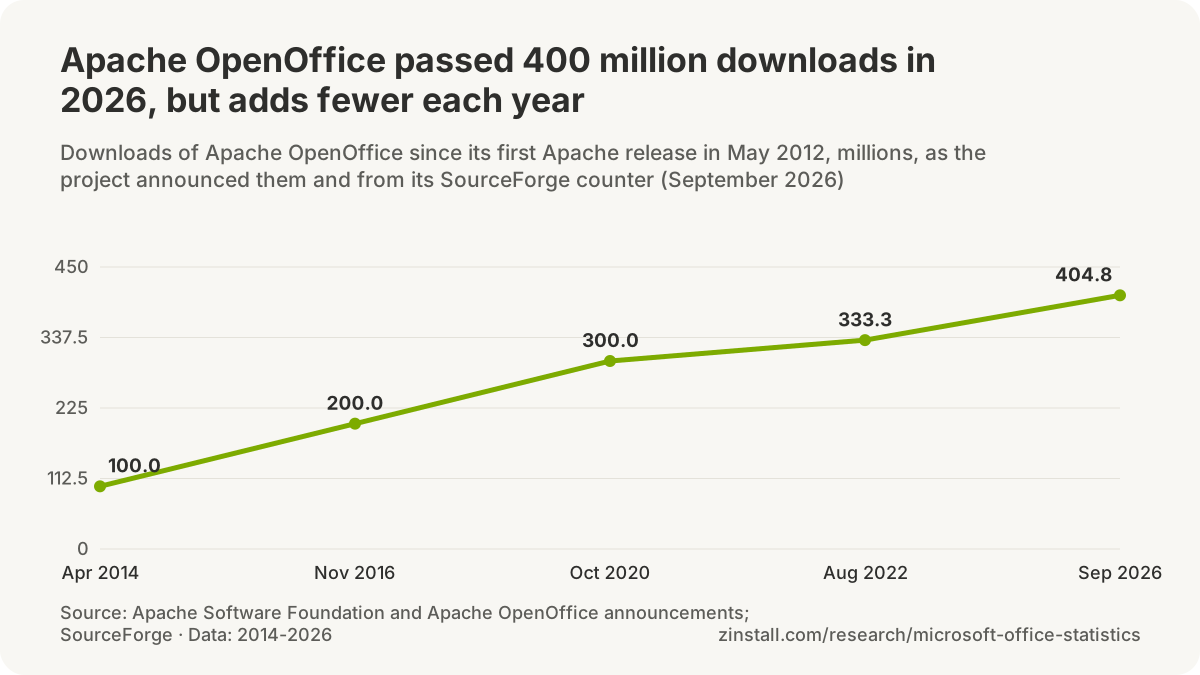
- Around 100 million LibreOffice users, on a conservative basis, is The Document Foundation's own estimate for 2025, with 140 to 180 million on a higher reading of update-page visits (The Document Foundation, 2026).
- 200 million people around the world use LibreOffice, The Document Foundation said in January 2025, an estimate it lowered to around 100 million in June 2026 (The Document Foundation, 2025).
- LibreOffice was downloaded 44.8 million times from its official download page in 2025, the highest annual figure in the project's history, by The Document Foundation's count (The Document Foundation, 2026).
- Over 35 million downloads of LibreOffice were counted in 2024, The Document Foundation said, on an average of 28.6 million a year since 2011 (The Document Foundation, 2025).
- 400 million downloads of LibreOffice since 2011 had been counted by the end of 2024, The Document Foundation said (The Document Foundation, 2025).
- LibreOffice was downloaded 51.2 million times from its official download page in the twelve months from October 2025 to September 2026, by The Document Foundation's count (The Document Foundation, 2026).
- 581.6 million visits to LibreOffice's update page were counted in 2025, not deduplicated, which The Document Foundation uses to gauge its active user base (The Document Foundation, 2026).
- 1,031,162 downloads of LibreOffice 26.8 were counted in its first week (late August 2026), the most for any LibreOffice release, from the official download page only (The Document Foundation, 2026).
- 395,976,603 binary downloads of Apache OpenOffice had been counted in total by 4 January 2026, with version 4.1.16 (10 November 2025) the latest release, the project told the Apache board in January 2026 (Apache Software Foundation, 2026).
- 10 November 2025 is the release date of Apache OpenOffice 4.1.16, the latest version as of October 2026 and the first release in almost two years (Apache OpenOffice, 2025).
- 371,285 installs of LibreOffice (libreoffice) were recorded by Homebrew's macOS app analytics in the 365 days to 14 October 2026, number 11 of 26,054 casks with 1.5% of all cask installs (Homebrew, 2026).
- 17,798 installs of Microsoft Office (microsoft-office) were recorded by Homebrew's macOS app analytics in the 365 days to 14 October 2026, number 211 of 26,054 casks with under 0.1% of all cask installs (Homebrew, 2026).
- 25 million LibreOffice users worldwide was The Document Foundation's estimate in September 2011, a year after the project began, 10 million from downloads and CDs and 15 million on Linux (The Document Foundation, 2011).
- About 120 million LibreOffice users was The Document Foundation's estimate in August 2016, up from 100 million in February 2016, based on download numbers (PCWorld, 2016).
- Close to 120 million downloads of LibreOffice had been counted from September 2010 to the end of 2015, The Document Foundation said, with about 150 million unique addresses checking for updates since 2012 (The Document Foundation, 2016).
- 15 million unique IP addresses downloaded LibreOffice for Windows and macOS in 2012, rising from just over 200,000 a week in January to well over 600,000 in December, The Document Foundation said (The Document Foundation, 2012).
WPS Office (Kingsoft)

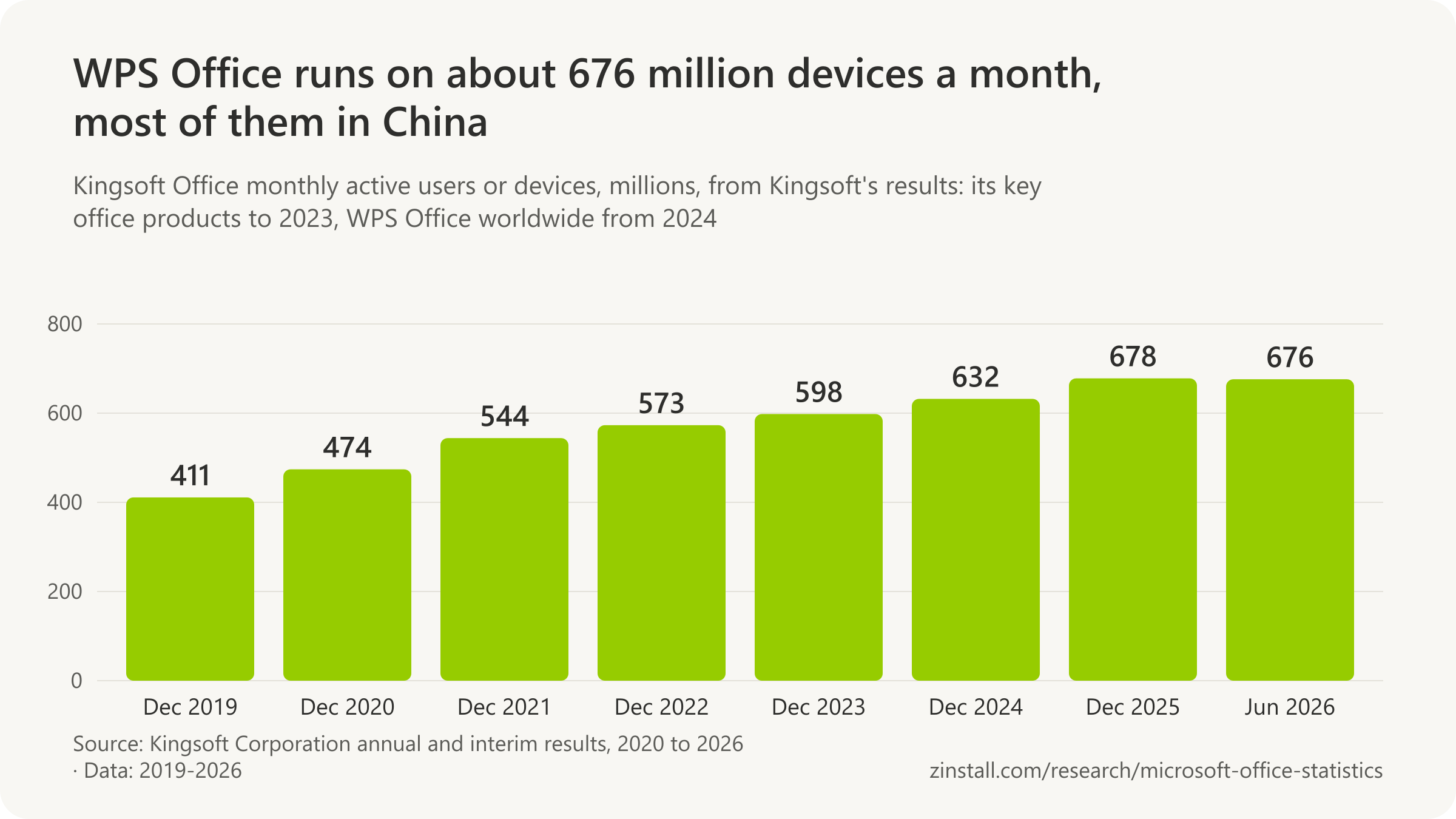

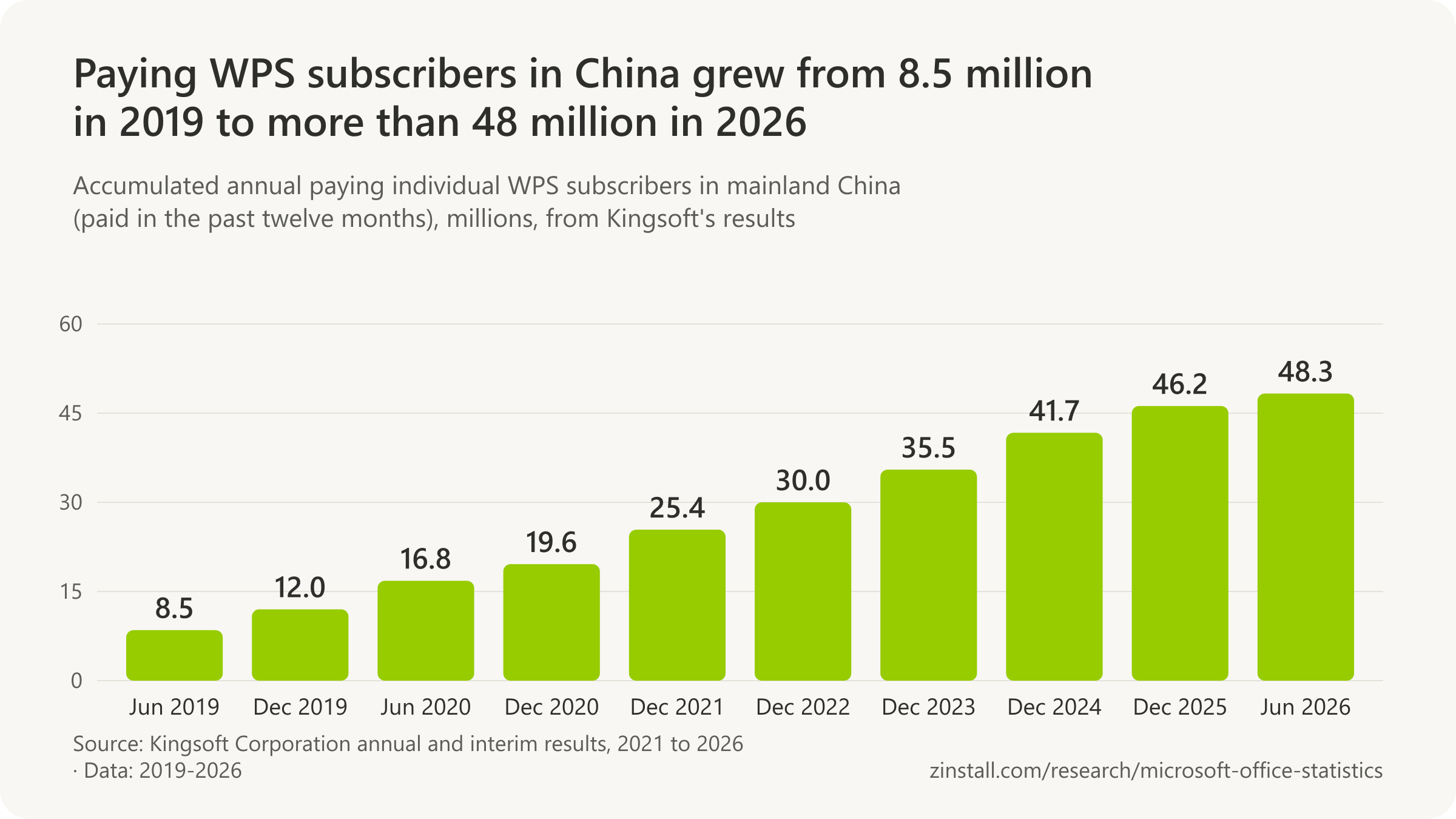
- WPS had 2.85 million paying individual subscribers outside mainland China over the twelve months to December 2025, up 64% in a year, Kingsoft Corporation reported, its first overseas disclosure (Kingsoft, 2026).
- 5.93 billion yuan of revenue came from Kingsoft's office software and services business (WPS) in 2025, up 16% in a year, Kingsoft Corporation reported (Kingsoft, 2026).
Other suites
- Over 10 million iWork users (Pages, Numbers and Keynote) was the figure Apple gave in January 2013, the only iWork user count Apple has published; iWork became free in 2013 and 2017 (Apple, 2013).
- More than 21 million users trust ONLYOFFICE worldwide, its developer Ascensio System says on its home page in October 2026, a claim with no stated method (ONLYOFFICE, 2026).
- Over 450,000 customers use Zoho Workplace (Zoho's mail and office suite), Zoho says on its product page in October 2026 (Zoho, 2026).
- More than 20 million customers worldwide used WordPerfect Office 12, Corel said in March 2005, the last user figure published for WordPerfect (Computerworld, 2005).
- 5 million ONLYOFFICE users was the count its developer Ascensio System gave in July 2018, adding it was not sure it had counted everyone (ONLYOFFICE, 2018).
- Over 10 million users worldwide had chosen ONLYOFFICE by August 2022, its developer Ascensio System said when opening a Singapore office (Ascensio System, 2022).
- More than 16 million users had Zoho Workplace, Zoho's mail and office suite, in February 2022, Zoho said, citing migrations after Google ended its free legacy Workspace edition (Help Net Security, 2022).
- No user or download count is published for SoftMaker Office or the free FreeOffice suite: SoftMaker's About page in October 2026 describes the German company's office software since 1987 without a figure (SoftMaker, 2026).
- No user count is published for WordPerfect Office by its owner Alludo (formerly Corel): its home page in October 2026 calls it a 'trusted productivity suite' without a figure, so Corel's 20 million customers of 2005 remain the last number (Alludo, 2026).
Microsoft against Google: independent counts
- Office 365 became the most deployed app by number of business customers in Okta's network in January 2015, overtaking Salesforce, which had led since Okta began tracking in 2012 (Okta, 2015).
- Office 365 remained the most popular app by number of customers in Okta's network in 2015, followed by Salesforce, Box and Google Apps (Okta, 2016).
- Office 365 remained the most popular app by number of customers in Okta's network in 2016, ahead of Salesforce and Box, while Amazon Web Services passed G Suite for fourth place (Okta, 2017).
- 29 apps on average were used by Okta's G Suite customers in 2016, against 22 for its Office 365 customers (Okta, 2017).
- Office 365 was still the most popular app by number of customers in Okta's network in the year to October 2017, a lead it had held since January 2015 (Okta, 2018).
- Office 365 led Okta's ranking of the most popular business apps by number of customers in the year to October 2018, and increased its lead (Okta, 2019).
- Office 365 and Salesforce held first and second place by number of customers in Okta's network for the sixth year in a row in the year to October 2019 (Okta, 2020).
- Microsoft 365 kept first place by number of customers in Okta's network in the year to October 2020, while AWS took second place from Salesforce for the first time since 2015 (Okta, 2021).
- Microsoft 365 remained the most popular app by number of customers in Okta's network in the year to October 2021, ahead of AWS, Google Workspace, Salesforce and Zoom (Okta, 2022).
- Microsoft 365 kept first place by number of customers in Okta's network in the year to October 2022, while Google Workspace grew faster (32% against 21%) (Okta, 2023).
- Microsoft 365 was the most popular app by number of customers in Okta's network in the year to October 2023, and Google Workspace took second place for the first time (Okta, 2024).
- Microsoft 365 was the most popular app by number of customers in Okta's network in 2024, followed by Google Workspace, AWS, Salesforce and Zoom (Okta, 2025).
- Microsoft 365 was the most popular app by number of customers in Okta's network in the year to October 2025, followed by Google Workspace, AWS, Salesforce and Zoom (Okta, 2026).
- 51% of Okta's customers that use Microsoft 365 also used Google Workspace in November 2024 to October 2025, the first time over half, Okta's Businesses at Work 2026 report found (Okta, 2026).
- 28% of Okta's Office 365 customers also subscribed to G Suite in late 2018, 'double bundling' themselves, Okta's Businesses at Work 2019 report found (Okta, 2019).
- 31% of Okta customers with Office 365 also used G Suite in 2019, up from 28% a year earlier and 21% in 2016, TechTarget reported from Okta's Businesses at Work 2020 report (TechTarget, 2020).
- 8.5% of public companies used Office 365 for cloud email and 4.7% used Google Apps for Work, in Gartner's 2016 scan of nearly 40,000 companies' email routing records (Gartner, 2016).
- 67% of US knowledge workers preferred Microsoft Word over Google Docs and 15% the opposite, in Okta's survey of over 1,200 workers in December 2018 and January 2019 (Okta, 2019).
- 34.8% of organizations used Office 365 as their cloud productivity suite and 25% used G Suite in 2016, in Bitglass's scan of more than 120,000 companies (BetaNews, 2016).
- 56.3% of organizations used Office 365 in 2018, up from 34.3% a year earlier, while G Suite held at about 25%, in Bitglass's cloud adoption report (BetaNews, 2018).
- 43% of US school-district technology decision-makers said their schools ran primarily on Google Workspace, 41% on Google Workspace and Microsoft 365, and 9% on Microsoft 365 alone, in a 2021 EdWeek Research Center survey sponsored by ManagedMethods (ManagedMethods, 2021).
- 17% of organizations used Google's G Suite and 16% Google's free productivity apps in 2017, against 82% using on-premises Microsoft Office and 53% Office 365, in Spiceworks' survey of 1,168 IT professionals in the US, Canada and the UK (Spiceworks, 2017).
- 16% of organizations used open-source office suites such as LibreOffice and OpenOffice and 3% Apple iWork for iCloud in 2017, in Spiceworks' survey of 1,168 IT professionals in the US, Canada and the UK (Spiceworks, 2017).
- 29.7% of worldwide spending on collaboration software went to Microsoft in 2022 and 13.5% to Google, ahead of Zoom (11.2%), Salesforce (7.6%) and Cisco (3.2%), by IDC's estimate reported by Computerworld (Computerworld, 2023).
Governments and public bodies
| Body, measure and year | Count |
|---|---|
| Schleswig-Holstein: state employees with LibreOffice as standard, 2024 | about 30,000 |
| Schleswig-Holstein: mailboxes moved off Microsoft Exchange, 2025 | more than 40,000 |
| Schleswig-Holstein: state workplaces on LibreOffice, 2025 | nearly 80% |
| Schleswig-Holstein: licence savings, 2025 | more than 15 million euros |
| Denmark, digital ministry: staff moving to LibreOffice, 2025 | half |
| Lyon: target for open-source office software, 2022 | 80% |
| Lyon: PCs moved to OnlyOffice each month, 2025 | 300 to 350 a month |
| Lyon: hosted suite against Office 365, cost, 2025 | three times cheaper |
| Munich: workplaces on LiMux, 2013 | over 14,800 |
| Munich: LiMux savings, 2013 | more than 11.7 million euros |
| Munich: cost of returning to Windows and Office, 2017 | 49.3 million euros |
| French gendarmerie: PCs on OpenOffice, 2005 | 70,000 |
| Austrian armed forces: PCs moved to LibreOffice, 2025 | 16,000 |
| Italian defence ministry: LibreOffice users planned by 2017 | 75,000 by 2017 |
| Toulouse: desktops on LibreOffice, 2014 | 90% |
| German federal administration: workplaces with Microsoft licences, 2025 | about 473,000 |
| German Foreign Office: workplaces with only LibreOffice, 2026 | 12,030 |
| German federal administration: openDesk licences in use, 2026 | 8,475 |
| German federal government: Microsoft licence costs, 2024 | 204.5 million euros |
| German federal government: Microsoft licence spending, 2025 | 481.4 million euros |
| openDesk: public-administration workplaces, 2026 | 100,000 |
| Dutch tax administration: staff leaving Microsoft 365's cloud, 2026 | about 5,000 of 47,500 |
| Swiss federal administration: openDesk pilot workplaces, 2026 | 3,000 of 54,000 |
Numbers in circulation
- Computerworld reported in March 2025 that The Document Foundation estimated around 200 million LibreOffice users while saying it does not track users and cannot be sure (Computerworld, 2025).
- TechCrunch reported in February 2010 that OpenOffice.org had been downloaded 300 million times since 2002, the Sun-era count that roundups confuse with Apache OpenOffice's 2020 milestone (TechCrunch, 2010).
- WPS Office has more than 600 million monthly active users, WPS's own About page says, recasting its parent's monthly active devices as users (WPS, 2026).
- About Chromebooks wrote in February 2026 that Google Workspace had over 3 billion monthly active users and 11 million paying customers 'according to Alphabet's Q4 2025 earnings report', two claims Google's own sources do not support (About Chromebooks, 2026).
- Wikipedia's Google Workspace article states that Google Workspace had 9 million paying businesses as of October 2021, misdating a figure Google gave Business Insider in March 2023 (Wikipedia, 2026).
- Almost 68% of US school districts used G Suite against 17% for Office 365 Education, Thurrott.com reported in May 2017 from an EdWeek Market Brief survey (Thurrott.com, 2017).
- Google Workspace holds 73.42% of 6sense's Office Suites category against 16.39% for Microsoft Office, a September 2026 roundup reported, a count of tracked customer domains rather than users or revenue (Makerstations, 2026).
- Google Workspace holds 50.34% of the office productivity tools category against 45.46% for Microsoft 365, a July 2026 statistics roundup said, citing 6sense technographic data in a different category from 6sense's Office Suites (SQ Magazine, 2026).
- 8,156,511 companies use Microsoft Office 365, about 31.5% of its office productivity category, by technographics vendor Enlyft's count in October 2026, against 8,007,989 (about 30.9%) for Google Apps (Enlyft, 2026).
- More than 8 million customers pay for Google Workspace, a June 2025 statistics roundup said, citing 'Google, Patronum', a figure Google never published: its own counts went from 6 million (2020) to over 9 million (2023) and 10 million (2025) (Exploding Topics, 2025).
- WPS covers over 80% of China's government and enterprise market, a financial news report said in October 2025 without naming a source, after China's Ministry of Commerce published export-control attachments in WPS format for the first time (Deep News via Tiger Brokers, 2025).
Sources: TechRadar; Google (2017, 2020, 2021); The Document Foundation (2011-2026); The Apache Software Foundation (2014, 2026); Apache OpenOffice (2016-2026); Homebrew; PCWorld; Kingsoft Corporation (2020-2026); Apple; Ascensio System SIA (2018, 2022, 2026); Zoho Corporation; Computerworld (2005-2025); Help Net Security; SoftMaker Software GmbH; Alludo; Okta (2015-2026); TechTarget; Gartner; BetaNews (2016, 2018); ManagedMethods; Spiceworks; Land Schleswig-Holstein (2024, 2025); heise online (2025); LyonMag; Les Numériques; The Register; ZDNet France; European Commission, Open Source Observatory (2014, 2016); Bundesregierung (2026); Stuttgarter Zeitung; Deutsche Rentenversicherung Bund; The Next Web; Born City; TechCrunch (2010, 2012); WPS Software; About Chromebooks; Wikipedia; Thurrott.com; Makerstations; SQ Magazine; Enlyft; Exploding Topics; Deep News; 9to5Google
What happens next for Office?
Microsoft 365 Apps keep getting security updates on Windows 10 until 10 October 2028, three years after Windows 10's end (Microsoft, 2026).

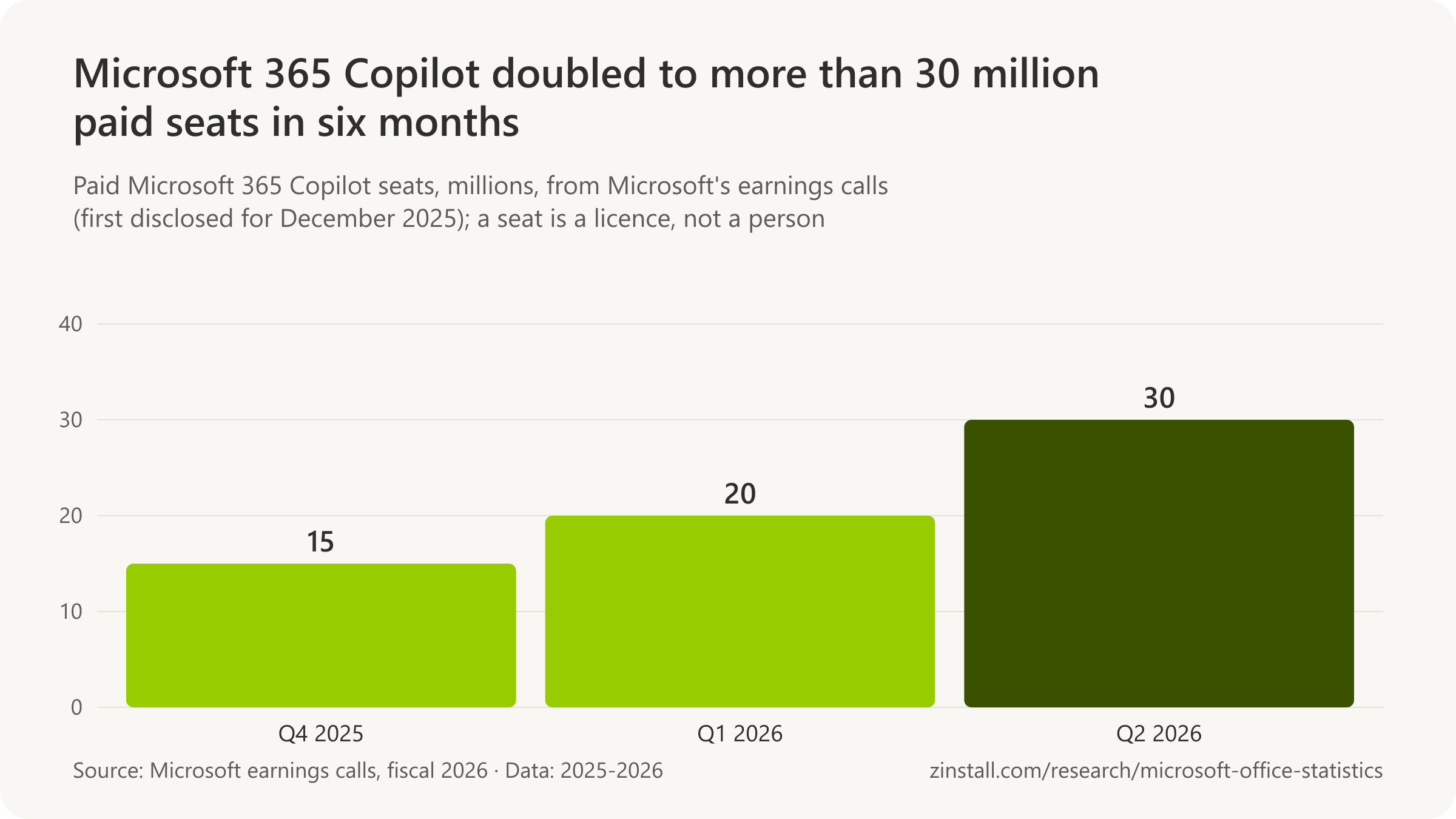
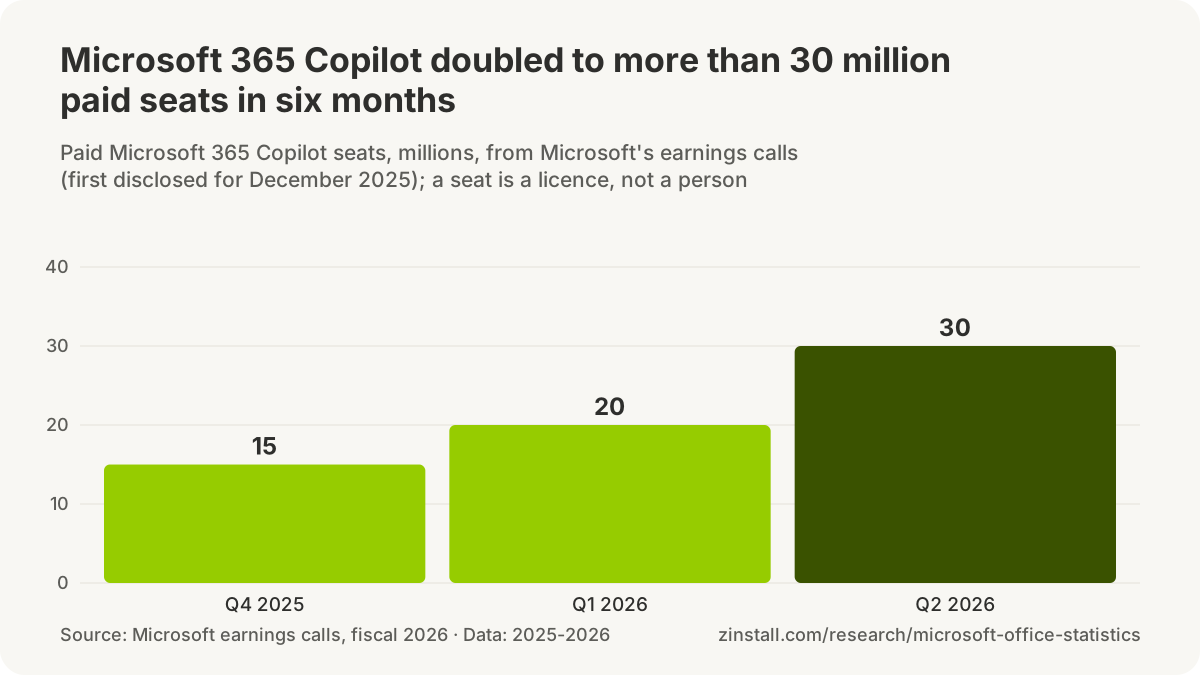
- About 7% of Microsoft 365 business seats carried a paid Copilot seat by mid-2026.
- The new Outlook for Windows becomes the default for enterprise customers in March 2027, postponed from April 2026.
- Microsoft will support existing classic Outlook installations until at least 2029.
- Microsoft has promised one more Office LTSC release after Office LTSC 2024, its only commitment to a future one-time-purchase Office.
- Microsoft expects its on-premises business Office and Windows revenue to fall by a mid-single-digit percentage in the year to June 2027.
| Product and milestone | Date or price |
|---|---|
| Office 2024 for Mac and Office LTSC 2024 for Mac: end of support | 9 October 2029 |
| Outlook 2024 and Outlook LTSC 2024: end of support | 9 October 2029 |
| Visio 2024 and Visio LTSC 2024: end of support | 9 October 2029 |
| Access 2024: retirement | 9 October 2029 |
| Microsoft 365 Apps on Windows 10: last version with new features | Version 2608 |
| New Outlook as the default, as planned in November 2024: business plans, then enterprise | January 2025 (business plans); 2026 (enterprise) |
| Microsoft 365 Copilot: list price per user a month, 2023 | $30 per user per month |
| Microsoft 365 Copilot Business: price per user a month, 2026 | $21 per user per month |
Sources: Microsoft (2023, 2024, 2026); GeekWire
Moving these programs to a new computer: Outlook · Microsoft 365
More statistics (24)
The next fixed dates are October 2028, when Microsoft 365 Apps stop getting security updates on Windows 10, and 9 October 2029, when Office 2024 and Office LTSC 2024 reach their end of support. Microsoft has promised one more Office LTSC release and no new consumer one-time-purchase version. In between, the new Outlook replaces the classic one in stages, and Copilot is sold as a paid add-on seat.
Dates ahead
- Microsoft 365 Apps on Windows 10 keep receiving security updates for three years after Windows 10's end of support, until 10 October 2028 (Microsoft, 2026).
- Microsoft 365 Apps on Windows 10 stop receiving feature updates at Version 2608, the August 2026 build, and then receive only security updates until 10 October 2028 (Microsoft, 2026).
- 9 October 2029 is the retirement date of Access 2024, the one-time-purchase database app released on 1 October 2024, five years after release under the Modern Lifecycle Policy (Microsoft Lifecycle, 2024).
- 9 October 2029 is the end of support for Visio 2024 (Standard and Professional) and Visio LTSC 2024, the one-time-purchase versions of Microsoft's diagramming app, while the Visio Plan 2 subscription has no end date (Microsoft Lifecycle, 2024).
- 9 October 2029 is the end of support for Outlook 2024 and Outlook LTSC 2024, the newest one-time-purchase versions of classic Outlook for Windows, matching the 'at least 2029' Microsoft promised classic Outlook in 2024 (Microsoft Lifecycle, 2024).
- Another Office LTSC release after Office LTSC 2024 was promised by Microsoft in March 2024, the only public commitment to a future perpetual Office version (Microsoft, 2024).
- Office LTSC 2024, the perpetual volume-licensed version, is 'designed for specific scenarios' such as regulated devices that cannot take feature updates, factory process-control machines and systems that cannot connect to the internet, Microsoft tells organisations still on Office 2016, 2019 or LTSC 2021 (Microsoft, 2026).
- Office LTSC 2024 is Microsoft's recommended upgrade only for organisations 'not yet ready to move to the cloud', its 2026 Office LTSC 2021 end-of-support notice says, with Microsoft 365 Apps the default path (Microsoft Lifecycle, 2026).
Outlook
- Until at least 2029 Microsoft will honour the published support timelines of existing classic Outlook for Windows installations, perpetual and subscription, it said when setting out the new Outlook's opt-in, opt-out and cutover stages (Microsoft, 2024).
- 1 August 2024 was when the new Outlook for Windows became generally available for business customers, still as an opt-in app, after reaching personal accounts in September 2023 (Microsoft, 2024).
- January 2025 for small businesses and 2026 for enterprise customers were the dates Microsoft gave at Ignite 2024 for moving the new Outlook from opt-in to the opt-out phase, in which it becomes the default (Microsoft, 2024).
- March 2027 is when the new Outlook for Windows becomes the default (the opt-out phase) for enterprise customers, Microsoft told administrators in February 2026, postponing the April 2026 date it had set in December 2024 (Microsoft, 2026).
- Users on a perpetual Office licence will not be migrated to the new Outlook when the enterprise opt-out phase starts in March 2027, nor will on-premises accounts or users whose admins hide the toggle, Microsoft's Message Center notice says (Microsoft, 2026).
- 31 December 2024 was the end of support for the Windows Mail, Calendar and People apps, which Microsoft replaced with the new Outlook for Windows (Microsoft Support, 2026).
Copilot
- 3.3% of Microsoft 365's paid commercial seats had a paid Microsoft 365 Copilot seat at the end of December 2025 (15 million of more than 450 million), derived from Microsoft's January 2026 earnings call (Microsoft, 2026).
- Nearly 70% of Fortune 500 companies were using Microsoft 365 Copilot by September 2024, Microsoft said on its October 2024 earnings call (Microsoft, 2024).
- Nearly 60% of Fortune 500 companies were using Microsoft 365 Copilot by March 2024, Microsoft said on its April 2024 earnings call (Microsoft, 2024).
- More than 90% of Fortune 500 companies were using Microsoft 365 Copilot by September 2025, Microsoft said on its October 2025 earnings call (Microsoft, 2025).
- About 7% of Microsoft 365's paid commercial seats carried a paid Microsoft 365 Copilot seat by mid-2026, GeekWire calculated from Microsoft's figures of 30 million Copilot seats and more than 450 million commercial seats (GeekWire, 2026).
- $30 per user per month was the list price Microsoft set for Microsoft 365 Copilot for business customers on Microsoft 365 E3, E5, Business Standard and Business Premium, announced in July 2023 (Microsoft, 2023).
- $21 per user per month is the list price of Microsoft 365 Copilot Business, the Copilot add-on for small business plans, on Microsoft's US business plan page in October 2026 (Microsoft, 2026).
Microsoft's outlook
- A mid-single-digit decline in Microsoft's on-premises commercial Office and Windows revenue is expected for the year to June 2027, as Microsoft laps the one-time purchases that followed product launches (Microsoft, 2026).
Numbers in circulation
- 20 million paid Copilot users is how TechCrunch's April 2026 headline restated Microsoft's over 20 million paid Microsoft 365 Copilot seats, turning seats into users (TechCrunch, 2026).
- More than 20 million enterprise users paying for Copilot, up from 15 million paying customers in January, is how Computerworld restated Microsoft's paid Microsoft 365 Copilot seat counts in May 2026, citing TechCrunch rather than Microsoft (Computerworld, 2026).
Sources: Microsoft (2023-2026); GeekWire; TechCrunch; Computerworld
Data. All 798 statistics on this page, each with its source, verbatim quote and locator: CSV · JSON. Charts and figures on this page may be reused with a link to https://www.zinstall.com/research/microsoft-office-statistics as the source. Original publishers retain attribution.
Data behind each chart (CSV, 29 files)
- Office 2021 and 2024 get five years of support, half the ten years Office 2003 to 2016 got
- Microsoft 365 business seats grew from 258 million to more than 450 million in under six years
- Office 2016 is still the most common version at small German firms, almost a year after its support ended
- Office 2003 was still in almost half of organisations in 2017, three years after its support ended
- Microsoft kept fixing Office 2016 and 2019 for 11 months after their support ended
- Microsoft fixed 497 security flaws in desktop Office in 2026 to October, three times 2025's count
- Office 2019 took about three years to reach a third of small German firms' Office PCs
- Microsoft's one-time-purchase business Office revenue shrank every year to 2024, then grew with Office 2024
- Google Workspace had more than 13 million customers in 2026, up from 2 million in 2015
- Microsoft 365 Copilot doubled to more than 30 million paid seats in six months
- Microsoft 365 consumer subscribers grew from 4.4 million in 2014 to nearly 95 million in 2026
- Office 365 had 200 million monthly business users in 2019; Microsoft has since reported seats instead
- Growth in Microsoft 365 business seats slowed from 74% a year in 2015 to 6% in 2026
- At small German firms, Office 2019, 2021 and 2024 replaced Office 2010 and 2013 while Office 2016 held at about a third
- Four in five small German firms' Office PCs run a version without security updates
- More than 300 flaws were fixed in each of Office 2016 and 2019 after their support ended
- Office vulnerabilities in the US National Vulnerability Database jumped to 450 in 2026 to October
- Four in five exploits Kaspersky detected on users' computers in 2022 and 2023 targeted Office
- CISA has added 45 exploited Office flaws to its catalogue since 2021, most of them old
- After a decade of fast growth, Microsoft 365 business cloud revenue still grows at mid-teens rates
- Consumer Office revenue grew 24% in fiscal 2026, its fastest in a decade, after the Copilot price rise
- Consumer subscription revenue grew by a third in early 2026; one-time business purchases rose around Office 2016's end
- Microsoft's Office revenue more than doubled from $24.3 billion to $54.9 billion in ten years
- Business customers bring Microsoft 365 eleven times the revenue of consumers
- Apache OpenOffice downloads fell from 54 million in 2013 to under 12 million in 2025
- Apache OpenOffice passed 400 million downloads in 2026, but adds fewer each year
- WPS Office runs on about 676 million devices a month, most of them in China
- Paying WPS subscribers in China grew from 8.5 million in 2019 to more than 48 million in 2026
- Google Workspace for Education passed 170 million users in 2021
Methodology
What we included. Microsoft's own figures (lifecycle pages, earnings releases, annual reports, blogs and support pages), surveys and network counts that state their sample (Intra2net, Spiceworks, Litmus, Smart Profile, Forrester and Gartner as quoted, Okta), rivals' own counts (Google, Kingsoft, The Document Foundation, Apache OpenOffice), government answers and announcements, and this page's own counts of public catalogues (Microsoft's security update guide, NIST's National Vulnerability Database, CISA's Known Exploited Vulnerabilities catalogue), labelled as derived with the method in each record; restatements in the press and on roundup sites, traced to their source. Official statistics, the trackers' own publications, company filings and transcripts, and peer-reviewed or analyst reports are preferred; vendor surveys and news reports are included only where no better source exists and are labelled as such in the dataset.
How each figure was verified. Every record carries the exact sentence or table cell from the source (the quote) and where it sits (the locator). A researcher confirmed each one against the source document; a script then re-fetched every source on October 15, 2026 and checked for the quote. Records the script could not confirm are kept only if the researcher's check was complete, and are marked for human review in the dataset. Restatements (a later outlet quoting an earlier figure) are recorded as restatements, with the primary figure alongside.
What we excluded. Figures whose only source is a roundup, a technographics vendor or Statista (they appear only as restatement records, traced to what they cite); any worldwide share of PCs or people by Office version, which nobody measures; any total of Office users newer than Microsoft's last stated one; and any first-party Zinstall data. Where a source gives a figure only in a form we could not confirm (for example, a chart with no data table), the record is marked unverified and is not exported.
Rounding and derivation. Numbers are reproduced as published. Where a tracker publishes two decimals, statements and table cells give one decimal, rounded half up, and the dataset keeps the published value. In the short sentences at the top of the page and of each section, large counts and money amounts may be rounded to two or three significant figures; the exact figure follows in the section's full statements and in the dataset. Derived figures (a change between two months, a share computed from two counts) say so and name their inputs. The bold figure in each statement is a reading aid, not an edit.
Updates. Sources are re-checked and new figures added quarterly, with the monthly tracker series topped up as they are published; the next scheduled refresh is January 2027, then quarterly (after Microsoft's earnings releases and Intra2net's yearly survey). Corrections are welcome through the contact page.
Measures. Each figure is given in the measure its publisher used. Seats count licences, which one person can hold several of; subscribers count paid subscriptions, which a household can share; Intra2net counts PCs at small German firms without Microsoft 365; Spiceworks counts organisations with at least one copy of a version; Litmus counts email opens; downloads count copies, not people. Lifecycle dates are the days Microsoft announces, in Pacific time.
Cite this page
Zinstall. "Microsoft Office Statistics: Versions in Use, End-of-Support Dates, Microsoft 365 and Office Against Its Rivals." https://www.zinstall.com/research/microsoft-office-statistics. Updated 2026-10-15.
Frequently asked questions
When does Office 2021 support end?
It ended on 13 October 2026, for Office 2021 and Office LTSC 2021 alike, with no extension and no paid Extended Security Updates. Office 2016 and 2019 ended on 14 October 2025. The next deadline is 9 October 2029, for Office 2024 and Office LTSC 2024; Microsoft 365 Apps, the subscription, has no end date.
How many people still use Office 2016?
No one counts them: Microsoft publishes no figure for any version. In the only regular survey, Intra2net's of small German firms without Microsoft 365, Office 2016 ran on 34% of on-premises Office PCs in September 2026, eleven months after its support ended, and was still the most common version.
How many people still use Office 2003?
There is no recent count. The last published figures are from 2017: Office 2003 ran somewhere on the networks of 46% of the organisations in Spiceworks' IT network, and Outlook 2000 to 2003 accounted for 7% of the desktop Outlook email opens Litmus tracked. Its support ended on 8 April 2014.
How many people use Microsoft Office?
Microsoft no longer gives a number of people. It reports more than 450 million paid Microsoft 365 business seats (December 2025) and nearly 95 million consumer subscribers (March 2026); a seat is a licence, and one person can hold several. Its last total of people, more than 1.2 billion, was first given in 2015 and repeated until 2018.
Is it safe to keep using an unsupported version of Office?
It gets no security fixes after its end of support, and old Office flaws are among the most used by attackers. CISA's catalogue of actively exploited vulnerabilities lists 45 Office flaws, 30 of them from 2017 or earlier, and 80.1% of the exploits Kaspersky detected on its users' computers in the third quarter of 2023 targeted Office.
Does Microsoft sell Extended Security Updates for Office?
No. Unlike Windows 10, no Office version has had paid Extended Security Updates. Microsoft did keep listing fixes for Office 2016 and 2019 in its monthly updates for eleven months after their support ended, at its own discretion, against five or six months for Office 2007, 2010 and 2013.
What is Microsoft Office's market share?
No source measures it across all office suites in one unit. IDC estimated Microsoft's share of worldwide collaboration-software spending at 29.7% in 2022, against 13.5% for Google. By their own counts, Google Workspace has more than 13 million customers, WPS Office 676 million monthly active devices and LibreOffice around 100 million users.
How many copies of Office 2021 or Office 2024 have been sold?
Microsoft has not said. Its last sales count for a one-time-purchase version was nearly 200 million Office 2010 licences in the 18 months after launch, given in January 2012; for Office 2021 it gave no sales or adoption figure at all.
Sources: Microsoft (2012-2026); Intra2net AG (2026); Spiceworks; Litmus; Cybersecurity and Infrastructure Security Agency; Kaspersky; Microsoft Security Response Center; Computerworld; Google; Kingsoft Corporation; The Document Foundation
Ready to transfer your programs and files?
Sources
Every source document behind the figures on this page, listed by publisher. The sources line under each section links each publisher to its document, and the dataset carries the verbatim quote and locator for every statistic.
Show all 472 sources
Loading the list of sources. It is also published as a file: JSON.
guaranteeAny PC, any Windows Buy now